Peritoneal Dialysis Update — Sep 17, 2026
Generated Oct 8, 2026 · 10:46
The latest research on this topic, summarized for clinicians.
If the audio fails to play, refresh the page to renew the link.
Get this every week in your podcast app — free.
New research episodes land in your feed automatically — listen on your commute.
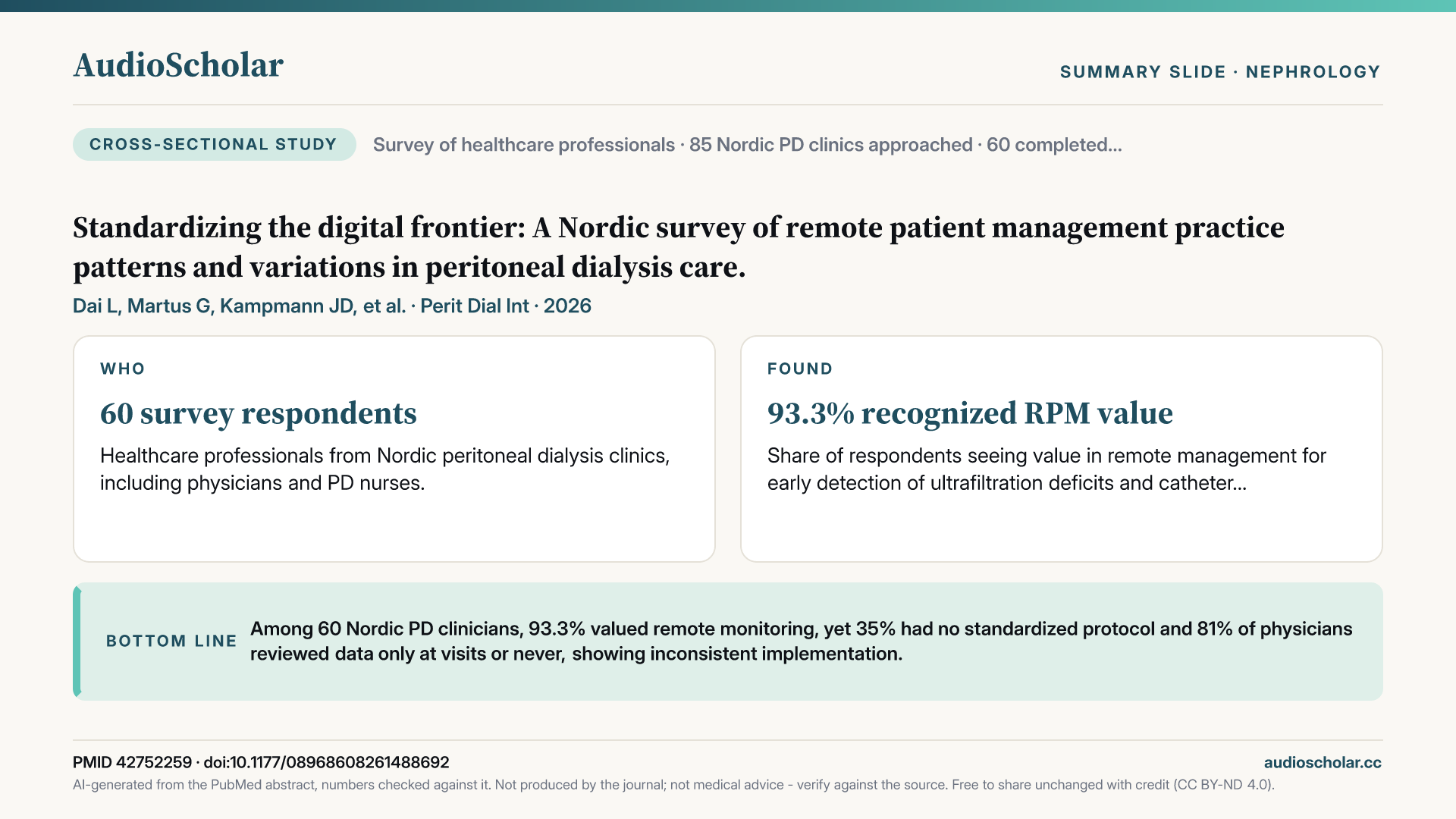
Standardizing the digital frontier: A Nordic survey of remote patient management practice patterns and variations in peritoneal dialysis care.
Among 60 Nordic PD clinicians, 93.3% valued remote monitoring, yet 35% had no standardized protocol and 81% of physicians reviewed data only at visits or never, showing inconsistent implementation.
Peritoneal Dialysis International · 2026 · PubMed

Papers in this briefing
- 01
Remote Monitoring in Automated Peritoneal Dialysis Improves Treatment Adherence and Reduces Hospitalization Burden: A Prospective Multicenter Cohort Study.
Remote monitoring-assisted APD had the highest adherence (median 83.4%) and fewer hospitalization days than APD (adjusted IRR 0.34), with better volume control than CAPD, supporting telehealth integration in home PD.
Telemedicine reports · 2026
- 02
The Impact of Persistent Iron Overload and Ferritin Trend on the Clinical Outcome of Peritoneal Dialysis Patients: A Retrospective Study Over 10 Years.
In PD patients, a ferritin rise above 750 ng/mL was not independently associated with survival after adjustment, and reversing iron overload did not improve outcomes, so ferritin trends alone may not drive prognosis.
Kidney medicine · 2026
- 03
International comparison of home dialysis uptake: a multi-registry analysis from the INTEGRATED Research Group.
Home dialysis uptake within 12 months of starting dialysis ranged from 41% in Australia-New Zealand to 13% in France, with older age lowering uptake, suggesting health system and cultural drivers.
Clinical kidney journal · 2026
- 04
Standardizing the digital frontier: A Nordic survey of remote patient management practice patterns and variations in peritoneal dialysis care.
Among 60 Nordic PD clinicians, 93.3% valued remote monitoring, yet 35% had no standardized protocol and 81% of physicians reviewed data only at visits or never, showing inconsistent implementation.
Peritoneal Dialysis International · 2026
- 05
Over-hydration as a key modifiable predictor of obstructive sleep apnea severity in dialysis patients with daytime sleepiness.
Obstructive sleep apnea affected 75% of dialysis patients with daytime sleepiness, and over-hydration independently predicted severity overall and in PD patients, making volume management a potential therapeutic target.
Medicine · 2026
- 06
Dialysis deserts in the Philippines: a national geospatial modeling study of dialysis services.
Two-hour coverage of PD facilities was only 51.3% versus 67.9% one-hour HD coverage, and full PD integration would reach an additional 11 million people despite a decade of PD-first policy.
Global health action · 2026
- 07
The peritoneal immune niche in peritoneal dialysis-induced membrane failure: macrophages, neutrophils and extracellular trap biology.
Macrophages are the best-established drivers of peritoneal remodeling, and neutrophil extracellular trap effluent proxies link to transport phenotype and technical failure, while macrophage traps rest on thin PD-specific evidence.
Frontiers in immunology · 2026
- 08
Medical resolution of refractory peritoneal dialysis-associated peritonitis without catheter removal.
An E. coli peritonitis meeting refractory criteria on day 5 resolved by day 15 without catheter removal after adding intraperitoneal amikacin, suggesting effluent leucocyte trends may guide decisions better than a strict threshold.
BMJ case reports · 2026
- 09
Frailty in peritoneal dialysis patients: a scoping review.
Across 29 studies, frailty prevalence in PD patients ranged widely from 7.3% to 83%, and no assessment tool is tailored to PD, highlighting the need for optimized instruments.
Frontiers in medicine · 2026
- 10
Social Reintegration and Associated Factors Among Patients Receiving Peritoneal Dialysis: A Cross-Sectional Study.
Of 202 PD patients, 18.3% had low social reintegration, associated with dialysis duration over 10 years (OR 0.293) and ADL dependence (OR 0.236), supporting functional assessment in routine follow-up.
Journal of multidisciplinary healthcare · 2026
The full briefing
This AudioScholar briefing is generated by artificial intelligence for healthcare professionals and trainees. It is not medical advice.
Welcome to your bi-weekly update in Peritoneal Dialysis. This period's papers keep returning to one point: the tools around home dialysis matter only as much as the system behind them. Remote monitoring looks promising, but many physicians are not reviewing the data. Fluid overload shows up again as a modifiable driver of harm, this time of sleep apnea. A decade of iron data questions whether chasing ferritin changes outcomes. Underneath all of it sit wide gaps in who gets peritoneal dialysis at all, and how frail those patients are once they do.
Remote monitoring of automated peritoneal dialysis is moving from pilot to routine, so the question is whether it changes outcomes or just generates data. Kim and colleagues, writing in Telemedicine Reports, followed seventy-three patients across several centres for a year. Each patient had been stable on one modality: manual exchanges, conventional automated cycling, or cycling with remote monitoring [1]. Patients on remote-monitored cycling completed more of their prescribed treatments and had better fluid status on bioimpedance. They also spent roughly a third as many days in hospital as patients on conventional cycling, with lower inpatient costs to match. Small clearance, nutrition and cardiac function were similar across the groups. This is observational, though. The groups were small and not randomized, and patients who choose or are offered remote monitoring may differ in ways adjustment cannot capture. So this is an association worth taking seriously, not proof of effect.
The Nordic survey led by Dai, in Peritoneal Dialysis International, shows how unevenly that technology is actually used [4]. They surveyed clinicians across eighty-five Nordic programmes and received sixty responses. Nearly all respondents valued remote data for catching ultrafiltration problems and catheter complications early. Yet about a third of respondents said their unit had no standardized protocol, and a fifth did not know whether one existed. Nurses were the engaged reviewers, with about two thirds of nurses looking at the data at least twice weekly. Roughly four in five physicians looked only at clinic visits or not at all. The small, self-selected sample limits how far this generalizes.
Put the two together and they pull against each other. The cohort credits the platform with fewer hospital days, while the survey suggests the platform's value depends on who is watching it, and how often. Neither study can say whether the benefit comes from the technology or from the workflow around it. A pragmatic trial comparing protocolized review with ad hoc review would settle that.
Volume comes up again in a quite different setting. Park and colleagues, in Medicine, studied forty dialysis patients with excessive daytime sleepiness, sixteen of them on peritoneal dialysis [5]. All patients had home sleep testing and body composition monitoring. Three quarters of these sleepy patients had obstructive sleep apnea, and snoring did not distinguish them from patients without apnea. Overhydration independently tracked with apnea severity, and in the peritoneal dialysis subgroup so did time on dialysis. The likely mechanism is fluid shifting rostrally when the patient lies down. But the study is cross-sectional and single-centre, used a limited level of sleep testing, and the peritoneal subgroup is tiny. The authors argue for objective volume management as a therapeutic target, but nobody here has yet shown that removing fluid reduces apnea. Read alongside the remote-monitoring cohort, it adds a plausible downstream reason why better fluid control might matter [1].
Iron is the opposite case: a parameter that may matter less than assumed. Tao and colleagues, in Kidney Medicine, reviewed five hundred eighty-six patients starting peritoneal dialysis at one Hong Kong unit over ten years [2]. Patients whose ferritin climbed steeply in the first year had worse crude three-year survival. That difference disappeared after adjustment, which points to sicker patients rather than iron itself. Seven in ten patients who started with iron overload were still overloaded a year later. Patients whose overload reversed did no better on survival, technique failure, peritonitis or hospitalization. Being retrospective and single-centre, the study cannot exclude residual confounding, and ferritin is a noisy, inflammation-driven marker. Still, the findings weaken the case that high ferritin is harmful in itself in this population.
Turning to the membrane itself, two very different papers ask how much injury the peritoneum can absorb. Lu and colleagues, in Frontiers in Immunology, offer an evidence-graded perspective on ultrafiltration failure [7]. They separate evidence from peritoneal dialysis patients themselves from animal models and other organs. Macrophages are the best-established drivers of membrane remodelling. Neutrophil extracellular traps carry the strongest signal specific to peritoneal dialysis, with effluent markers linked to transport status and technique failure. Macrophage traps rest on a single mechanistic study. The authors propose that chronic dialysate exposure primes the membrane and that peritonitis acts as a second hit. Lingering extracellular DNA could then amplify fibrosis through cytosolic DNA sensing. It is hypothesis, explicitly labelled as such, but it gives a rationale for effluent biomarkers.
That second-hit framing gives a tension to a case report in BMJ Case Reports. Tan and colleagues describe a man in his sixties with E. coli peritonitis whose effluent white count was still above two thousand on day five, which meets the definition of refractory infection [8]. He declined catheter removal because of frailty and procedural risk. His counts kept falling, and with intraperitoneal amikacin added to intravenous ceftriaxone the infection resolved by day fifteen. The authors suggest the trend may matter more than the absolute threshold. This is one patient, and survivorship bias is obvious. If prolonged inflammation does damage the membrane, as the perspective proposes, then a slower medical resolution may carry a hidden cost to the membrane. Neither paper can say how often catheter salvage is safe, and only a registry study of refractory peritonitis outcomes stratified by effluent trajectory could answer that.
That frail patient leads into function and frailty more broadly. Zheng and colleagues, in Frontiers in Medicine, scoped twenty-nine studies of frailty in peritoneal dialysis [9]. Reported prevalence ranged from under a tenth of patients to over four fifths, largely depending on which tool was used. The Fried phenotype and the Clinical Frailty Scale dominated, and none of the tools was built for peritoneal dialysis. Contributors spanned social, disease, body composition and psychological factors. As a scoping review it maps the field without pooling or grading, so the main finding is that frailty measurement here is not yet standardized.
Lin and colleagues, in the Journal of Multidisciplinary Healthcare, looked at the other end of the spectrum: how well patients maintain their social roles [10]. In two hundred two patients at one Chinese centre, about four in five patients had high social reintegration. Patients who were dependent in daily activities, and those on dialysis for more than a decade, had roughly a quarter of the odds of high reintegration. It is cross-sectional, with a small low-reintegration group, so direction cannot be inferred. Notice that dialysis vintage turns up again, as it did in the sleep apnea study [5]. Long vintage looks like a marker worth tracking.
Finally, access, where the largest datasets of the period sit. Boyer and colleagues, in the Clinical Kidney Journal, pooled more than a quarter of a million incident dialysis patients from Australia and New Zealand, Canada, France and the United Kingdom [3]. Home dialysis uptake within the first year ranged roughly threefold, from about forty percent in Australia and New Zealand to thirteen percent in France. Older age reduced uptake everywhere, and France also had the oldest starting population. Registry data cannot separate patient preference from system design, but the authors point to health systems and culture as drivers.
Fajardo and colleagues, in Global Health Action, show that policy alone does not close gaps [6]. A decade into the Philippines' peritoneal-dialysis-first policy, only about half of the regional population lived within two hours of a peritoneal dialysis facility. Their geospatial model, adjusted for slower walking in kidney failure, estimates that adding peritoneal dialysis to existing haemodialysis sites would reach about eleven million more people. That is modelled access, not observed uptake, but it agrees with the registry analysis: infrastructure and organization shape modality more than intent does.
If you read only one paper from this period, make it the Nordic remote monitoring survey by Dai. It reopens the question that the hospitalization benefits of remote monitoring rely on: whether anyone is actually acting on the data. Without that, the observational gains are hard to interpret.
Here is what this period adds up to. Remote monitoring of automated dialysis is associated with fewer hospital days and better fluid control. That evidence is observational and small, and real-world physician engagement is patchy, so the mechanism of benefit is unsettled. Fluid overload keeps emerging as a modifiable target, now linked to sleep apnea severity, though no trial yet shows that correcting it helps. In one large single-centre cohort, reversing iron overload did not improve outcomes, which weakens ferritin as a treatment target. Frailty and long dialysis vintage keep turning up, yet frailty measurement in peritoneal dialysis is still not standardized. And home dialysis uptake varies threefold between comparable countries, a gap that system design appears to explain better than clinical need.
That's your Peritoneal Dialysis update for this period. Until next time.
This is an automated summary generated by artificial intelligence, which can make mistakes. Always review the original source materials.
Spot something worth flagging?
Get this every week in your podcast app — free.
New research episodes land in your feed automatically — listen on your commute.