This Week in Orthopedics — Oct 8, 2026
Generated Oct 8, 2026 · 11:20
The week's practice-changing Orthopedics research, summarized for clinicians.
If the audio fails to play, refresh the page to renew the link.
Get next week’s Orthopedics briefing — free.
In your podcast app, or readable in your inbox with the audio one tap away.
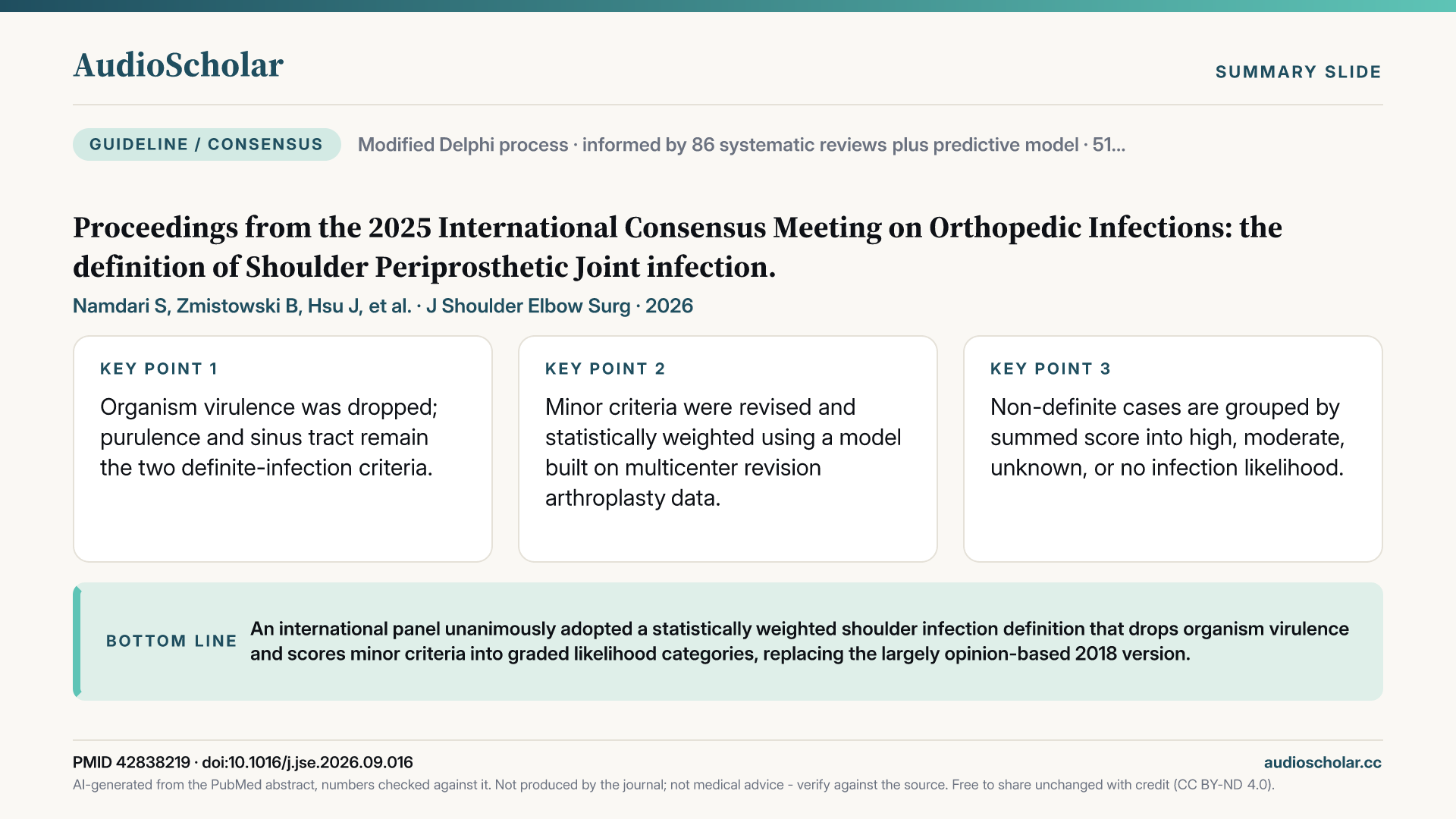
Proceedings from the 2025 International Consensus Meeting on Orthopedic Infections: the definition of Shoulder Periprosthetic Joint infection.
An international panel unanimously adopted a statistically weighted shoulder infection definition that drops organism virulence and scores minor criteria into graded likelihood categories, replacing the largely opinion-based 2018 version.
Journal of Shoulder and Elbow Surgery · 2026 · PubMed

This week’s papers
- 01
Proceedings from the 2025 International Consensus Meeting on Orthopedic Infections: the definition of Shoulder Periprosthetic Joint infection.
An international panel unanimously adopted a statistically weighted shoulder infection definition that drops organism virulence and scores minor criteria into graded likelihood categories, replacing the largely opinion-based 2018 version.
Namdari S, Zmistowski B, Hsu J, et al. · Journal of Shoulder and Elbow Surgery · 2026
- 02
Preoperative Malnutrition and Risk of Periprosthetic Joint Infection After Reverse Total Shoulder Arthroplasty: Evaluation Using the Geriatric Nutritional Risk Index.
In 157 reverse shoulder arthroplasty patients, a Geriatric Nutritional Risk Index below 98 was independently linked to higher infection rates, 10.4 versus 1.8 percent, while two-year functional scores were similar.
Nishiura R, Nakazawa K, Manaka T, et al. · Journal of Shoulder and Elbow Surgery · 2026
- 03
Orthobiologic Augmentation for Anterior Cruciate Ligament Reconstruction Is Not Associated With Improved Clinical or Radiographic Outcomes: A Systematic Review and Meta-analysis of Randomized Controlled Trials.
Pooling nine randomized trials of 543 patients, platelet-rich plasma, marrow concentrate and stem cell augmentation of cruciate grafts did not improve patient-reported outcomes, tunnel widening or graft maturation.
Driscoll A, Mazzocco J, Fucaloro S, et al. · Arthroscopy · 2026
- 04
Comparative Efficacy of Leukocyte-Rich and Leukocyte-Poor PRP for Lateral Epicondylitis on Isokinetic and Isometric Upper Limb Strength under an Identical Rehabilitation Protocol: A Randomized Controlled Trial.
In 71 randomized lateral epicondylitis patients, neither leukocyte-rich nor leukocyte-poor platelet-rich plasma improved twelve-month wrist extensor strength meaningfully beyond saline when combined with identical rehabilitation.
Wałecka J, Kaszyński J, Cisowski P, et al. · Journal of Shoulder and Elbow Surgery · 2026
- 05
Biologic and Synthetic Augmentation in Rotator Cuff Repair: Emerging Technologies.
Among rotator cuff augmentation options, bioinductive collagen implants have the strongest Level I support for better healing and fewer retears, while xenografts have fallen from favor due to inconsistent results.
Boufadel P, Daher M, Satalich JR, et al. · Journal of Bone and Joint Surgery · 2026
- 06
Meniscal Root Tears: Epidemiology, Diagnosis, Management, and Outcomes.
Meniscal root repair is associated with better long-term outcomes than partial meniscectomy or nonoperative care in selected patients, though no standardized postoperative rehabilitation protocol yet exists.
Livingston M, Ross P, Saraf SM, et al. · Journal of Bone and Joint Surgery · 2026
- 07
Improved Outcomes and Low Rate of Medical Discharge at a Minimum 10-Year Follow-Up After Arthroscopic Bankart Repair With Remplissage for "Off-Track" Engaging Hill-Sachs Lesions With Subcritical Glenoid Bone Loss in Active-Duty Servicemembers.
In 22 servicemembers followed at least ten years after Bankart repair with remplissage, outcome scores stayed improved, recurrent instability was rare, and 86 percent returned to duty.
Ben-Ari E, Chung B, Sandler AB, et al. · Arthroscopy · 2026
- 08
Does Early Surgery Reduce Mortality Compared With Delayed Surgery Among Patients With Periprosthetic Hip Fracture? A Target Trial Emulation.
A target trial emulation of 4,564 Japanese patients correcting for immortal time bias found no clear 30-day mortality benefit from surgery within two days for periprosthetic hip fracture.
Yoshiyama T, Fukasawa T, Anno T, et al. · Clinical Orthopedics and Related Research · 2026
- 09
Does Additional Distal S2 Fixation Improve Lumbosacral Stability Compared with Standard L4-S1 Fixation in High-Grade Spondylolisthesis? A Prospective Randomised Comparative Study.
In a 70-patient single-center randomized trial for high-grade spondylolisthesis, adding S2 fixation lowered pain and disability and eliminated S1 screw breakage, though fusion differences were not significant.
Basiony M, Hamoud MA · Spine · 2026
- 10
Survival and Reoperation After Intralesional Procedures Versus Resection and Reconstruction for Renal Cell Carcinoma Bone Metastases.
For renal cell carcinoma long-bone metastases, intralesional surgery had similar reoperation rates to resection and reconstruction and higher overall mortality, but no mortality difference for solitary metastases.
Kashyap J, Carlson LA, Garvin LE, et al. · Journal of Bone and Joint Surgery · 2026
The full briefing
This AudioScholar briefing is generated by artificial intelligence for healthcare professionals and trainees. It is not medical advice.
Welcome to This Week in Orthopedics. This week we're covering 10 notable papers spanning infection after shoulder arthroplasty, the uneven evidence behind biologic augmentation, and surgical decision-making in fractures, the spine and metastatic bone disease. Let's dive in.
We start with shoulder periprosthetic joint infection, where a new definition and a modifiable risk factor arrived together. In the Journal of Shoulder and Elbow Surgery, Namdari and colleagues present the 2025 International Consensus Meeting definition of shoulder periprosthetic joint infection [1]. The 2018 definition leaned heavily on expert opinion for its minor criteria. This update draws on 86 systematic reviews and a predictive model built from the American Shoulder and Elbow Surgeons multicenter revision arthroplasty dataset, filtered through a modified Delphi process. Several changes matter at the bedside. Organism virulence is gone from the definition. Definite infection still rests on just two findings, gross intra-articular purulence or a sinus tract. The minor criteria are now statistically weighted. They include erythema, unexpected wound drainage, elevated sedimentation rate and C-reactive protein, synovial neutrophil percentage, frozen section, humeral osteolysis on radiographs, intraoperative humeral loosening, and positive culture. Summed scores place patients into high, moderate, unknown or no likelihood of infection, with 13 or more points marking high likelihood. All 51 delegates endorsed it. It remains consensus built on modeling rather than prospective validation, and the panel itself expects it to keep evolving. In the same journal, Nishiura and colleagues looked at nutrition before reverse shoulder arthroplasty in 157 patients, using the Geriatric Nutritional Risk Index with a cutoff of 98 [2]. Just under a third of patients screened as malnourished. Overall complication rates were similar between groups, but infection occurred in about one in ten malnourished patients versus fewer than one in fifty of the well-nourished. After adjustment, malnutrition carried roughly a sevenfold increase in the odds of infection. The estimate rests on very few events, so its true size is uncertain. Two-year function and pain were broadly similar, apart from reduced forward flexion. This is a single-center retrospective study, and it shows an association, not proof that nutritional intervention would lower infection rates. Taken together, these papers sharpen how shoulder infection is defined and point to a candidate risk marker, though the second still awaits confirmation.
Our second theme is biologic augmentation, where the trial evidence this week is mostly sobering. In Arthroscopy, Driscoll and colleagues pooled 9 randomized trials with 543 patients that tested platelet-rich plasma, bone marrow aspirate concentrate or mesenchymal stem cells applied to anterior cruciate ligament grafts [3]. Platelet-rich plasma did not improve Lysholm scores. Bone marrow aspirate concentrate did not improve knee injury and osteoarthritis outcome scores. Augmentation did not reduce bone tunnel enlargement. Most of the included trials found no meaningful change in radiographic graft maturation. No complications from the biologics were reported, but heterogeneity was substantial and some comparisons drew on only a handful of studies. A randomized trial in the Journal of Shoulder and Elbow Surgery from Wałecka and colleagues points in the same direction [4]. Seventy-one patients with lateral epicondylitis received leukocyte-poor platelet-rich plasma, leukocyte-rich platelet-rich plasma, or saline, all alongside an identical rehabilitation protocol. Wrist extensor strength improved in all three groups, including saline, and neither formulation beat saline by a clinically meaningful margin on the primary outcome. A few secondary strength measures hinted at temporary differences, but most of these faded after correction for multiple comparisons. The authors conclude that platelet-rich plasma is at most an adjunct to rehabilitation, not what drives recovery. The picture is less bleak for the rotator cuff. In a Journal of Bone and Joint Surgery review, Boufadel and colleagues summarize the options for augmenting cuff repair [5]. Xenografts have fallen out of favor because of inconsistent outcomes and inflammatory reactions. Allograft and synthetic grafts may help in selected cases, though indications remain loosely defined. Bioinductive collagen implants have the strongest support, with Level one studies showing better structural healing and fewer retears in selected patients. The long head of the biceps tendon is described as an inexpensive autograft option when it is available. The common thread is that the case for augmentation varies by tissue and by product. For injectable orthobiologics in the knee and elbow, randomized evidence does not show added benefit.
Our third theme is soft-tissue stabilization in the knee and shoulder, framed by a review and a long-term case series. In the Journal of Bone and Joint Surgery, Livingston and colleagues review meniscal root tears [6]. These tears disrupt load distribution and speed cartilage loss. MRI supports the diagnosis, and arthroscopy confirms it. In appropriately selected patients, root repair is associated with better long-term outcomes than partial meniscectomy or nonoperative care. Selection depends on age, activity, tear pattern and how much degenerative change is already present. Rehabilitation is the clear gap. No accepted protocol exists, although most surgeons limit early weight-bearing and restrict deep loaded flexion for up to four or five months. In Arthroscopy, Ben-Ari and colleagues report a minimum ten-year follow-up of arthroscopic Bankart repair with remplissage in active-duty servicemembers [7]. These patients had off-track Hill-Sachs lesions and subcritical glenoid bone loss, averaging about six percent. Twenty-two patients were analyzed. Patient-reported outcome scores improved substantially and held steady between mid-term and long-term follow-up. Most patients reached the minimal clinically important difference. Only one patient had recurrent instability requiring a Latarjet. Just under nine in ten returned to duty, and three patients were medically discharged because of the shoulder. It is a small, retrospective case series with no comparison group, so it supports durability in this high-demand group rather than superiority over bone-block procedures.
Our final theme covers three surgical decisions: timing, construct length and the extent of resection. In Clinical Orthopedics and Related Research, Yoshiyama and colleagues used a Japanese administrative database of 4,564 patients with periprosthetic hip fractures [8]. Their method, a target trial emulation using a clone-censor-weight design, avoids immortal time bias. That bias can make delayed surgery look artificially safe, because patients who die while waiting never enter the delayed group. They compared surgery within two days of admission with surgery between days three and ten. At 30 days there was no clear difference in mortality. If anything, the point estimate was higher with early surgery, roughly 1.7 versus 0.8 percent, though the difference was not statistically significant. Patients averaged 84 years of age. Because the data are observational and the 30-day event count is small, the study does not support assuming that the early-surgery benefit seen in native hip fractures automatically applies here. In Spine, Basiony and Hamoud randomized 70 patients with Meyerding grade three or four spondylolisthesis to an L4 to S1 construct or the same construct extended with bilateral S2 or S2 alar-iliac screws [9]. Every patient was followed to 36 months. The extended construct produced lower pain and disability scores. Fusion, pseudarthrosis and screw pull-out numerically favored S2 extension, but none of these differences reached significance. The most striking finding was S1 screw breakage. It occurred in about two thirds of patients with S1-only anchorage and in none of the patients with S2 extension. The trial was single-center and open to performance bias, and it mixed two distal techniques, so the authors call for multicenter confirmation. Finally, in the Journal of Bone and Joint Surgery, Kashyap and colleagues reviewed 105 patients with renal cell carcinoma long-bone metastases [10]. They compared intralesional surgery with resection and reconstruction. Reoperation rates did not differ meaningfully between approaches. Intralesional surgery was associated with roughly double the mortality hazard overall, but not among patients with a solitary metastasis. That pattern points toward confounding by disease burden in a retrospective cohort. The authors judge both approaches reasonable in selected patients.
If you only have time for one paper this week, make it the 2025 International Consensus Meeting definition of shoulder periprosthetic joint infection [1]. It replaces an opinion-weighted framework with a statistically weighted scoring system that will shape how shoulder infections are diagnosed, reported and studied, though it still awaits independent validation.
Here is what this week's evidence adds up to in Orthopedics. First, shoulder infection now has an evidence-informed, scored definition with unanimous expert backing [1]. Malnutrition is emerging as a possible risk marker [2], but that link comes from a single small retrospective cohort. Second, randomized evidence does not show that platelet-rich plasma or marrow concentrate improves outcomes after cruciate reconstruction [3], or that platelet-rich plasma beats saline for epicondylitis strength [4]. Collagen implants for cuff repair stand apart with stronger trial support [5]. Third, the assumption that faster surgery saves lives after periprosthetic hip fracture is not supported by bias-corrected observational data [8]. Fourth, early randomized data suggest that extending fixation to S2 in high-grade spondylolisthesis protects S1 screws and improves pain and function [9], pending multicenter replication. And for metastatic renal cell carcinoma and long-term remplissage outcomes, the evidence remains retrospective and hypothesis-generating [7][10].
That's your roundup for This Week in Orthopedics. The full transcript and references are available on the episode page. This is an AI-curated summary — for clinical decisions, always consult primary sources and current guidelines. See you next week.
If this weekly briefing is useful, follow the show in your podcast app so new episodes arrive automatically. And if you have a paper you have been meaning to read, upload the PDF, or paste any link, at audioscholar dot C C. We will turn it into audio like this one, in any of thirty-one languages.
This is an automated summary generated by artificial intelligence, which can make mistakes. Always review the original source materials.
Spot something worth flagging?
Get this every week in your podcast app — free.
New orthopedics episodes land in your feed automatically — listen on your commute.