This Week in Otolaryngology — Oct 8, 2026
Generated Oct 9, 2026 · 10:51
The week's practice-changing Otolaryngology (ENT) research, summarized for clinicians.
If the audio fails to play, refresh the page to renew the link.
Get next week’s Otolaryngology (ENT) briefing — free.
In your podcast app, or readable in your inbox with the audio one tap away.
Utility of Early Post-Treatment Circulating Tumor Tissue Modified Viral HPV DNA Testing in HPV-Associated Oropharyngeal Cancer.
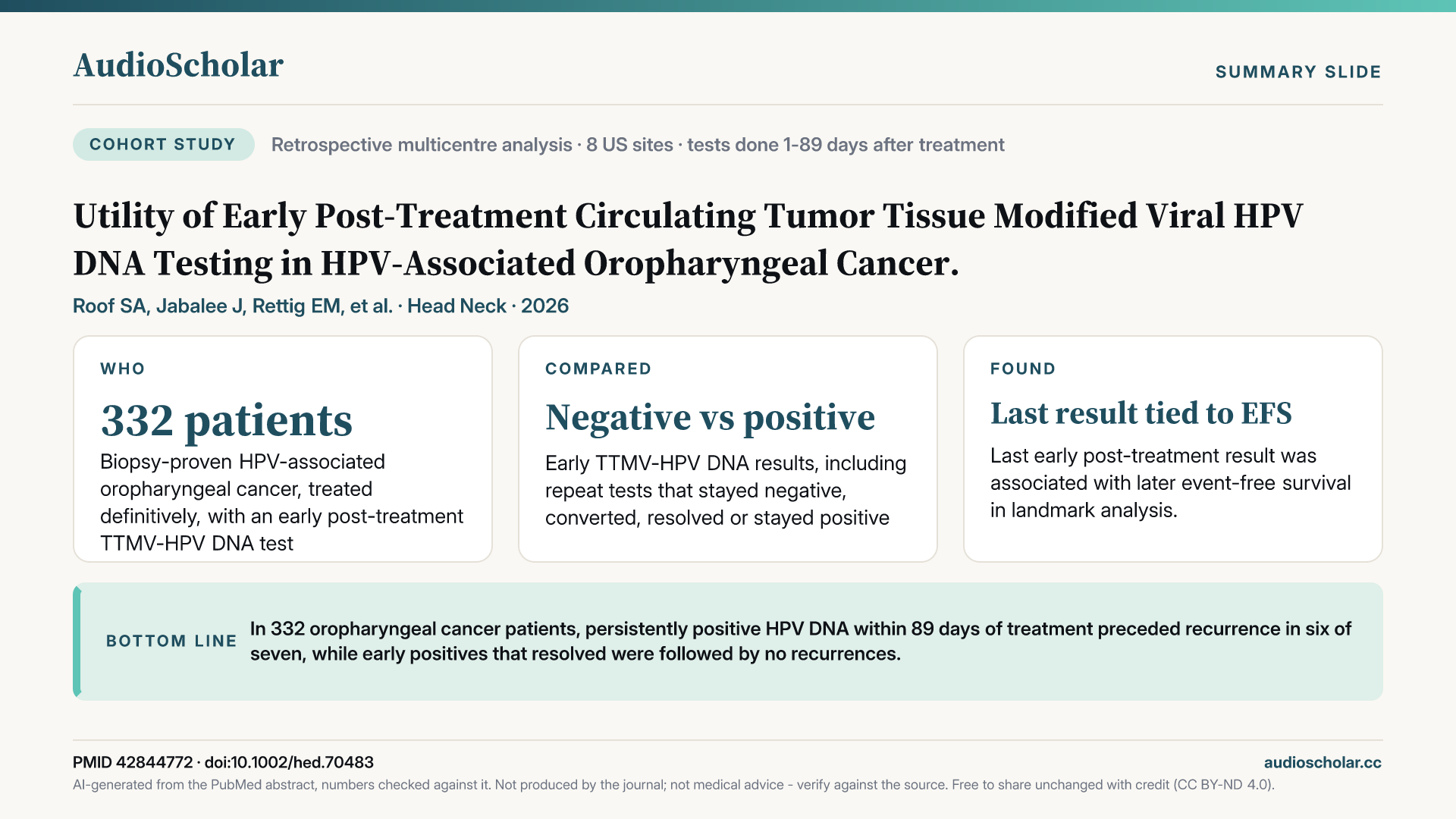
In 332 oropharyngeal cancer patients, persistently positive HPV DNA within 89 days of treatment preceded recurrence in six of seven, while early positives that resolved were followed by no recurrences.
Head & Neck · 2026 · PubMed

This week’s papers
- 01
Utility of Early Post-Treatment Circulating Tumor Tissue Modified Viral HPV DNA Testing in HPV-Associated Oropharyngeal Cancer.
In 332 oropharyngeal cancer patients, persistently positive HPV DNA within 89 days of treatment preceded recurrence in six of seven, while early positives that resolved were followed by no recurrences.
Roof SA et al. · Head & Neck · 2026
- 02
Efficacy and Safety of Cisplatin Versus Carboplatin for Patients With Squamous Cell Carcinoma of Head and Neck: A Systematic Review and Meta-Analysis.
Pooling eight studies of 1044 head and neck cancer patients, cisplatin and carboplatin showed no significant survival or serious toxicity differences, apart from a modest five-year locoregional advantage for cisplatin.
Rahim S et al. · Head & Neck · 2026
- 03
Radiation-Associated Lymphedema in Head and Neck Cancer: A Systematic Review and Meta-Analysis.
Across 26 studies, lymphedema affected nearly half of patients after head and neck radiotherapy, with about a third clinically significant, though certainty of evidence was very low.
Swisher AR et al. · The Laryngoscope · 2026
- 04
Core Needle Biopsy in the Diagnosis of Major Salivary Gland Tumors.
Core needle biopsy of major salivary gland lesions showed about 94 percent sensitivity and 98 percent specificity for malignancy, and observed non-operated lesions revealed no malignancy over two years.
Naukkarinen M et al. · The Laryngoscope · 2026
- 05
Primary Tumor Location and Lymphatic Spread in Papillary Thyroid Carcinoma.
In 1688 papillary thyroid carcinoma patients, central and lateral nodal positivity were similar regardless of primary tumor location, arguing against location-based tailoring of neck dissection extent.
Fournier I et al. · Otolaryngology-Head and Neck Surgery · 2026
- 06
Shaving Versus Resection on Recurrent Laryngeal Nerve in Thyroid Cancer Surgeries: A Systematic Review and Meta-Analysis.
Shaving thyroid cancer off an invaded recurrent laryngeal nerve was associated with better voice outcomes and lower recurrence than resection without survival difference, though selection bias likely contributes.
Tran E et al. · Head & Neck · 2026
- 07
Comparison of the Effects of High-Flow Nasal Cannula Oxygen and Jet Ventilation Techniques.
In a 36-patient randomized trial of endolaryngeal surgery, high-flow nasal oxygen caused progressive hypercapnia and acidosis after about 20 minutes, whereas jet ventilation maintained stable carbon dioxide and pH.
Özdağlı S et al. · The Laryngoscope · 2026
- 08
Surgical Indications for Type II Thyroplasty in Adductor Spasmodic Dysphonia: A Scoping Review.
Type II thyroplasty with titanium bridges for adductor spasmodic dysphonia produced durable voice improvement up to about eight years with low revision rates, though surgical indications varied widely across studies.
Sangalang M et al. · The Laryngoscope · 2026
- 09
Short-term nasal decongestant as bridge therapy with intranasal corticosteroids in children with persistent allergic rhinitis: A randomized controlled trial.
Adding five days of oxymetazoline to intranasal steroids in children with allergic rhinitis improved symptoms, airflow, quality of life and adherence at four weeks, without rebound congestion, in an open-label trial.
Yüksel NC et al. · International Journal of Pediatric Otorhinolaryngology · 2026
- 10
Non-usage rates after paediatric cochlear implantation: A systematic review and meta-analysis.
More than one in ten pediatric cochlear implant recipients showed non-use or partial use, with higher rates linked to region, longer hearing loss, and implantation after twelve months.
Au JXY et al. · International Journal of Pediatric Otorhinolaryngology · 2026
The full briefing
This AudioScholar briefing is generated by artificial intelligence for healthcare professionals and trainees. It is not medical advice.
Welcome to This Week in Otolaryngology. This week we're covering 10 notable papers spanning head and neck cancer surveillance and survivorship, thyroid and laryngeal surgery, and pediatric rhinology and hearing. Let's dive in.
We start with head and neck oncology, where this week's papers address when to test, what to give, and what survivors live with afterward. In Head and Neck, Roof and colleagues looked at circulating tumor tissue modified viral HPV DNA testing in the window before the conventional three-month response assessment for HPV-associated oropharyngeal cancer [1]. Across 332 patients at eight United States sites, the first test drawn within 89 days of finishing treatment was negative in about 93 percent of patients. The trajectory is what matters. Among the patients who were initially negative and retested, nearly all stayed negative, but two converted to positive and both of those patients recurred. Among 13 patients with an early positive result and enough follow-up, six patients cleared to negative and none of them recurred, while seven patients stayed persistently positive and six of those seven recurred. The message is that an early positive result is not by itself a verdict; persistent positivity carries the risk, and a positive that resolves was not followed by recurrence in this cohort. This is retrospective work with small numbers in the positive groups, so it informs how an early result might be interpreted rather than establishing a new surveillance schedule. Also in Head and Neck, Rahim and colleagues pooled eight studies and just over a thousand patients comparing cisplatin with carboplatin regimens [2]. They found no statistically significant differences in overall survival, progression-free survival, locoregional control, or distant metastasis-free survival, and no significant differences in serious hematologic toxicity or nausea. The one signal was a modest five-year locoregional advantage for cisplatin, resting on only two studies. Because the pool mixes randomized and observational data, and carboplatin is typically chosen for sicker patients, this supports carboplatin as a reasonable alternative when cisplatin is unsuitable, but it is not strong enough to argue the two drugs are interchangeable for fit patients. Turning to survivorship, Swisher and colleagues in The Laryngoscope pooled 26 studies of more than three thousand patients and estimated that lymphedema affects nearly half of patients after radiation for mucosal head and neck cancer [3]. Internal lymphedema was somewhat more common than external, and roughly a third of patients had clinically significant, grade two or higher disease. The authors are candid that certainty is very low, heterogeneity was considerable, and definitions varied widely, but the scale of the estimate strengthens the case for routine surveillance within survivorship pathways. Rounding out the theme, Naukkarinen and colleagues, also in The Laryngoscope, reviewed 217 patients undergoing core needle biopsy of major salivary gland lesions in Helsinki [4]. Against histology, core biopsy showed about 94 percent sensitivity and about 98 percent specificity for malignancy, with one false benign and one false malignant result. Notably, more than half of the lesions were managed with observation alone, and no malignancy emerged in that group over at least two years. This single-center experience suggests core biopsy may help identify lesions that can be safely watched, though longer follow-up would firm that up.
Our second theme is thyroid surgery, where two papers test long-held assumptions about the extent of operation. In Otolaryngology-Head and Neck Surgery, Fournier, Zafereo and colleagues studied 1,688 patients with papillary thyroid carcinoma undergoing neck dissection at a quaternary center [5]. Central neck positivity was essentially the same, around three quarters, whether the primary sat in the superior pole, mid gland, inferior pole, or isthmus, and lateral neck positivity was likewise comparable by location. Level three was the most frequently involved lateral level, in about four out of five lateral dissections, followed closely by level four. Superior pole tumors did show a link to ipsilateral level three involvement, but the authors conclude that tumor location did not predict overall nodal distribution and should not determine the extent of dissection. It is a large but single-center retrospective series, so it challenges location-based tailoring rather than defining a new template. In Head and Neck, Tran and colleagues meta-analyzed 13 retrospective cohorts comparing shaving versus resecting a recurrent laryngeal nerve invaded by thyroid cancer [6]. Survival and tracheotomy needs did not differ, while shaving was associated with lower recurrence, better vocal fold mobility, and longer phonation time. The authors themselves flag the central caveat: shaved patients had less advanced disease, so these associations may reflect selection bias. The data are consistent with nerve preservation when feasible but do not settle the controversy, and prospective studies are needed.
Our third theme is the larynx, spanning the operating room airway and voice surgery. In The Laryngoscope, Özdağlı and colleagues randomized 36 patients undergoing endolaryngeal surgery to high-frequency jet ventilation or high-flow nasal cannula oxygen [7]. Carbon dioxide levels tracked together for the first ten minutes, but by twenty minutes the nasal cannula group was running clearly higher, and by the end of surgery the median arterial carbon dioxide reached about 66 millimeters of mercury with high-flow oxygen versus about 44 with jet ventilation. That translated into meaningful respiratory acidosis, higher lactate, and lower oxygenation in the high-flow group. The authors propose a twenty-minute threshold for tubeless high-flow technique and favor jet ventilation for longer procedures. It is a small, healthy-patient trial, so the threshold is a proposal rather than a validated cutoff, but the time-dependent pattern is clear. Also in The Laryngoscope, Sangalang and colleagues produced a scoping review of type two thyroplasty with titanium bridges for adductor spasmodic dysphonia [8]. Across 15 studies, Voice Handicap Index-10 scores fell substantially after surgery, with improvement sustained up to about eight years, revision rates of two to seven percent, and only minor, transient complications. Bridge fractures were not consistently linked to symptom recurrence. Indications were heterogeneous, ranging from botulinum toxin non-responders to good responders wanting a permanent option, and the authors propose preliminary international eligibility criteria and a core outcome set. This is observational evidence mapping a field, not a comparison against botulinum toxin.
Our final theme is pediatrics, where adherence emerges as the common thread. In the International Journal of Pediatric Otorhinolaryngology, Yüksel and colleagues randomized 76 children with moderate-to-severe persistent allergic rhinitis to intranasal corticosteroid alone or with a five-day oxymetazoline bridge [9]. At four weeks, the bridged group had roughly double the reduction in nasal symptom scores, larger gains in nasal airflow and quality of life, and higher adherence scores. No child used the decongestant beyond five days, and there was no rebound congestion or treatment-related adverse event. The trial was open-label, single-center, retrospectively registered, and had uneven group sizes after dropout, so this is promising early evidence for a time-limited bridge rather than a settled recommendation. Also in that journal, Au and colleagues pooled 29 studies of nearly 2,600 children to estimate long-term cochlear implant use [10]. About four and a half percent of recipients stopped using their device, and about nine percent used it less than eight hours a day, so more than one in ten children showed suboptimal adherence. Non-use varied strikingly by region and was substantially higher in specific clinical subgroups. Longer duration of hearing loss was associated with more partial use, and implantation at or before twelve months was associated with less partial use than implantation between twelve and twenty-four months. These are observational associations, but they add weight to the case for early implantation and risk-stratified follow-up.
If you only have time for one paper this week, make it the early post-treatment HPV DNA study by Roof and colleagues in Head and Neck [1]. It reframes how an early positive result after oropharyngeal cancer treatment might be read, suggesting that the trajectory rather than a single value carries the prognostic weight, while leaving open whether earlier testing should change management.
Here is what this week's evidence adds up to in Otolaryngology. First, in HPV-associated oropharyngeal cancer, persistent circulating tumor DNA positivity after treatment tracked closely with recurrence while resolving positives did not, though the positive groups were small and retrospective. Second, cisplatin and carboplatin looked broadly similar for survival and toxicity in pooled, largely observational data, with an unresolved hint of better long-term locoregional control with cisplatin. Third, radiation-associated lymphedema appears to affect roughly half of head and neck cancer survivors, an estimate of very low certainty but large enough to support systematic surveillance. Fourth, in papillary thyroid cancer, primary tumor location did not predict nodal spread in a large single-center series, and recurrent laryngeal nerve shaving looked favorable but is confounded by selection bias. Fifth, high-flow nasal oxygen during laryngeal surgery produced progressive hypercapnia beyond about twenty minutes in a small trial, and pediatric adherence, whether to nasal steroids or cochlear implants, remains a modifiable gap with early supporting evidence for interventions.
That's your roundup for This Week in Otolaryngology. The full transcript and references are available on the episode page. This is an AI-curated summary — for clinical decisions, always consult primary sources and current guidelines. See you next week.
If this weekly briefing is useful, follow the show in your podcast app so new episodes arrive automatically. And if you have a paper you have been meaning to read, upload the PDF, or paste any link, at audioscholar dot C C. We will turn it into audio like this one, in any of thirty-one languages.
This is an automated summary generated by artificial intelligence, which can make mistakes. Always review the original source materials.
Spot something worth flagging?
Get this every week in your podcast app — free.
New otolaryngology episodes land in your feed automatically — listen on your commute.