This Week in Critical Care — Oct 14, 2026
Generated Oct 14, 2026 · 10:25
The week's practice-changing Critical Care research, summarized for clinicians.
If the audio fails to play, refresh the page to renew the link.
Get next week’s Critical Care briefing — free.
In your podcast app, or readable in your inbox with the audio one tap away.
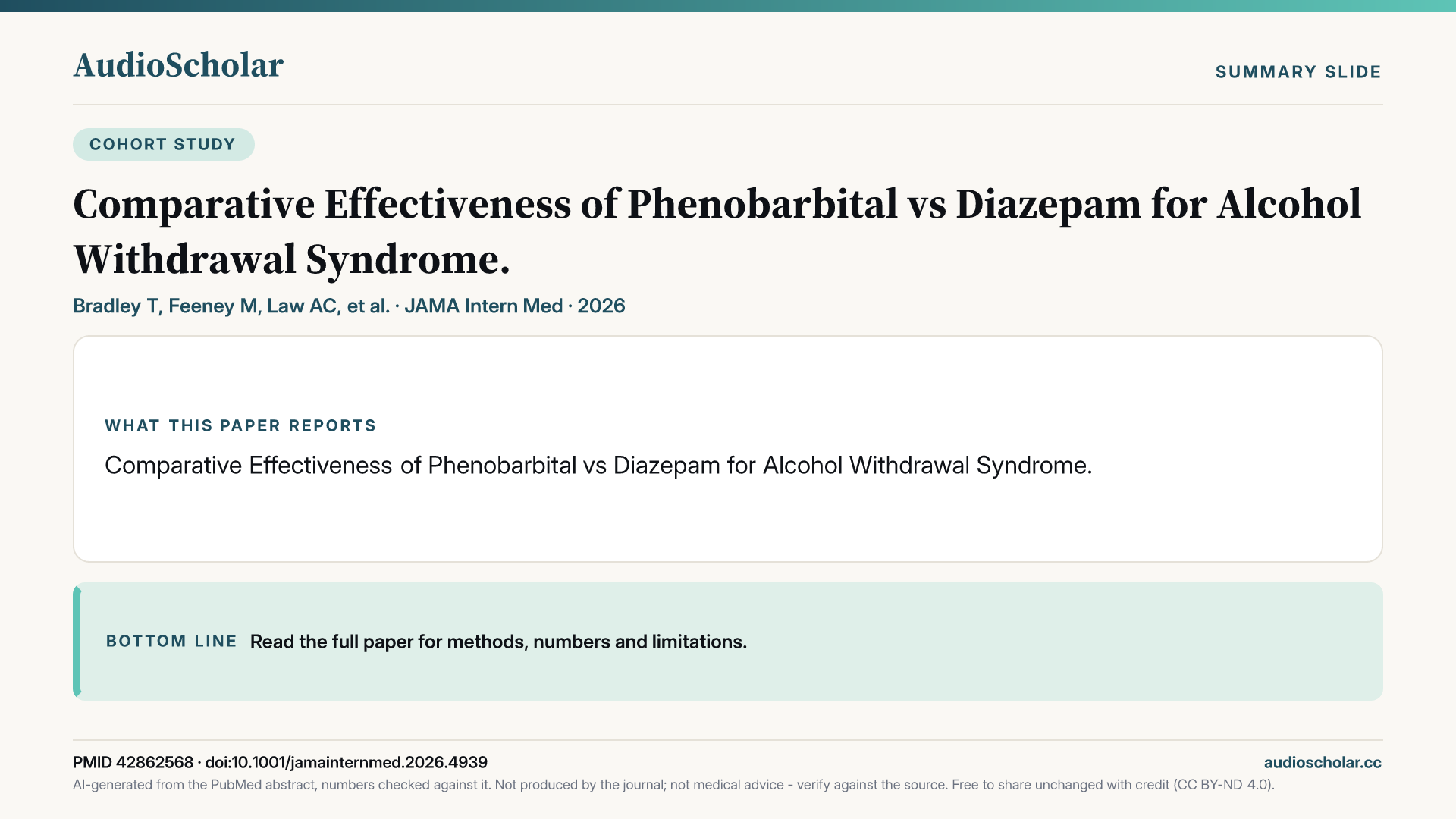
Comparative Effectiveness of Phenobarbital vs Diazepam for Alcohol Withdrawal Syndrome.
In over 24,000 hospitalized patients with alcohol withdrawal, phenobarbital and diazepam produced similar length of stay and mechanical ventilation rates, suggesting near therapeutic equivalence in observational data.
JAMA Internal Medicine · 2026 · PubMed

This week’s papers
- 01
Polymyxin B hemoadsorption in endotoxic septic shock: ten questions on the Tigris trial.
Tigris investigators explain that the trial's high posterior probability of mortality benefit for polymyxin B hemoadsorption rests on a prior and eligibility criteria derived from an EUPHRATES subgroup.
Legrand M et al. · Critical Care · 2026
- 02
The effects of hemoadsorption in patients with sepsis-associated persistent severe AKI who require CRRT: A prospective, randomized controlled pilot study.
Adding hemoadsorption to hemofiltration in sepsis-associated severe kidney injury did not significantly reduce 30-day mortality, though severity scores and cytokines improved and a CCL14 subgroup signal emerged post hoc.
Shi K et al. · Annals of Intensive Care · 2026
- 03
Individualized Treatment Effects of Cefepime vs Piperacillin-Tazobactam in Adults Hospitalized with Acute Infection.
Secondary ACORN analysis found patient characteristics modified the effect of cefepime versus piperacillin-tazobactam on survival without kidney injury, with some patients gaining about seven points from cefepime.
Qian ET et al. · American Journal of Respiratory and Critical Care Medicine · 2026
- 04
Early piperacillin exposure during continuous infusion in critically ill patients: the impact of renal and liver dysfunctions.
Only about a third of critically ill patients on continuous-infusion piperacillin reached target concentrations on day one, with overexposure driven mainly by renal dysfunction, bilirubin and dose.
Conseil M et al. · Annals of Intensive Care · 2026
- 05
Comparative Effectiveness of Phenobarbital vs Diazepam for Alcohol Withdrawal Syndrome.
In over 24,000 hospitalized patients with alcohol withdrawal, phenobarbital and diazepam produced similar length of stay and mechanical ventilation rates, suggesting near therapeutic equivalence in observational data.
Bradley T et al. · JAMA Internal Medicine · 2026
- 06
Effectiveness of Continuous Automatic Endotracheal Cuff Pressure Monitoring in Preventing Ventilator-Associated Pneumonia in the Pediatric Intensive Care Unit: A Randomized Controlled Trial.
Continuous automatic cuff pressure monitoring lowered the proportion of ventilated children developing ventilator-associated pneumonia from 24 to 13 percent, though rate-based analyses were not statistically significant.
Aşık A et al. · Chest · 2026
- 07
Prophylactic high-flow nasal oxygen vs. conventional oxygen for prevention of postoperative respiratory complications: a randomized trial.
Prophylactic high-flow nasal oxygen after thoracoscopic lung resection reduced moderate-to-severe pulmonary complications from about 40 to 23 percent in a single-centre trial, without shortening hospital stay.
Lin R et al. · Critical Care · 2026
- 08
Mechanical versus manual bag-valve ventilation during cardiopulmonary resuscitation in adults with cardiac arrest: A systematic review and Bayesian meta-analysis.
Pooled observational data link mechanical ventilation during CPR to about 20 percent more return of spontaneous circulation than bag-valve ventilation, but survival and neurological benefits remain inconclusive.
Chu YQ et al. · Resuscitation · 2026
- 09
Early Post-ROSC Laboratory Phenotypes and Clinical Outcomes after Out-of-Hospital Cardiac Arrest: A 10-Year National Cohort Study.
Early post-arrest laboratory values identified three phenotypes, with a multi-organ dysfunction phenotype carrying roughly double the odds of poor neurological recovery and higher three-year mortality.
Liu X et al. · Resuscitation · 2026
- 10
Fibrinolytic Activation and Its Association with Mortality After Traumatic and Thermal Injury.
High admission plasmin-antiplasmin and D-dimer levels were associated with five- to sevenfold higher odds of death after trauma and burns, with similar fibrinolytic trajectories across injury types.
Chow AMSP et al. · Shock · 2026
The full briefing
This AudioScholar briefing is generated by artificial intelligence for healthcare professionals and trainees. It is not medical advice.
Welcome to This Week in Critical Care. This week we're covering 10 notable papers spanning sepsis therapies from blood purification to antibiotic choice and dosing, prevention of respiratory complications in ventilated and postoperative patients, and resuscitation science after cardiac arrest and major injury. Let's dive in.
We start with extracorporeal blood purification in sepsis, a field where enthusiasm has often outrun the evidence. In Critical Care, the Tigris investigators, led by Legrand, address ten questions about their own trial of polymyxin B hemoadsorption in endotoxic septic shock, meaning endotoxemia with multiple organ failure [1]. Tigris reported a high posterior probability of mortality benefit, but the piece is candid about how that result was built: the Bayesian prior came from a subgroup of the earlier EUPHRATES trial, and that same subgroup shaped who was eligible for Tigris. The authors frame the review as a way for clinicians to judge what the trial does and does not demonstrate, which is a useful reminder that a posterior probability depends heavily on the prior behind it. A pilot trial from Shi and colleagues in Annals of Intensive Care offers a sobering counterpoint [2]. Seventy-six patients with sepsis-associated persistent severe acute kidney injury on continuous renal replacement were randomized to hemofiltration with or without a hemoadsorption cartridge. Thirty-day mortality was about 37 percent with hemoadsorption versus about 53 percent without, a difference that was not statistically significant. Severity scores, cytokine clearance and hemodynamics improved, but kidney recovery, ventilation time and length of stay did not. A post hoc signal in patients with high urinary CCL14 is explicitly hypothesis-generating. Taken together, these two papers point to the same unresolved question: whether purification works only in a biomarker-defined subset, and whether that subset can be identified prospectively rather than after the fact.
Our second theme is drug choice and drug exposure, where three papers ask whether the average answer hides important variation between patients. In the American Journal of Respiratory and Critical Care Medicine, Qian and colleagues revisited the ACORN trial, which found no average difference between cefepime and piperacillin-tazobactam for kidney injury or death [3]. Using an individualized treatment effect model, they found that patient characteristics did modify the effect on survival without kidney injury. Among 626 patients predicted to benefit from cefepime, survival without kidney injury was about seven points higher with cefepime. Among roughly two hundred patients predicted to benefit from piperacillin-tazobactam, the difference pointed the other way but was imprecise. The delirium and coma advantage for cefepime, by contrast, was not modified by individual characteristics. This is a secondary analysis and needs external validation before it could guide bedside selection, but it suggests a null average result may conceal benefit in some patients and harm in others. A single-centre French study by Conseil and colleagues, also in Annals of Intensive Care, adds a dosing dimension [4]. Among 350 patients receiving continuous-infusion piperacillin-tazobactam, only about a third of patients hit the target concentration range on day one, with the rest split roughly evenly between underexposure and overexposure. Renal dysfunction, raised bilirubin and higher doses drove overexposure, and concentrations were highest with combined liver and kidney dysfunction. The data are retrospective, but they strengthen the case that routine renal dose adjustment alone is an imprecise tool, and they support the authors' argument for early therapeutic drug monitoring. Finally, in JAMA Internal Medicine, Bradley and colleagues emulated a trial of phenobarbital versus diazepam for alcohol withdrawal using data from 754 acute care hospitals in the United States, covering more than 24,000 patients [5]. Unlike earlier work that compared phenobarbital against lorazepam, this study used a long-acting, self-tapering benzodiazepine as the comparator. Length of stay was essentially identical at a little over four days, and mechanical ventilation was needed in about three percent of patients in each group. The one difference was self-directed discharge, which was about three points more common with diazepam. The authors read this as near therapeutic equivalence. It is observational and cannot exclude residual confounding, but its size and careful design make it the most direct comparison of these two agents available so far.
Our third theme is preventing respiratory complications, with two randomized trials from very different settings. In Chest, Aşık and colleagues randomized 241 ventilated children in a pediatric intensive care unit to continuous automatic cuff pressure monitoring or intermittent manual checks, with a target of 20 to 25 centimetres of water [6]. Ventilator-associated pneumonia fell from about a quarter of patients to about one in eight, and compliance with the target pressure was clearly better with the automated device. The picture is less tidy than the headline, though: the rate per thousand ventilator-days and the unadjusted time-to-pneumonia analysis were not statistically significant, and the trial was open-label and single-country. It is supportive evidence for automated cuff regulation in children, not yet definitive. In Critical Care, Lin and colleagues randomized 210 patients after thoracoscopic lobectomy or segmentectomy for lung cancer to prophylactic high-flow nasal oxygen or conventional oxygen [7]. High-flow roughly halved the odds of more severe pulmonary complications, and moderate-to-severe complications dropped from about 40 percent to about 23 percent, with early symptom improvements but no difference in physiology or length of stay. This was a single-centre open-label trial, and the authors themselves state that it does not support routine use in all lung resection patients, only a possible role in selected older or higher-risk patients.
Our final theme covers resuscitation and the hours after major insults. In Resuscitation, Chu and colleagues pooled eight studies of nearly 7,000 adults in cardiac arrest comparing mechanical ventilation with manual bag-valve ventilation during CPR [8]. Mechanical ventilation was associated with about a fifth more return of spontaneous circulation, with pneumothorax rates similar. Posterior probabilities favoured mechanical ventilation for survival and neurological outcome too, but the authors judge those estimates imprecise and inconclusive, and the underlying studies are observational. Guidelines currently do not recommend one approach over the other, and this analysis does not settle that. Also in Resuscitation, Liu and colleagues used a decade of Singapore national data on about 1,500 resuscitated out-of-hospital arrests to derive three laboratory phenotypes from bloods drawn within six hours of return of circulation [9]. Compared with a multi-organ dysfunction phenotype, a homeostatic phenotype and an immune-dysregulated phenotype each had roughly half the odds of poor neurological recovery and lower mortality out to three years. Creatinine, eosinophils and lymphocytes discriminated most. This is exploratory, but it moves post-arrest phenotyping beyond prehospital variables toward biology that might eventually guide therapy. Rounding out the theme, in Shock, Chow and colleagues measured fibrinolytic markers serially over 48 hours in 590 trauma and burn patients [10]. Trauma patients had higher fibrinolytic activation than burn patients, yet the trajectories were similar, and after adjustment, a high admission plasmin-antiplasmin level was associated with about seven times the odds of death, while high D-dimer carried about five times the odds. The authors suggest similar resuscitative adjuncts might apply to both populations, an idea that remains untested.
If you only have time for one paper this week, make it the phenobarbital versus diazepam comparison in JAMA Internal Medicine [5]. It tackles the comparison clinicians have actually been asking about, against a long-acting benzodiazepine rather than lorazepam, at a scale that makes the finding of equivalence hard to dismiss, while leaving room for a randomized trial to confirm it.
Here is what this week's evidence adds up to in Critical Care. First, hemoadsorption in sepsis still lacks a convincing, prospectively confirmed mortality benefit; Tigris depends on a subgroup-derived prior, and the kidney injury pilot was negative on its primary outcome. Second, antibiotic choice and dose may matter more at the individual level than average trial results suggest, with cefepime possibly favourable for kidney outcomes in some patients and piperacillin exposure frequently off target, though both findings need validation. Third, large observational data suggest phenobarbital and diazepam perform similarly for alcohol withdrawal, without randomized confirmation. Fourth, two single-centre randomized trials support automated cuff pressure control in ventilated children and prophylactic high-flow oxygen in higher-risk lung resection patients, but neither is yet broad or replicated enough to change standards. Fifth, post-arrest laboratory phenotypes and early fibrinolytic markers carry strong prognostic signals, but whether they can guide treatment is still unknown.
That's your roundup for This Week in Critical Care. The full transcript and references are available on the episode page. This is an AI-curated summary — for clinical decisions, always consult primary sources and current guidelines. See you next week.
If this weekly briefing is useful, follow the show in your podcast app so new episodes arrive automatically. And a quick rating on Apple Podcasts or Spotify helps other physicians discover the show.
This is an automated summary generated by artificial intelligence, which can make mistakes. Always review the original source materials.
Spot something worth flagging?
Get this every week in your podcast app — free.
New critical_care episodes land in your feed automatically — listen on your commute.