This Week in Pulmonary — Oct 20, 2026
Generated Oct 20, 2026 · 10:56
The week's practice-changing Pulmonary research, summarized for clinicians.
If the audio fails to play, refresh the page to renew the link.
Get next week’s Pulmonary briefing — free.
In your podcast app, or readable in your inbox with the audio one tap away.
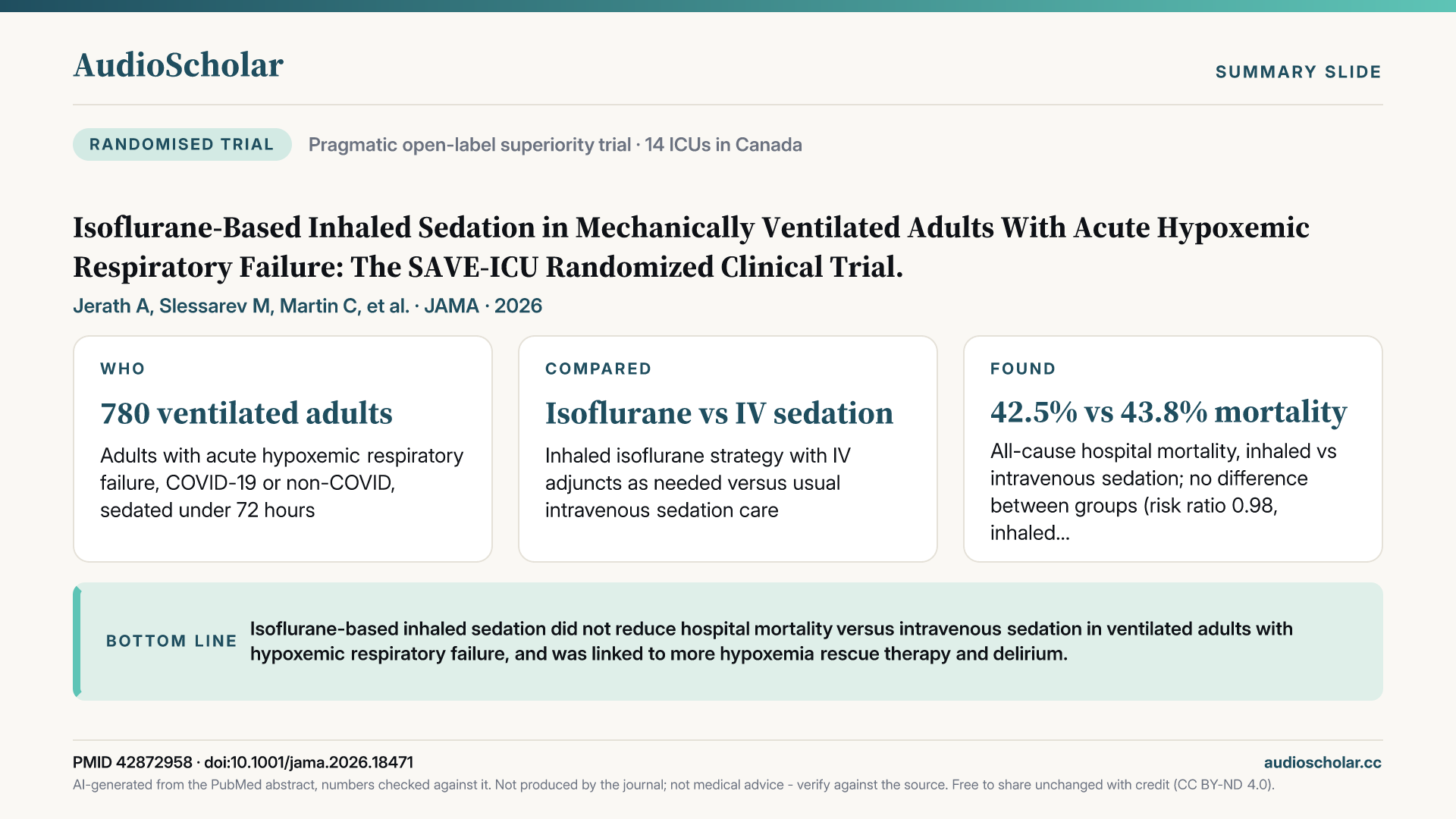
Isoflurane-Based Inhaled Sedation in Mechanically Ventilated Adults With Acute Hypoxemic Respiratory Failure: The SAVE-ICU Randomized Clinical Trial.
In 780 ventilated adults with hypoxemic respiratory failure, isoflurane-based inhaled sedation did not lower hospital mortality versus intravenous sedation and was linked to more rescue therapy and delirium.
JAMA · 2026 · PubMed

This week’s papers
- 01
Isoflurane-Based Inhaled Sedation in Mechanically Ventilated Adults With Acute Hypoxemic Respiratory Failure: The SAVE-ICU Randomized Clinical Trial.
In 780 ventilated adults with hypoxemic respiratory failure, isoflurane-based inhaled sedation did not lower hospital mortality versus intravenous sedation and was linked to more rescue therapy and delirium.
Jerath A et al. · JAMA · 2026
From the briefingThe largest is the SAVE-ICU trial in JAMA, led by Jerath, a pragmatic open-label randomized trial across 14 Canadian intensive care units comparing isoflurane-based inhaled sedation with usual intravenous sedation in 780 mechanically ventilated adults with acute hypoxemic respiratory failure, most of them without COVID [1]. The primary outcome was clearly negative: roughly 43 percent of patients in each arm died before hospital discharge, with no difference across age, sex, or COVID status, and ventilator-free, ICU-free and hospital-free days were similar. Two secondary signals ran against the inhaled strategy. Patients sedated with isoflurane received adjunctive therapies for refractory hypoxemia about nine percentage points more often, and they had roughly one fewer day alive without delirium or coma. Practice context matters here, since about half of patients in the inhaled arm also received intravenous sedation on any given day, so this tests a strategy rather than isoflurane alone. Still, for this population the trial offers no support for inhaled sedation as a route to better survival.
If you only have time for one paper this week, make it the SAVE-ICU trial in JAMA [1]. It is a large, pragmatic, multicentre test of a sedation strategy that had attracted real enthusiasm, and it returned a clear negative answer on mortality with secondary signals pointing in the wrong direction.
Written by AI from the published abstract, for healthcare professionals. Not medical advice; check the paper before acting on it.
- 02
High-Frequency Chest Wall Oscillation in Acute Respiratory Failure With Bronchial Hypersecretion: A Randomized Controlled Trial.
Adding high-frequency chest wall oscillation for hypersecretive patients on noninvasive support did not significantly reduce therapeutic bronchoscopy after adjustment; shorter hospital stays were exploratory and need confirmation.
Ielo S et al. · Chest · 2026
From the briefingIn Chest, Ielo and colleagues ran a single-centre trial of 88 patients on high-flow nasal oxygen or noninvasive ventilation who had bronchial hypersecretion and a weak cough, adding high-frequency chest wall oscillation to standard care [2]. Crude rates of therapeutic bronchoscopy were cut by more than half, but after adjustment for age, sex and cause of admission the difference was no longer statistically significant, so the primary endpoint was not met. Hospital stays were about four and a half days shorter, but the authors label these secondary findings exploratory and hypothesis-generating.
Written by AI from the published abstract, for healthcare professionals. Not medical advice; check the paper before acting on it.
- 03
The Prognostic Value of PaCO2 on the Response to Noninvasive Ventilation in Patients with AECOPD Complicated by Type II Respiratory Failure.
In 676 hypercapnic COPD exacerbations, a 24-hour PaCO2 above 60.2 mmHg marked sharply higher odds of noninvasive ventilation failure, a retrospective threshold still requiring external validation.
Song F et al. · International Journal of Chronic Obstructive Pulmonary Disease · 2026
From the briefingRounding out the theme, Song and colleagues, in the International Journal of Chronic Obstructive Pulmonary Disease, reviewed 676 patients with COPD exacerbations and hypercapnic respiratory failure treated with noninvasive ventilation across two centres [3]. About one in nine patients failed ventilation, and the arterial carbon dioxide level 24 hours into treatment showed an L-shaped relationship with failure: below a threshold of 60.2 millimetres of mercury there was no association, while above it the odds climbed steeply. This is a retrospective cohort and the authors themselves say the threshold needs external validation before it can anchor escalation decisions.
Written by AI from the published abstract, for healthcare professionals. Not medical advice; check the paper before acting on it.
- 04
Association of inhaled corticosteroid use with first Pseudomonas aeruginosa isolation in eosinophilic bronchiectasis: a multicenter retrospective study.
Inhaled corticosteroid use was associated with a roughly three- to four-fold higher risk of first Pseudomonas isolation in bronchiectasis patients with blood eosinophils of at least 100 cells per microlitre.
Wang Y et al. · Respiratory Medicine · 2026
From the briefingIn Respiratory Medicine, Wang and colleagues examined 719 patients with bronchiectasis across several centres and found that inhaled corticosteroid use was associated with a roughly three- to four-fold higher risk of first Pseudomonas aeruginosa isolation among patients with blood eosinophils of 100 cells per microlitre or more, with no such association below that level [4]. This sits awkwardly with the growing interest in treating eosinophilic bronchiectasis with inhaled steroids, and it is a useful counterweight, though the design is retrospective, the confidence around the estimates is wide, and prescribing was not randomized.
Written by AI from the published abstract, for healthcare professionals. Not medical advice; check the paper before acting on it.
- 05
Fertility, pregnancy, and women's health in bronchiectasis: a multicenter study and ELF-EMBARC patient survey.
Across 121 pregnancies in women with bronchiectasis, exacerbations complicated 58.6 percent, pre-pregnancy FEV1 correlated with birth weight, and subfertility was driven mainly by primary ciliary dyskinesia.
Boehm-Cohen L et al. · Chest · 2026
From the briefingAlso on bronchiectasis, Boehm-Cohen and colleagues, writing in Chest from the EMBARC network, described 121 pregnancies in 83 women plus an international patient survey of 629 respondents [5]. Lung function stayed stable through pregnancy, but exacerbations complicated close to 60 percent of pregnancies, and pre-pregnancy lung function correlated with both birth weight and gestational age. Assisted reproduction was used in about a third of pregnancies, far more often in primary ciliary dyskinesia, and the authors conclude that subfertility is driven mainly by that diagnosis, while other forms of bronchiectasis look similar to the general population. The survey also suggested earlier menopause in women diagnosed before 50. These data are descriptive but fill a genuine gap for pre-conception counselling.
Written by AI from the published abstract, for healthcare professionals. Not medical advice; check the paper before acting on it.
- 06
Safety and diagnostic yield of transbronchial lung cryobiopsy in patients with interstitial lung disease and severe pulmonary function impairment.
At one experienced centre, cryobiopsy in interstitial lung disease with severe functional impairment gave about 80 percent diagnostic contribution with pneumothorax and bleeding rates not significantly different from milder disease.
Lederer C et al. · Respiratory Research · 2026
From the briefingTurning to interstitial disease, Lederer and colleagues in Respiratory Research reported 396 consecutive transbronchial cryobiopsies at a single high-volume German centre, including 43 patients with severe impairment, defined as forced vital capacity under 50 percent or diffusing capacity under 35 percent predicted [6]. Cryobiopsy contributed to a final multidisciplinary diagnosis in about 80 percent of patients in both groups, and pneumothorax rates were similar. Severe bleeding requiring endoscopic control occurred in about a quarter of the severely impaired patients versus under a fifth of the others, a difference that was not statistically significant in what is a small subgroup. The authors frame cryobiopsy as a possible option for carefully selected patients in experienced centres, which is a cautious reading of single-centre retrospective data rather than a case for broadening guideline criteria.
Written by AI from the published abstract, for healthcare professionals. Not medical advice; check the paper before acting on it.
- 07
Effect of clarithromycin on the circulating inflammatory proteome in community-acquired pneumonia: a secondary analysis of the ACCESS trial.
Clarithromycin selectively lowered interleukin 6 in hospitalized pneumonia, and in a hyperinflammatory endotype it was associated with lower 90-day mortality, a hypothesis-generating secondary trial analysis.
Stylianakis E et al. · Chest · 2026
From the briefingIn Chest, Stylianakis and colleagues performed a secondary analysis of the ACCESS trial, profiling inflammatory proteins in 197 hospitalized patients at baseline and day four [7]. Clarithromycin selectively lowered interleukin 6, and among patients who reached the trial's primary endpoint, several interferon-related signals were suppressed only in the clarithromycin arm. Clustering identified two inflammatory endotypes, and in the more inflamed endotype, 90-day mortality was lower with clarithromycin. That supports the idea of biological heterogeneity in pneumonia and immunomodulatory benefit from macrolides, but as a post hoc subgroup finding it is hypothesis-generating.
Written by AI from the published abstract, for healthcare professionals. Not medical advice; check the paper before acting on it.
- 08
Epidemiology, risk factors and clinical outcome of community-acquired pneumonia in severely immunosuppressed patients: a comprehensive analysis from the multinational, prospective CAPNETZ Cohort.
Among 232 immunosuppressed pneumonia patients, prognosis was not worse than matched controls, standard severity scores predicted outcomes poorly, and non-core pathogens caused 16.4 percent of cases.
Müller S et al. · ERJ Open Research · 2026
From the briefingFrom ERJ Open Research, Müller and colleagues analysed 232 immunosuppressed patients with pneumonia from the prospective multinational CAPNETZ cohort, matched to patients without immunosuppression [8]. About one in ten reached the endpoint of death or organ replacement within 30 days, and immunosuppression overall was not associated with worse prognosis, with patients on immunosuppressive drugs actually faring better. The familiar severity scores, including CURB-65 and qSOFA, performed only modestly better than chance in this group. Non-core pathogens caused about one in six infections, linked to transplantation, prior anti-infective treatment and ICU admission, yet SARS-CoV-2, Haemophilus and pneumococcus remained the most common causes, which supports covering usual pathogens while broadening the search selectively.
Written by AI from the published abstract, for healthcare professionals. Not medical advice; check the paper before acting on it.
- 09
A phase 2a study with SPL84: A novel RNA-targeted approach to restore CFTR function in people with CF carrying the 3849+10 kb C→T mutation.
Inhaled antisense oligonucleotide SPL84 was well tolerated in 17 people with cystic fibrosis carrying the 3849+10 kb mutation, with up to 70 percent per cohort gaining at least five FEV1 points.
Cofta S et al. · European Respiratory Journal · 2026
From the briefingIn the European Respiratory Journal, Cofta and colleagues report a phase 2a placebo-controlled trial of SPL84, an inhaled antisense oligonucleotide designed to correct aberrant splicing in people with cystic fibrosis carrying the 3849 plus 10 kilobase C to T mutation [9]. Seventeen participants received weekly inhalations for nine weeks; the drug was well tolerated without drug-related serious adverse events, and up to 70 percent of treated participants per cohort gained at least five points in percent predicted FEV1. With so few patients and exploratory efficacy endpoints, this is proof of concept, though the authors describe it as the first sign of clinical benefit from an RNA-targeted nucleic acid therapy in lung disease.
Written by AI from the published abstract, for healthcare professionals. Not medical advice; check the paper before acting on it.
- 10
Multimodal investigation of the association between bevacizumab and pulmonary arterial hypertension.
Registry, national cohort and pharmacovigilance data found no evidence that bevacizumab causes pulmonary arterial hypertension in adults, though a trigger role in predisposed individuals cannot be excluded.
Valentin S et al. · ERJ Open Research · 2026
From the briefingFinally, Valentin and colleagues in ERJ Open Research combined the French pulmonary hypertension registry, national health data, and the WHO pharmacovigilance database to examine bevacizumab and pulmonary arterial hypertension [10]. The registry yielded seven temporally linked cases, most in patients with predisposing conditions such as a BMPR2 mutation or portal hypertension; the national cohort showed no increased incidence; and the pharmacovigilance signal was modest and appeared only under broad definitions. The authors find no evidence of a causal link in adults, while leaving open a role as a secondary trigger in predisposed people.
Written by AI from the published abstract, for healthcare professionals. Not medical advice; check the paper before acting on it.
The full briefing
This AudioScholar briefing is generated by artificial intelligence for healthcare professionals and trainees. It is not medical advice.
Welcome to This Week in Pulmonary. This week we're covering 10 notable papers spanning acute respiratory failure and critical care, bronchiectasis and interstitial lung disease, and pneumonia alongside new therapeutics and drug safety. Let's dive in.
We start in the ICU, where three papers test the tools used to support patients in acute respiratory failure. The largest is the SAVE-ICU trial in JAMA, led by Jerath, a pragmatic open-label randomized trial across 14 Canadian intensive care units comparing isoflurane-based inhaled sedation with usual intravenous sedation in 780 mechanically ventilated adults with acute hypoxemic respiratory failure, most of them without COVID [1]. The primary outcome was clearly negative: roughly 43 percent of patients in each arm died before hospital discharge, with no difference across age, sex, or COVID status, and ventilator-free, ICU-free and hospital-free days were similar. Two secondary signals ran against the inhaled strategy. Patients sedated with isoflurane received adjunctive therapies for refractory hypoxemia about nine percentage points more often, and they had roughly one fewer day alive without delirium or coma. Practice context matters here, since about half of patients in the inhaled arm also received intravenous sedation on any given day, so this tests a strategy rather than isoflurane alone. Still, for this population the trial offers no support for inhaled sedation as a route to better survival. In Chest, Ielo and colleagues ran a single-centre trial of 88 patients on high-flow nasal oxygen or noninvasive ventilation who had bronchial hypersecretion and a weak cough, adding high-frequency chest wall oscillation to standard care [2]. Crude rates of therapeutic bronchoscopy were cut by more than half, but after adjustment for age, sex and cause of admission the difference was no longer statistically significant, so the primary endpoint was not met. Hospital stays were about four and a half days shorter, but the authors label these secondary findings exploratory and hypothesis-generating. Rounding out the theme, Song and colleagues, in the International Journal of Chronic Obstructive Pulmonary Disease, reviewed 676 patients with COPD exacerbations and hypercapnic respiratory failure treated with noninvasive ventilation across two centres [3]. About one in nine patients failed ventilation, and the arterial carbon dioxide level 24 hours into treatment showed an L-shaped relationship with failure: below a threshold of 60.2 millimetres of mercury there was no association, while above it the odds climbed steeply. This is a retrospective cohort and the authors themselves say the threshold needs external validation before it can anchor escalation decisions.
Our second theme is chronic airway and parenchymal disease, with two bronchiectasis papers and one on diagnosing interstitial lung disease. In Respiratory Medicine, Wang and colleagues examined 719 patients with bronchiectasis across several centres and found that inhaled corticosteroid use was associated with a roughly three- to four-fold higher risk of first Pseudomonas aeruginosa isolation among patients with blood eosinophils of 100 cells per microlitre or more, with no such association below that level [4]. This sits awkwardly with the growing interest in treating eosinophilic bronchiectasis with inhaled steroids, and it is a useful counterweight, though the design is retrospective, the confidence around the estimates is wide, and prescribing was not randomized. Also on bronchiectasis, Boehm-Cohen and colleagues, writing in Chest from the EMBARC network, described 121 pregnancies in 83 women plus an international patient survey of 629 respondents [5]. Lung function stayed stable through pregnancy, but exacerbations complicated close to 60 percent of pregnancies, and pre-pregnancy lung function correlated with both birth weight and gestational age. Assisted reproduction was used in about a third of pregnancies, far more often in primary ciliary dyskinesia, and the authors conclude that subfertility is driven mainly by that diagnosis, while other forms of bronchiectasis look similar to the general population. The survey also suggested earlier menopause in women diagnosed before 50. These data are descriptive but fill a genuine gap for pre-conception counselling. Turning to interstitial disease, Lederer and colleagues in Respiratory Research reported 396 consecutive transbronchial cryobiopsies at a single high-volume German centre, including 43 patients with severe impairment, defined as forced vital capacity under 50 percent or diffusing capacity under 35 percent predicted [6]. Cryobiopsy contributed to a final multidisciplinary diagnosis in about 80 percent of patients in both groups, and pneumothorax rates were similar. Severe bleeding requiring endoscopic control occurred in about a quarter of the severely impaired patients versus under a fifth of the others, a difference that was not statistically significant in what is a small subgroup. The authors frame cryobiopsy as a possible option for carefully selected patients in experienced centres, which is a cautious reading of single-centre retrospective data rather than a case for broadening guideline criteria.
Our third theme is community-acquired pneumonia, with two papers probing who benefits and who is at risk. In Chest, Stylianakis and colleagues performed a secondary analysis of the ACCESS trial, profiling inflammatory proteins in 197 hospitalized patients at baseline and day four [7]. Clarithromycin selectively lowered interleukin 6, and among patients who reached the trial's primary endpoint, several interferon-related signals were suppressed only in the clarithromycin arm. Clustering identified two inflammatory endotypes, and in the more inflamed endotype, 90-day mortality was lower with clarithromycin. That supports the idea of biological heterogeneity in pneumonia and immunomodulatory benefit from macrolides, but as a post hoc subgroup finding it is hypothesis-generating. From ERJ Open Research, Müller and colleagues analysed 232 immunosuppressed patients with pneumonia from the prospective multinational CAPNETZ cohort, matched to patients without immunosuppression [8]. About one in ten reached the endpoint of death or organ replacement within 30 days, and immunosuppression overall was not associated with worse prognosis, with patients on immunosuppressive drugs actually faring better. The familiar severity scores, including CURB-65 and qSOFA, performed only modestly better than chance in this group. Non-core pathogens caused about one in six infections, linked to transplantation, prior anti-infective treatment and ICU admission, yet SARS-CoV-2, Haemophilus and pneumococcus remained the most common causes, which supports covering usual pathogens while broadening the search selectively.
Our final theme pairs a new therapeutic approach with a drug-safety question. In the European Respiratory Journal, Cofta and colleagues report a phase 2a placebo-controlled trial of SPL84, an inhaled antisense oligonucleotide designed to correct aberrant splicing in people with cystic fibrosis carrying the 3849 plus 10 kilobase C to T mutation [9]. Seventeen participants received weekly inhalations for nine weeks; the drug was well tolerated without drug-related serious adverse events, and up to 70 percent of treated participants per cohort gained at least five points in percent predicted FEV1. With so few patients and exploratory efficacy endpoints, this is proof of concept, though the authors describe it as the first sign of clinical benefit from an RNA-targeted nucleic acid therapy in lung disease. Finally, Valentin and colleagues in ERJ Open Research combined the French pulmonary hypertension registry, national health data, and the WHO pharmacovigilance database to examine bevacizumab and pulmonary arterial hypertension [10]. The registry yielded seven temporally linked cases, most in patients with predisposing conditions such as a BMPR2 mutation or portal hypertension; the national cohort showed no increased incidence; and the pharmacovigilance signal was modest and appeared only under broad definitions. The authors find no evidence of a causal link in adults, while leaving open a role as a secondary trigger in predisposed people.
If you only have time for one paper this week, make it the SAVE-ICU trial in JAMA [1]. It is a large, pragmatic, multicentre test of a sedation strategy that had attracted real enthusiasm, and it returned a clear negative answer on mortality with secondary signals pointing in the wrong direction.
Here is what this week's evidence adds up to in Pulmonary. First, for ventilated adults with hypoxemic respiratory failure, isoflurane-based inhaled sedation did not improve survival in a well-powered randomized trial and was associated with more rescue therapy and fewer delirium-free days. Second, in hypercapnic COPD exacerbations, a 24-hour carbon dioxide level above about 60 millimetres of mercury tracked with noninvasive ventilation failure, but that cut-off comes from retrospective data awaiting validation, and chest wall oscillation for secretions remains unproven after a negative primary endpoint. Third, in bronchiectasis, observational data link inhaled steroids to earlier Pseudomonas in eosinophilic patients, and pregnancy is commonly complicated by exacerbations, with pre-pregnancy lung function tied to neonatal outcomes. Fourth, in pneumonia, standard severity scores performed poorly in immunosuppressed patients, and macrolide immunomodulation may matter most in a hyperinflammatory endotype, a finding still at the hypothesis stage. And fifth, RNA-targeted therapy for a rare cystic fibrosis mutation shows an early efficacy signal, while bevacizumab shows no convincing causal link to pulmonary arterial hypertension.
That's your roundup for This Week in Pulmonary. The full transcript and references are available on the episode page. This is an AI-curated summary — for clinical decisions, always consult primary sources and current guidelines. See you next week.
If this weekly briefing is useful, follow the show in your podcast app so new episodes arrive automatically. And think of one colleague — in any specialty — who never has time to keep up with the literature. Tell them about AudioScholar: a free ten-minute weekly for every specialty, to listen to in any podcast app, or to read at audioscholar dot C C.
This is an automated summary generated by artificial intelligence, which can make mistakes. Always review the original source materials.
Spot something worth flagging?
Get this every week in your podcast app — free.
New pulmonary episodes land in your feed automatically — listen on your commute.