This Week in Obstetrics & Gynecology — Oct 22, 2026
Generated Oct 23, 2026 · 10:21
The week's practice-changing Obstetrics & Gynecology research, summarized for clinicians.
If the audio fails to play, refresh the page to renew the link.
Get next week’s Obstetrics & Gynecology briefing — free.
In your podcast app, or readable in your inbox with the audio one tap away.
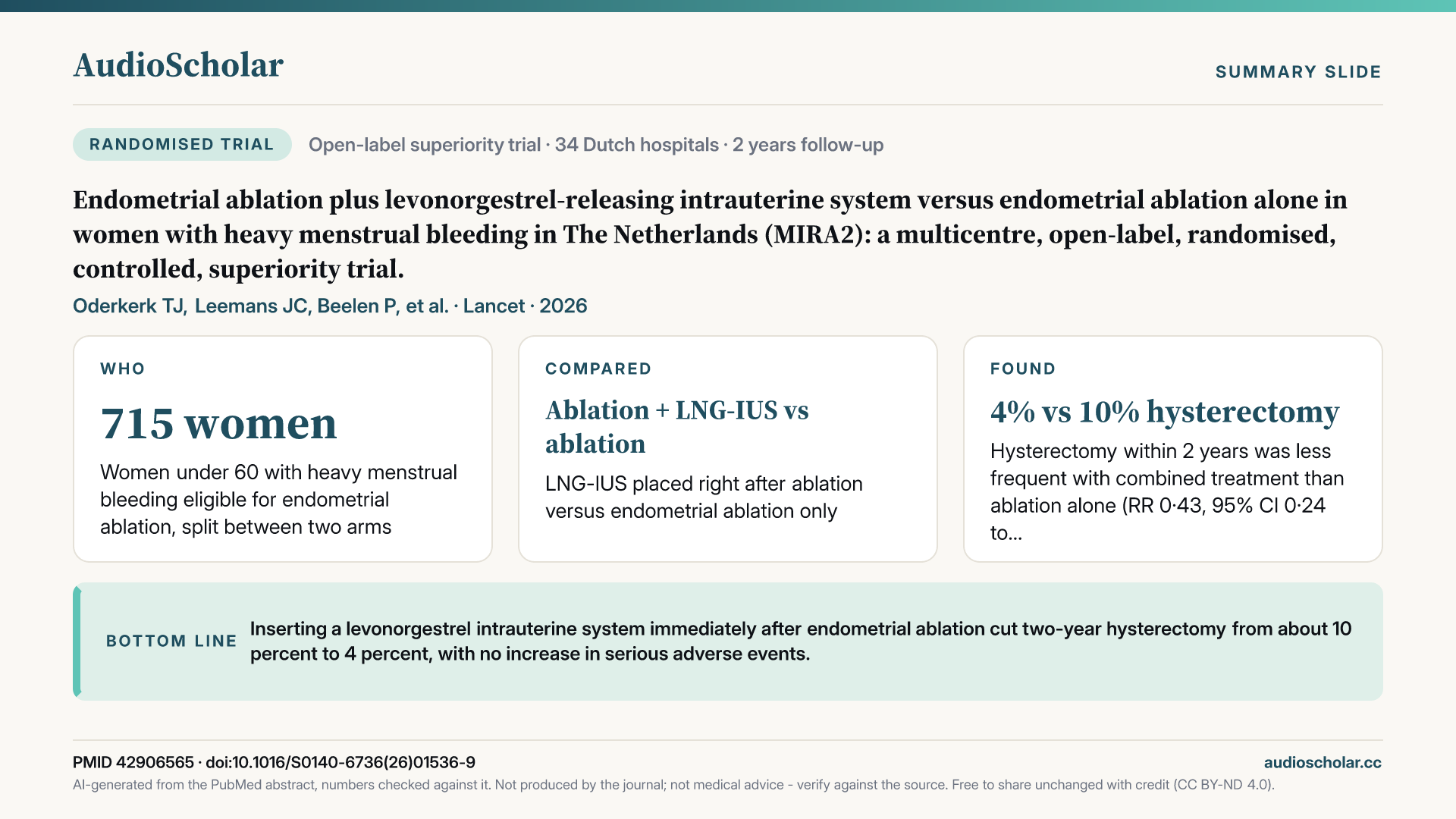
Endometrial ablation plus levonorgestrel-releasing intrauterine system versus endometrial ablation alone in women with heavy menstrual bleeding in The Netherlands (MIRA2): a multicentre, open-label, randomised, controlled, superiority trial.
Inserting a levonorgestrel intrauterine system immediately after endometrial ablation cut two-year hysterectomy from about 10 percent to 4 percent, with no increase in serious adverse events.
The Lancet · 2026 · PubMed

This week’s papers
- 01
Endometrial ablation plus levonorgestrel-releasing intrauterine system versus endometrial ablation alone in women with heavy menstrual bleeding in The Netherlands (MIRA2): a multicentre, open-label, randomised, controlled, superiority trial.
Inserting a levonorgestrel intrauterine system immediately after endometrial ablation cut two-year hysterectomy from about 10 percent to 4 percent, with no increase in serious adverse events.
Oderkerk TJ, Leemans JC, Beelen P, et al. · The Lancet · 2026
From the briefingIn The Lancet, Oderkerk and colleagues report MIRA2, a Dutch multicentre open-label trial across 34 hospitals that randomised 715 women under 60 with heavy menstrual bleeding to endometrial ablation alone or ablation with immediate insertion of a 52 milligram levonorgestrel intrauterine system [1]. The rationale is that residual or regenerating endometrium drives treatment failure. At two years, hysterectomy was needed in about 4 percent of women in the combined group versus about 10 percent with ablation alone, which cut the risk by more than half, and serious adverse events were identical at roughly 8 percent in each arm. The trial was unmasked and roughly one in seventeen participants lacked primary outcome data, but hysterectomy is a hard endpoint, and this is the most direct randomised evidence so far that adding the device at the time of ablation reduces later surgery.
If you only have time for one paper this week, make it the MIRA2 trial in The Lancet [1]. It is a large randomised trial with a hard endpoint addressing a very common procedure, and it largely settles whether a hormonal device placed at ablation reduces later hysterectomy.
Written by AI from the published abstract, for healthcare professionals. Not medical advice; check the paper before acting on it.
- 02
Cytology and hrHPV Testing in HPV-Vaccinated Women Entering Cervical Screening: A Prospective Observational Study.
In young HPV-vaccinated Scottish women, HPV testing kept a high negative predictive value but a low positive predictive value for CIN2+, supporting continued cytology triage.
Cruickshank ME, Pan J, Cuschieri K, et al. · BJOG · 2026
From the briefingMoving to the cervix, Cruickshank and colleagues in BJOG examined women in Scotland born between 1991 and 1995, the first cohorts eligible for HPV vaccination, as they entered screening [2]. Among 10,000 co-tested samples, high-risk HPV was present in about 86 percent of borderline or mildly abnormal smears and in just over a quarter of cytology-negative samples. Within the colposcopy referral pathway, HPV testing kept a very high negative predictive value of about 99 percent, but its positive predictive value for high-grade disease was only about 14 percent, compared with about 72 percent for high-grade cytology. The authors stress these are not population-level accuracy figures, but they argue that low disease prevalence in vaccinated women erodes the value of a positive HPV result, supporting a continued role for cytology triage while screening strategies for highly vaccinated cohorts are reassessed.
Written by AI from the published abstract, for healthcare professionals. Not medical advice; check the paper before acting on it.
- 03
Progesterone Receptor Antagonists for Labor Induction: A Systematic Review and Meta-analysis.
Across 15 randomized trials, mifepristone for term labor induction was associated with about one-third lower odds of cesarean and faster induction, though safety outcomes were sparsely reported.
Pellot IR, Darché RL, Pires PW, et al. · Obstetrics & Gynecology · 2026
From the briefingIn Obstetrics and Gynecology, Pellot and colleagues pooled 15 randomised trials of mifepristone, the progesterone receptor antagonist, for term induction in singleton pregnancies, covering more than 1,800 women [3]. Mifepristone was associated with about a third lower odds of cesarean delivery, roughly 33 percent versus 42 percent, along with higher Bishop scores at 24 hours, shorter induction-to-delivery intervals, and less need for prostaglandin or oxytocin. The effect held when restricted to placebo-controlled, high-quality trials. No signal of harm emerged for postpartum hemorrhage, neonatal intensive care admission, or low Apgar scores, but most trials did not report those outcomes, so the safety picture is reassuring rather than settled. The authors conclude the data support a role for progesterone antagonists in induction, though dosing varied across trials and large modern trials would strengthen the case.
Written by AI from the published abstract, for healthcare professionals. Not medical advice; check the paper before acting on it.
- 04
Effect of ultrasound-guided visual biofeedback performed by midwives on duration of second stage of labor: randomized controlled trial.
Midwife-led transperineal ultrasound biofeedback shortened the second stage by about 25 minutes in nulliparous women with epidurals and reduced perineal tears and fever, without changing delivery mode.
Avrahami I, Bilitzky-Kopit A, Tarasov M, et al. · Ultrasound in Obstetrics & Gynecology · 2026
From the briefingComplementing this, Avrahami and colleagues in Ultrasound in Obstetrics and Gynecology randomised 327 nulliparous women with epidurals at a single centre to midwife-led coaching using transperineal ultrasound biofeedback, where women watched the fetal head descend on a screen, or to traditional vaginal coaching [4]. The second stage was about 25 minutes shorter with ultrasound coaching, and rates of second-degree or worse perineal tears and intrapartum fever were both lower. Mode of delivery did not differ, and the authors themselves call for larger studies before claims about delivery outcomes can be made.
Written by AI from the published abstract, for healthcare professionals. Not medical advice; check the paper before acting on it.
- 05
Postpartum Blood Pressure After Hypertensive Disorders of Pregnancy and Subsequent Cardiovascular Disease: A Population-Based Cohort Study.
After hypertensive pregnancy, abnormal blood pressure at six weeks postpartum roughly doubled long-term cardiovascular risk, yet fewer than half of English women had a reading recorded.
Korb D, Ramakrishnan R, Kwok ACH, et al. · BJOG · 2026
From the briefingKorb and colleagues used English primary care data linked to hospital and mortality records for nearly 40,000 women with hypertensive disorders of pregnancy [5]. Women with abnormal blood pressure at the six-week postpartum check had roughly double the risk of subsequent cardiovascular disease over up to 20 years, about 11 percent versus 5 percent, and around two thirds of cardiovascular events occurred in women under 40. Just as striking, fewer than half of women with hypertensive disorders had any blood pressure recorded at six weeks, and the absence of a normal reading was itself linked to higher risk. Because women without a recording were excluded from the main analysis, selection bias is possible, but the gap in follow-up is the clearest signal.
Written by AI from the published abstract, for healthcare professionals. Not medical advice; check the paper before acting on it.
- 06
Prediction of 10-Year Incident Hypertension After Pregnancy: A Population-Based Cohort Study.
Adding pregnancy factors, mainly hypertensive disorders of pregnancy, improved a Dutch model predicting ten-year hypertension after first birth from modest to good discrimination; external validation is pending.
Yang Z, Van Os HJA, Kist JM, et al. · BJOG · 2026
From the briefingFrom the Netherlands, Yang and colleagues built a model predicting ten-year incident hypertension after a first birth in more than 28,000 women [6]. Adding pregnancy-related factors, chiefly hypertensive disorders of pregnancy, raised discrimination from modest to good, with the C statistic climbing from about 0.66 to about 0.77. The improvement came almost entirely from better identification of women who went on to develop hypertension. Together these studies suggest that pregnancy history carries real prognostic weight, though neither tests whether acting on that information changes outcomes, and the Dutch model still needs external validation.
Written by AI from the published abstract, for healthcare professionals. Not medical advice; check the paper before acting on it.
- 07
Childhood Cancer Risk After Assisted Reproductive Technology.
In over a million Danish children, frozen embryo transfer and intracytoplasmic sperm injection, but not conventional IVF, were linked to higher childhood cancer risk, though absolute risks stayed low.
Mose K, Kjaer SK, Jensen A, et al. · JAMA · 2026
From the briefingIn JAMA, Mose and colleagues followed more than a million Danish children for a median of 20 years [7]. Children conceived with assisted reproduction had about a quarter higher cancer incidence overall, but the signal was concentrated after frozen embryo transfer, where risk roughly doubled, and after intracytoplasmic sperm injection, with about a 50 percent increase, while conventional IVF showed no excess. Frozen transfer was linked to leukemia, lymphoma, and soft tissue sarcoma, and sperm injection to lymphoma, sarcoma, and central nervous system tumours. Absolute risks remained low, and the findings held when compared with children of infertile women, which led the authors to point toward procedure-related rather than infertility-related factors as targets for further study. This is observational and the subtype estimates rest on small numbers, but it adds weight to calls for careful scrutiny of freeze-all and routine sperm injection practices.
Written by AI from the published abstract, for healthcare professionals. Not medical advice; check the paper before acting on it.
- 08
Strategy-Based Comparison of Fresh Double Embryo Transfer Versus Sequential Single Embryo Transfers in Women With Adequate Blastocyst Availability.
In a retrospective single-centre cohort with good blastocysts, sequential single transfers yielded higher cumulative live birth than fresh double transfer while eliminating twins and reducing preterm births.
Weng TH, Lee CC, Lee KS, et al. · Fertility and Sterility · 2026
From the briefingOn transfer strategy, Weng and colleagues in Fertility and Sterility retrospectively compared fresh double embryo transfer with sequential single transfers in 256 women under 40 with at least two good blastocysts [8]. Cumulative live birth was higher with the sequential single approach, about 64 percent versus 51 percent, twins were eliminated, and preterm births fell sharply. The groups differed in age and the design is single-centre and retrospective, so this supports rather than proves the single-transfer case.
Written by AI from the published abstract, for healthcare professionals. Not medical advice; check the paper before acting on it.
- 09
Fertility evaluation of infertile women: a committee opinion.
An updated committee opinion replacing the 2021 version endorses a systematic, prompt, cost-effective infertility workup that begins with the least invasive tests for the commonest causes.
Practice Committee (authors not listed) · Fertility and Sterility · 2026
From the briefingAlso in Fertility and Sterility, an updated committee opinion on the fertility evaluation of infertile women replaces the 2021 version, reiterating a systematic, expeditious, cost-effective workup that starts with the least invasive tests for the most common causes [9].
Written by AI from the published abstract, for healthcare professionals. Not medical advice; check the paper before acting on it.
- 10
Releasing the syndrome from captivity: why renaming PCOS to PMOS widens reproductive care beyond the anovulatory frame.
An opinion piece argues renaming PCOS to polyendocrine metabolic ovarian syndrome should broaden care to metabolic, endometrial, pregnancy, and psychological risks, aligned with a 2028 guideline update.
Piltonen TT, Teede HJ, Bahri Khomami M · Human Reproduction · 2026
From the briefingAnd in Human Reproduction, Piltonen, Teede, and Bahri Khomami argue that the renaming of polycystic ovary syndrome to polyendocrine metabolic ovarian syndrome, agreed through a global consensus process, is more than a relabelling [10]. They contend it reflects the condition's metabolic, psychological, and oncological burden, the absence of true cyst risk, and neglected endometrial and pregnancy complications, and they frame the 2028 international guideline update as the deadline for aligning coding, trials, and education. This is an opinion piece, not new data.
Written by AI from the published abstract, for healthcare professionals. Not medical advice; check the paper before acting on it.
The full briefing
This AudioScholar briefing is generated by artificial intelligence for healthcare professionals and trainees. It is not medical advice.
Welcome to This Week in Obstetrics & Gynecology. This week we're covering 10 notable papers spanning gynecologic management and screening, labor and the postpartum cardiovascular window, and the long-term consequences of how we deliver fertility care. Let's dive in.
We start in benign gynecology and screening, where a large trial and a screening study both address what happens after the first intervention. In The Lancet, Oderkerk and colleagues report MIRA2, a Dutch multicentre open-label trial across 34 hospitals that randomised 715 women under 60 with heavy menstrual bleeding to endometrial ablation alone or ablation with immediate insertion of a 52 milligram levonorgestrel intrauterine system [1]. The rationale is that residual or regenerating endometrium drives treatment failure. At two years, hysterectomy was needed in about 4 percent of women in the combined group versus about 10 percent with ablation alone, which cut the risk by more than half, and serious adverse events were identical at roughly 8 percent in each arm. The trial was unmasked and roughly one in seventeen participants lacked primary outcome data, but hysterectomy is a hard endpoint, and this is the most direct randomised evidence so far that adding the device at the time of ablation reduces later surgery. Moving to the cervix, Cruickshank and colleagues in BJOG examined women in Scotland born between 1991 and 1995, the first cohorts eligible for HPV vaccination, as they entered screening [2]. Among 10,000 co-tested samples, high-risk HPV was present in about 86 percent of borderline or mildly abnormal smears and in just over a quarter of cytology-negative samples. Within the colposcopy referral pathway, HPV testing kept a very high negative predictive value of about 99 percent, but its positive predictive value for high-grade disease was only about 14 percent, compared with about 72 percent for high-grade cytology. The authors stress these are not population-level accuracy figures, but they argue that low disease prevalence in vaccinated women erodes the value of a positive HPV result, supporting a continued role for cytology triage while screening strategies for highly vaccinated cohorts are reassessed.
Our second theme is labor, with two papers aimed at making induction and the second stage more efficient. In Obstetrics and Gynecology, Pellot and colleagues pooled 15 randomised trials of mifepristone, the progesterone receptor antagonist, for term induction in singleton pregnancies, covering more than 1,800 women [3]. Mifepristone was associated with about a third lower odds of cesarean delivery, roughly 33 percent versus 42 percent, along with higher Bishop scores at 24 hours, shorter induction-to-delivery intervals, and less need for prostaglandin or oxytocin. The effect held when restricted to placebo-controlled, high-quality trials. No signal of harm emerged for postpartum hemorrhage, neonatal intensive care admission, or low Apgar scores, but most trials did not report those outcomes, so the safety picture is reassuring rather than settled. The authors conclude the data support a role for progesterone antagonists in induction, though dosing varied across trials and large modern trials would strengthen the case. Complementing this, Avrahami and colleagues in Ultrasound in Obstetrics and Gynecology randomised 327 nulliparous women with epidurals at a single centre to midwife-led coaching using transperineal ultrasound biofeedback, where women watched the fetal head descend on a screen, or to traditional vaginal coaching [4]. The second stage was about 25 minutes shorter with ultrasound coaching, and rates of second-degree or worse perineal tears and intrapartum fever were both lower. Mode of delivery did not differ, and the authors themselves call for larger studies before claims about delivery outcomes can be made.
The third theme is the postpartum period as a window into lifelong cardiovascular risk, with two population cohorts both published in BJOG. Korb and colleagues used English primary care data linked to hospital and mortality records for nearly 40,000 women with hypertensive disorders of pregnancy [5]. Women with abnormal blood pressure at the six-week postpartum check had roughly double the risk of subsequent cardiovascular disease over up to 20 years, about 11 percent versus 5 percent, and around two thirds of cardiovascular events occurred in women under 40. Just as striking, fewer than half of women with hypertensive disorders had any blood pressure recorded at six weeks, and the absence of a normal reading was itself linked to higher risk. Because women without a recording were excluded from the main analysis, selection bias is possible, but the gap in follow-up is the clearest signal. From the Netherlands, Yang and colleagues built a model predicting ten-year incident hypertension after a first birth in more than 28,000 women [6]. Adding pregnancy-related factors, chiefly hypertensive disorders of pregnancy, raised discrimination from modest to good, with the C statistic climbing from about 0.66 to about 0.77. The improvement came almost entirely from better identification of women who went on to develop hypertension. Together these studies suggest that pregnancy history carries real prognostic weight, though neither tests whether acting on that information changes outcomes, and the Dutch model still needs external validation.
Our final theme is reproductive medicine, where the questions extend from embryo handling to the next generation and even to what we call a common condition. In JAMA, Mose and colleagues followed more than a million Danish children for a median of 20 years [7]. Children conceived with assisted reproduction had about a quarter higher cancer incidence overall, but the signal was concentrated after frozen embryo transfer, where risk roughly doubled, and after intracytoplasmic sperm injection, with about a 50 percent increase, while conventional IVF showed no excess. Frozen transfer was linked to leukemia, lymphoma, and soft tissue sarcoma, and sperm injection to lymphoma, sarcoma, and central nervous system tumours. Absolute risks remained low, and the findings held when compared with children of infertile women, which led the authors to point toward procedure-related rather than infertility-related factors as targets for further study. This is observational and the subtype estimates rest on small numbers, but it adds weight to calls for careful scrutiny of freeze-all and routine sperm injection practices. On transfer strategy, Weng and colleagues in Fertility and Sterility retrospectively compared fresh double embryo transfer with sequential single transfers in 256 women under 40 with at least two good blastocysts [8]. Cumulative live birth was higher with the sequential single approach, about 64 percent versus 51 percent, twins were eliminated, and preterm births fell sharply. The groups differed in age and the design is single-centre and retrospective, so this supports rather than proves the single-transfer case. Also in Fertility and Sterility, an updated committee opinion on the fertility evaluation of infertile women replaces the 2021 version, reiterating a systematic, expeditious, cost-effective workup that starts with the least invasive tests for the most common causes [9]. And in Human Reproduction, Piltonen, Teede, and Bahri Khomami argue that the renaming of polycystic ovary syndrome to polyendocrine metabolic ovarian syndrome, agreed through a global consensus process, is more than a relabelling [10]. They contend it reflects the condition's metabolic, psychological, and oncological burden, the absence of true cyst risk, and neglected endometrial and pregnancy complications, and they frame the 2028 international guideline update as the deadline for aligning coding, trials, and education. This is an opinion piece, not new data.
If you only have time for one paper this week, make it the MIRA2 trial in The Lancet [1]. It is a large randomised trial with a hard endpoint addressing a very common procedure, and it largely settles whether a hormonal device placed at ablation reduces later hysterectomy.
Here is what this week's evidence adds up to in Obstetrics & Gynecology. First, randomised evidence now shows that adding a levonorgestrel device at endometrial ablation cuts two-year hysterectomy by more than half without added complications, though longer follow-up and patient-reported outcomes remain to be seen. Second, mifepristone for term induction is associated with fewer cesareans and more efficient labor across pooled trials, but maternal and neonatal safety outcomes are thinly reported. Third, abnormal or missing six-week postpartum blood pressure after hypertensive pregnancy marks roughly doubled long-term cardiovascular risk, and pregnancy history meaningfully sharpens hypertension prediction, while whether intervention changes outcomes is untested. Fourth, a large Danish cohort links frozen embryo transfer and sperm injection, but not conventional IVF, to higher childhood cancer risk with low absolute numbers, an observational signal that warrants further study rather than settled causation. Finally, in vaccinated cohorts a positive HPV test predicts high-grade disease poorly, reopening the question of how screening should adapt.
That's your roundup for This Week in Obstetrics & Gynecology. The full transcript and references are available on the episode page. This is an AI-curated summary — for clinical decisions, always consult primary sources and current guidelines. See you next week.
If this weekly briefing is useful, follow the show in your podcast app so new episodes arrive automatically. And think of one colleague — in any specialty — who never has time to keep up with the literature. Tell them about AudioScholar: a free ten-minute weekly for every specialty, to listen to in any podcast app, or to read at audioscholar dot C C.
This is an automated summary generated by artificial intelligence, which can make mistakes. Always review the original source materials.
Spot something worth flagging?
Get this every week in your podcast app — free.
New obstetrics_gynecology episodes land in your feed automatically — listen on your commute.