Peritoneal Dialysis Update — Oct 15, 2026
Generated Oct 16, 2026 · 11:54
The latest research on this topic, summarized for clinicians.
If the audio fails to play, refresh the page to renew the link.
Get this every week in your podcast app — free.
New research episodes land in your feed automatically — listen on your commute.
Urgent Start of Peritoneal Dialysis Versus Hemodialysis in Kidney Failure in Severe Metabolic Acidosis: A Prospective Study.
In 68 patients with severe metabolic acidosis, urgent-start PD and HD produced similar pH and bicarbonate trajectories, in-hospital mortality (39% vs 42%) and technique survival, supporting PD as a safe urgent option.
Kidney360 · 2026 · PubMed

Papers in this briefing
- 01
The Cardiorenal Protective Effects of Low-dose Tolvaptan in Peritoneal Dialysis Patients with Volume Overload.
In 56 PD patients with volume overload, low-dose tolvaptan reduced overhydration more than conventional therapy, preserved residual GFR while on treatment, and lowered LV mass index, with one case of hypernatremia.
American journal of nephrology · 2026
From the briefingVolume overload remains one of the most common reasons patients leave peritoneal dialysis, so any pharmacologic help that also spares residual function deserves attention. Li and colleagues, writing in the American Journal of Nephrology, randomized sixty overloaded patients at a single Chinese centre to tolvaptan 15 milligrams every other day on top of conventional therapy, or to conventional therapy alone, for six months [1]. Overhydration fell in both groups but fell further with tolvaptan. Urine output stayed higher throughout. Left ventricular mass index moved in opposite directions, falling with tolvaptan and rising in controls. The most interesting finding concerns residual glomerular filtration. It held steady while patients were on the drug, then dropped significantly within three months of stopping. In controls it declined from the start. Ejection fraction followed the same pattern, rising on treatment and slipping afterwards. Natriuretic peptide fell similarly in both arms. One patient developed hypernatremia, which resolved. This was an open-label trial, small, single-centre, and powered on surrogate markers. The washout data cut both ways: they suggest a genuine drug effect, but they also imply the benefit lasts only as long as treatment does. The evidence supports low-dose tolvaptan as a residual-function-preserving option under close sodium monitoring. It has not been tested against hard outcomes.
Written by AI from the published abstract, for healthcare professionals. Not medical advice; check the paper before acting on it.
- 02
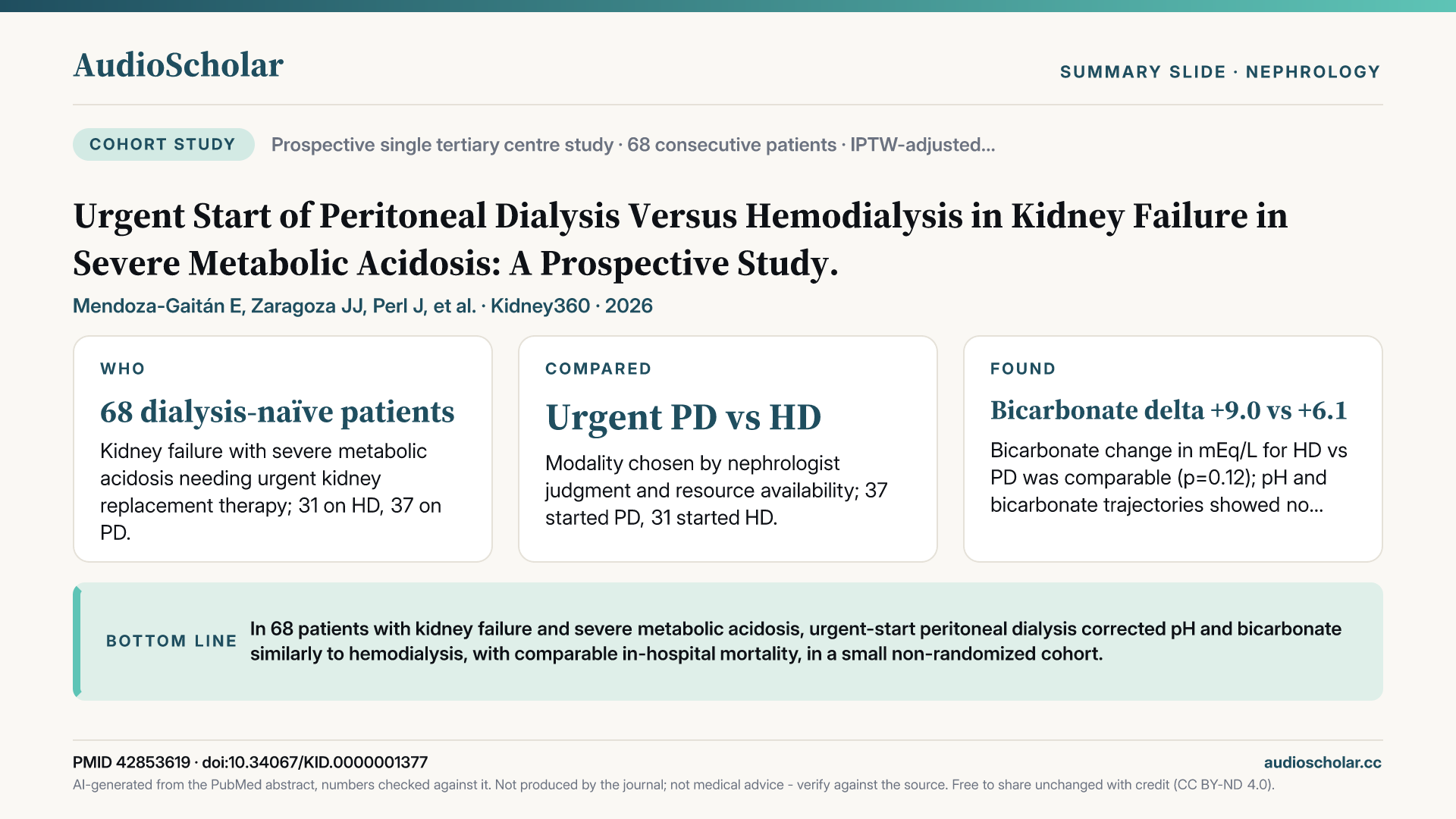
Urgent Start of Peritoneal Dialysis Versus Hemodialysis in Kidney Failure in Severe Metabolic Acidosis: A Prospective Study.
In 68 patients with severe metabolic acidosis, urgent-start PD and HD produced similar pH and bicarbonate trajectories, in-hospital mortality (39% vs 42%) and technique survival, supporting PD as a safe urgent option.
Kidney360 · 2026
From the briefingThe last cluster asks who gets onto peritoneal dialysis, how they start, and what keeps them there. The most practice-relevant paper here comes from Mendoza-Gaitán, with Perl among the co-authors, in Kidney360 [2]. They prospectively followed sixty-eight dialysis-naive patients with severe metabolic acidosis who needed urgent kidney replacement therapy at a Mexican tertiary centre. Thirty-one received haemodialysis and thirty-seven received urgent-start peritoneal dialysis. After weighting for baseline differences, pH and bicarbonate recovered along similar trajectories over the first forty-eight hours and through discharge. In-hospital mortality was similar too, at roughly two in five patients in each group. The caveats are real. The study was observational, with modality chosen by clinician judgment and resource availability. It was small, and it was not powered for mortality. Starting bicarbonate also looked lower in the haemodialysis group, so residual confounding is plausible. Even so, the findings challenge the reflex that severe acidosis automatically means haemodialysis.
Written by AI from the published abstract, for healthcare professionals. Not medical advice; check the paper before acting on it.
- 03
Temporal association of peritoneal dialysis-associated peritonitis rates and outcomes with COVID-19 pandemic onset in Australia: A registry analysis.
Across 11,499 prevalent Australian PD patients, peritonitis rates were lower after COVID-19 onset (0.30 vs 0.35 per patient-year), yet relapse and recurrence odds rose by roughly 40%, indicating persisting practice concerns.
Peritoneal Dialysis International · 2026
From the briefingInfection is where this period's data are richest and where they genuinely pull apart. In Peritoneal Dialysis International, Jain and colleagues used the Australia and New Zealand registry to follow about eleven and a half thousand prevalent Australian patients from 2015 through 2022 [3]. Overall peritonitis rates were lower after the pandemic began, falling from about 0.35 to 0.30 episodes per patient-year. The interrupted time series tells a more nuanced story. Rates had been declining steadily beforehand, and that decline bent upward after March 2020. The odds of relapsing and recurrent peritonitis each rose by roughly forty percent. Being a registry analysis, it cannot say why. Candidates include disrupted training, fewer home visits, and changes in which patients chose home therapy.
Written by AI from the published abstract, for healthcare professionals. Not medical advice; check the paper before acting on it.
- 04
Barriers to and Facilitators of the Adoption of Peritoneal Dialysis: A Systematic Review of Qualitative Studies.
Across 13 qualitative studies, fear of infection (77%), inadequate education (85%) and hemodialysis-centric systems (54%) were leading barriers to PD adoption, implying interventions must span individual, organizational and policy levels.
American Journal of Kidney Diseases · 2026
From the briefingWhy uptake stays near eleven percent globally is the question behind Shankar and colleagues' systematic review in the American Journal of Kidney Diseases [4]. They synthesized thirteen qualitative studies across nine countries. Barriers appeared at every level. Fear of infection featured in about three quarters of the studies, and the quality of patient education in nearly all of them. Provider influence, family dynamics, urgent starts and haemodialysis-centric health systems recurred as well. The primary studies were mostly cross-sectional and drawn from heterogeneous systems, so the review maps barriers rather than ranking them.
Written by AI from the published abstract, for healthcare professionals. Not medical advice; check the paper before acting on it.
- 05
Stenotrophomonas maltophilia peritoneal dialysis-related peritonitis: A 20-year single-centre retrospective review.
Among 28 S. maltophilia peritonitis episodes, only 21.4% achieved medical cure, 32.1% relapsed, 53.6% required catheter removal and 28.6% died, showing this uncommon pathogen carries substantial adverse outcomes.
Peritoneal Dialysis International · 2026
From the briefingAt the severe end, Pak and colleagues, also in Peritoneal Dialysis International, reviewed twenty years of Stenotrophomonas maltophilia peritonitis at a Hong Kong centre [5]. This is the largest series to date, at twenty-eight episodes. The organism caused under one percent of peritonitis, but the outcomes were grim. More than half of episodes ended in catheter removal, and more than a quarter ended in peritonitis-associated death. Most episodes followed a hospitalization or recent antibiotics. Initial isolates were almost uniformly susceptible to trimethoprim-sulfamethoxazole and minocycline, yet reduced susceptibility emerged later in about two in five episodes. The authors argue for early identification and adequately long courses of appropriate antibiotics. This is a retrospective single-centre series without a comparison group, so that argument rests on clinical reasoning rather than tested regimens.
Written by AI from the published abstract, for healthcare professionals. Not medical advice; check the paper before acting on it.
- 06
Efficacy and safety of roxadustat for the treatment of renal anemia in patients undergoing peritoneal dialysis: a systematic review and meta-analysis.
Across 19 PD studies (1,636 patients), roxadustat raised hemoglobin by 7.3 g/L more than ESA comparators, but certainty was low and evidence is insufficient to establish clinical superiority or long-term safety.
Renal failure · 2026
From the briefingThat erythropoietin signal leads naturally to anemia. Zhou and colleagues, in Renal Failure, pooled nineteen randomized studies of roxadustat versus erythropoiesis-stimulating agents, restricted to peritoneal dialysis and covering about sixteen hundred participants [6]. Hemoglobin ended up roughly seven grams per litre higher with roxadustat. Reported adverse events appeared to be about halved. The authors are unusually candid, though. They pooled final values rather than change from baseline. The comparator regimens varied widely. Adverse events were defined inconsistently. Certainty was graded low for hemoglobin and very low for most other outcomes. Their own conclusion is that the evidence cannot establish roxadustat as clinically superior in this population, and that long-term safety remains unknown.
Written by AI from the published abstract, for healthcare professionals. Not medical advice; check the paper before acting on it.
- 07
Improvement in peritoneal dialysis exit-site infection rates in an integrated health care system in the United States.
Across ten Kaiser hospitals, PD exit-site infection rates fell from 1.26 to 0.72 per 100 patient-months from 2014 to 2023, a 6.4% annual relative decline unexplained by program size.
Frontiers in nephrology · 2026
From the briefingSet that against Hukill and colleagues in Frontiers in Nephrology. Across ten Kaiser Permanente hospitals in Southern California, they tracked exit-site infections, a metric most registries do not capture [7]. Rates fell by about six percent per year between 2014 and 2023, roughly a forty-five percent decline over the decade. They found no obvious interruption, and program growth did not explain the trend. These two datasets are not strictly contradictory. They measure different infections in different systems. But one finds pandemic-era deterioration and the other finds uninterrupted improvement, and that gap matters. The California study also cannot identify what drove the improvement, which the authors acknowledge. Settling the question would take a single system reporting both exit-site and peritonitis outcomes, with protocol-level data on training and follow-up before and after 2020.
Written by AI from the published abstract, for healthcare professionals. Not medical advice; check the paper before acting on it.
- 08
Impact of incremental peritoneal dialysis on long-term nutritional trajectories in end-stage kidney disease: a longitudinal cohort study.
In 311 PD patients, incremental PD showed no difference in prognostic nutritional index trajectories versus full-dose PD, with 80% transitioning to full-dose at a median 10 months, supporting its nutritional safety.
Frontiers in nutrition · 2026
From the briefingHu and colleagues, in Frontiers in Nutrition, tackled incremental prescribing [8]. In 311 patients from a single Chinese centre, eighty-one started on incremental peritoneal dialysis. Their prognostic nutritional index followed trajectories indistinguishable from those of full-dose patients, even after weighting. Four in five incremental patients moved to full dose, at a median of about ten months. Low nutritional trajectories strongly predicted death regardless of starting strategy. The study is retrospective, and the authors frame the reassurance as conditional on active prescription adjustment.
Written by AI from the published abstract, for healthcare professionals. Not medical advice; check the paper before acting on it.
- 09
Long-term clinical outcomes of peritoneal dialysis patients: analysis of the Senegalese cohort from 2004 to 2020.
In 232 Senegalese PD patients, peritonitis occurred at 0.97 episodes per patient-year and five-year technique survival was 25.3%, with transfer to hemodialysis the leading discontinuation cause, underscoring infection and socioeconomic barriers.
Peritoneal Dialysis International · 2026
From the briefingKeita and colleagues in Peritoneal Dialysis International show those barriers playing out in practice [9]. They report sixteen years of the Senegalese program, covering 232 patients. Three quarters of these patients had no health insurance, and many came to peritoneal dialysis only because they could not afford private haemodialysis. Peritonitis ran close to one episode per patient-year, more than three times the Australian rate. Over a third of those episodes were culture-negative. Median patient survival was thirty-one months, and transfer to haemodialysis was the leading cause of technique failure. As a single-centre retrospective cohort, it describes rather than explains. The authors attribute the results largely to infection control, catheter placement and insurance coverage.
Written by AI from the published abstract, for healthcare professionals. Not medical advice; check the paper before acting on it.
- 10
SGLT2 inhibitors as a strategy for volume management in peritoneal dialysis: a case series.
In seven PD patients, SGLT2 inhibitors raised ultrafiltration in three of four with established PD, including anuric patients, though one died of fungal peritonitis, so prospective evaluation with infection surveillance is needed.
Frontiers in nephrology · 2026
From the briefingA very different volume strategy comes from Sosa Barrios and colleagues in Frontiers in Nephrology. They describe seven consecutive patients started on an SGLT2 inhibitor without any change to the dialysis prescription [10]. Ultrafiltration rose in most of these patients. The striking detail is that the largest gain came in a patient who was anuric throughout. That decouples the effect from the kidney and points to a direct action on the peritoneal membrane. Transport category did not change. The only non-responder was the only low-average transporter. Erythropoietin resistance fell in every treated patient, though the change was clinically meaningful in only a minority of them. One patient died of fungal peritonitis in the setting of documented non-adherence. The authors flag this as a reason for fungal surveillance in any prospective study. Seven patients cannot establish efficacy or safety. Still, the series and the tolvaptan trial point the same way: there may be pharmacologic room to manage volume without simply raising glucose exposure.
Written by AI from the published abstract, for healthcare professionals. Not medical advice; check the paper before acting on it.
The full briefing
This AudioScholar briefing is generated by artificial intelligence for healthcare professionals and trainees. It is not medical advice.
Welcome to your bi-weekly update in Peritoneal Dialysis. Three threads run through this period. The first is drugs layered on top of the dialysate to manage volume and anemia: a small randomized trial of low-dose tolvaptan, an intriguing SGLT2 inhibitor series, and a sobering look at roxadustat. The second is infection, where registry data from Australia and California tell somewhat different stories about the pandemic years. The third is getting patients onto peritoneal dialysis at all, including whether it can stand in for haemodialysis in severe acidosis.
Volume overload remains one of the most common reasons patients leave peritoneal dialysis, so any pharmacologic help that also spares residual function deserves attention. Li and colleagues, writing in the American Journal of Nephrology, randomized sixty overloaded patients at a single Chinese centre to tolvaptan 15 milligrams every other day on top of conventional therapy, or to conventional therapy alone, for six months [1]. Overhydration fell in both groups but fell further with tolvaptan. Urine output stayed higher throughout. Left ventricular mass index moved in opposite directions, falling with tolvaptan and rising in controls. The most interesting finding concerns residual glomerular filtration. It held steady while patients were on the drug, then dropped significantly within three months of stopping. In controls it declined from the start. Ejection fraction followed the same pattern, rising on treatment and slipping afterwards. Natriuretic peptide fell similarly in both arms. One patient developed hypernatremia, which resolved. This was an open-label trial, small, single-centre, and powered on surrogate markers. The washout data cut both ways: they suggest a genuine drug effect, but they also imply the benefit lasts only as long as treatment does. The evidence supports low-dose tolvaptan as a residual-function-preserving option under close sodium monitoring. It has not been tested against hard outcomes.
A very different volume strategy comes from Sosa Barrios and colleagues in Frontiers in Nephrology. They describe seven consecutive patients started on an SGLT2 inhibitor without any change to the dialysis prescription [10]. Ultrafiltration rose in most of these patients. The striking detail is that the largest gain came in a patient who was anuric throughout. That decouples the effect from the kidney and points to a direct action on the peritoneal membrane. Transport category did not change. The only non-responder was the only low-average transporter. Erythropoietin resistance fell in every treated patient, though the change was clinically meaningful in only a minority of them. One patient died of fungal peritonitis in the setting of documented non-adherence. The authors flag this as a reason for fungal surveillance in any prospective study. Seven patients cannot establish efficacy or safety. Still, the series and the tolvaptan trial point the same way: there may be pharmacologic room to manage volume without simply raising glucose exposure.
That erythropoietin signal leads naturally to anemia. Zhou and colleagues, in Renal Failure, pooled nineteen randomized studies of roxadustat versus erythropoiesis-stimulating agents, restricted to peritoneal dialysis and covering about sixteen hundred participants [6]. Hemoglobin ended up roughly seven grams per litre higher with roxadustat. Reported adverse events appeared to be about halved. The authors are unusually candid, though. They pooled final values rather than change from baseline. The comparator regimens varied widely. Adverse events were defined inconsistently. Certainty was graded low for hemoglobin and very low for most other outcomes. Their own conclusion is that the evidence cannot establish roxadustat as clinically superior in this population, and that long-term safety remains unknown.
Infection is where this period's data are richest and where they genuinely pull apart. In Peritoneal Dialysis International, Jain and colleagues used the Australia and New Zealand registry to follow about eleven and a half thousand prevalent Australian patients from 2015 through 2022 [3]. Overall peritonitis rates were lower after the pandemic began, falling from about 0.35 to 0.30 episodes per patient-year. The interrupted time series tells a more nuanced story. Rates had been declining steadily beforehand, and that decline bent upward after March 2020. The odds of relapsing and recurrent peritonitis each rose by roughly forty percent. Being a registry analysis, it cannot say why. Candidates include disrupted training, fewer home visits, and changes in which patients chose home therapy.
Set that against Hukill and colleagues in Frontiers in Nephrology. Across ten Kaiser Permanente hospitals in Southern California, they tracked exit-site infections, a metric most registries do not capture [7]. Rates fell by about six percent per year between 2014 and 2023, roughly a forty-five percent decline over the decade. They found no obvious interruption, and program growth did not explain the trend. These two datasets are not strictly contradictory. They measure different infections in different systems. But one finds pandemic-era deterioration and the other finds uninterrupted improvement, and that gap matters. The California study also cannot identify what drove the improvement, which the authors acknowledge. Settling the question would take a single system reporting both exit-site and peritonitis outcomes, with protocol-level data on training and follow-up before and after 2020.
At the severe end, Pak and colleagues, also in Peritoneal Dialysis International, reviewed twenty years of Stenotrophomonas maltophilia peritonitis at a Hong Kong centre [5]. This is the largest series to date, at twenty-eight episodes. The organism caused under one percent of peritonitis, but the outcomes were grim. More than half of episodes ended in catheter removal, and more than a quarter ended in peritonitis-associated death. Most episodes followed a hospitalization or recent antibiotics. Initial isolates were almost uniformly susceptible to trimethoprim-sulfamethoxazole and minocycline, yet reduced susceptibility emerged later in about two in five episodes. The authors argue for early identification and adequately long courses of appropriate antibiotics. This is a retrospective single-centre series without a comparison group, so that argument rests on clinical reasoning rather than tested regimens.
The last cluster asks who gets onto peritoneal dialysis, how they start, and what keeps them there. The most practice-relevant paper here comes from Mendoza-Gaitán, with Perl among the co-authors, in Kidney360 [2]. They prospectively followed sixty-eight dialysis-naive patients with severe metabolic acidosis who needed urgent kidney replacement therapy at a Mexican tertiary centre. Thirty-one received haemodialysis and thirty-seven received urgent-start peritoneal dialysis. After weighting for baseline differences, pH and bicarbonate recovered along similar trajectories over the first forty-eight hours and through discharge. In-hospital mortality was similar too, at roughly two in five patients in each group. The caveats are real. The study was observational, with modality chosen by clinician judgment and resource availability. It was small, and it was not powered for mortality. Starting bicarbonate also looked lower in the haemodialysis group, so residual confounding is plausible. Even so, the findings challenge the reflex that severe acidosis automatically means haemodialysis.
Hu and colleagues, in Frontiers in Nutrition, tackled incremental prescribing [8]. In 311 patients from a single Chinese centre, eighty-one started on incremental peritoneal dialysis. Their prognostic nutritional index followed trajectories indistinguishable from those of full-dose patients, even after weighting. Four in five incremental patients moved to full dose, at a median of about ten months. Low nutritional trajectories strongly predicted death regardless of starting strategy. The study is retrospective, and the authors frame the reassurance as conditional on active prescription adjustment.
Why uptake stays near eleven percent globally is the question behind Shankar and colleagues' systematic review in the American Journal of Kidney Diseases [4]. They synthesized thirteen qualitative studies across nine countries. Barriers appeared at every level. Fear of infection featured in about three quarters of the studies, and the quality of patient education in nearly all of them. Provider influence, family dynamics, urgent starts and haemodialysis-centric health systems recurred as well. The primary studies were mostly cross-sectional and drawn from heterogeneous systems, so the review maps barriers rather than ranking them.
Keita and colleagues in Peritoneal Dialysis International show those barriers playing out in practice [9]. They report sixteen years of the Senegalese program, covering 232 patients. Three quarters of these patients had no health insurance, and many came to peritoneal dialysis only because they could not afford private haemodialysis. Peritonitis ran close to one episode per patient-year, more than three times the Australian rate. Over a third of those episodes were culture-negative. Median patient survival was thirty-one months, and transfer to haemodialysis was the leading cause of technique failure. As a single-centre retrospective cohort, it describes rather than explains. The authors attribute the results largely to infection control, catheter placement and insurance coverage.
If you read only one paper from this period, make it the Kidney360 urgent-start study from Mendoza-Gaitán and colleagues. It reopens a question most units consider closed: whether severe metabolic acidosis is really a haemodialysis-only indication. That matters most wherever haemodialysis capacity is the bottleneck.
Here is what this period adds up to. First, there is now early randomized evidence that a drug can hold residual kidney function steady in overloaded peritoneal dialysis patients, but the effect appears to vanish when the drug stops, and the trial was small. Second, SGLT2 inhibitors may act directly on the peritoneal membrane. That idea rests on seven patients and carries a fungal infection question that prospective trials will need to answer. Third, the roxadustat literature in this population is larger than it is reliable, and comparative superiority over conventional agents remains unproven. Fourth, infection trends since 2020 diverge between datasets. Australian registry data show rising relapse and recurrence, while a large Californian system shows steadily falling exit-site infections, and nobody yet knows which practices explain the difference. Finally, the observational case is growing that peritoneal dialysis can handle urgent, metabolically severe starts. A randomized comparison would be needed before guidelines are likely to move.
That's your Peritoneal Dialysis update for this period. Until next time.
This is an automated summary generated by artificial intelligence, which can make mistakes. Always review the original source materials.
Spot something worth flagging?
Get this every week in your podcast app — free.
New research episodes land in your feed automatically — listen on your commute.