This Week in Anesthesiology — Oct 19, 2026
Generated Oct 20, 2026 · 10:49
The week's practice-changing Anesthesiology research, summarized for clinicians.
If the audio fails to play, refresh the page to renew the link.
Get next week’s Anesthesiology briefing — free.
In your podcast app, or readable in your inbox with the audio one tap away.
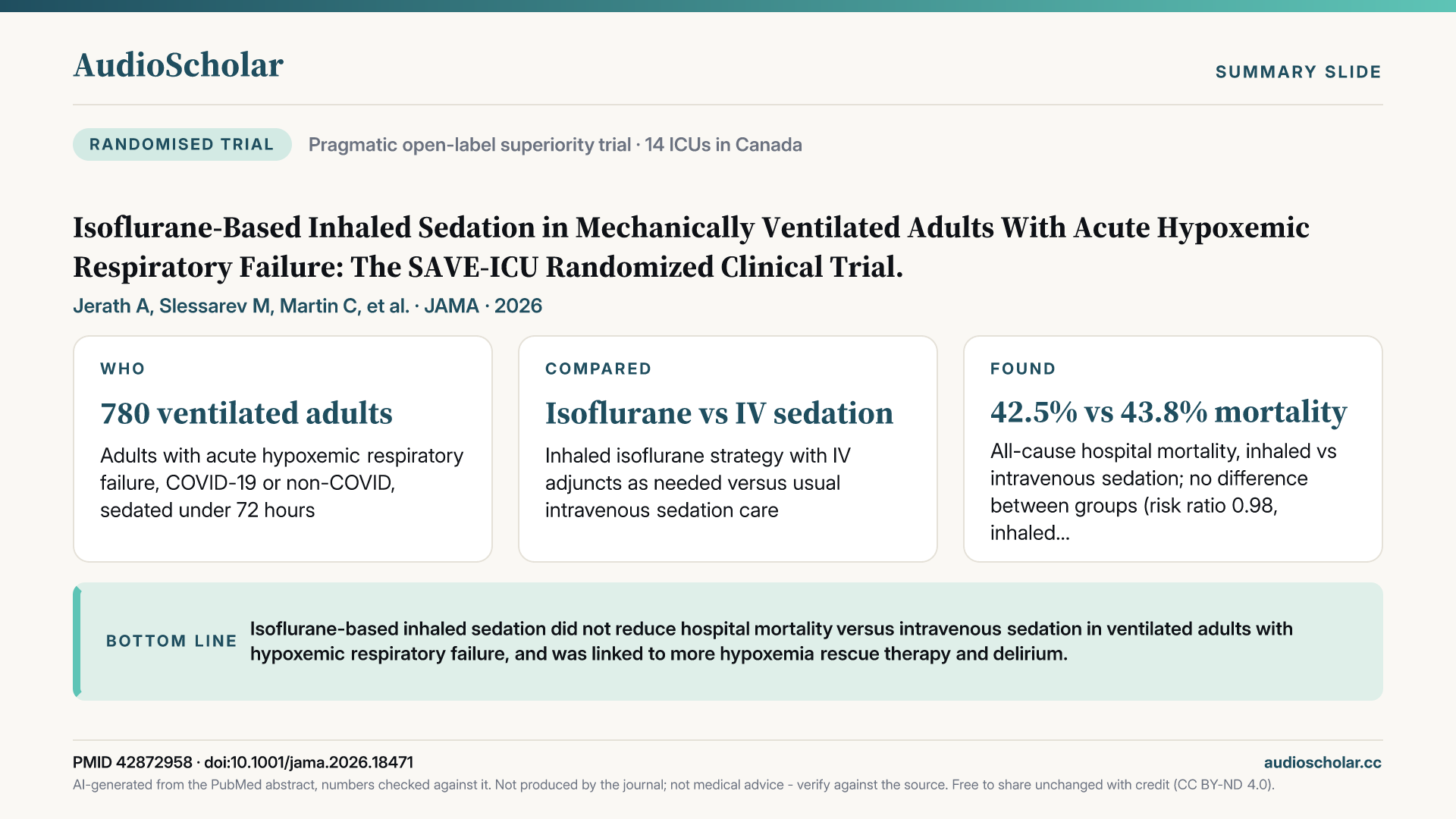
Isoflurane-Based Inhaled Sedation in Mechanically Ventilated Adults With Acute Hypoxemic Respiratory Failure: The SAVE-ICU Randomized Clinical Trial.
Isoflurane-based inhaled sedation did not reduce hospital mortality versus intravenous sedation in ventilated adults with hypoxemic respiratory failure, and was linked to more hypoxemia rescue therapy and delirium.
JAMA · 2026 · PubMed

This week’s papers
- 01
Isoflurane-Based Inhaled Sedation in Mechanically Ventilated Adults With Acute Hypoxemic Respiratory Failure: The SAVE-ICU Randomized Clinical Trial.
Isoflurane-based inhaled sedation did not reduce hospital mortality versus intravenous sedation in ventilated adults with hypoxemic respiratory failure, and was linked to more hypoxemia rescue therapy and delirium.
Jerath A et al. · JAMA · 2026
From the briefingThis week's two biggest trials tested appealing ideas at scale, and neither found a benefit on its primary outcome. In JAMA, Jerath and colleagues report the SAVE-ICU trial, a pragmatic, open-label study across 14 Canadian intensive care units that randomized 786 mechanically ventilated adults with acute hypoxemic respiratory failure, from COVID or other causes, to an isoflurane-based inhaled sedation strategy or usual intravenous sedation [1]. Hospital mortality was essentially identical, at roughly 42 percent with inhaled sedation versus 44 percent with intravenous sedation, a difference that was not statistically significant. Ventilator-free, intensive care-free, and hospital-free days were similar, and three-month quality of life and disability did not differ. Two secondary signals ran against isoflurane: patients in the inhaled arm needed rescue therapies for hypoxemia more often, by about nine percentage points, and had roughly one fewer day alive without delirium or coma. One nuance matters for interpretation: about half of the patients in the inhaled arm also received intravenous sedation on any given day in the first two weeks, so this was a test of a strategy rather than pure volatile sedation. Still, for this population the trial offers no support for inhaled sedation as a mortality-lowering approach.
If you only have time for one paper this week, make it the SAVE-ICU trial in JAMA [1]. It is the first large randomized test of volatile sedation in hypoxemic respiratory failure, and it largely settles the question of whether this strategy lowers mortality, while raising new questions about delirium and oxygenation.
Written by AI from the published abstract, for healthcare professionals. Not medical advice; check the paper before acting on it.
- 02
Operating Room Air Filtration-Sterilization and Surgical Infections: The ORACLE Randomized Trial in 110,538 Surgeries.
In a blinded cluster trial of over 110,000 surgeries, supplemental operating room air sterilization did not reduce wound infections, infection-related complications, or death and stopped for futility.
Sessler DI et al. · Anesthesiology · 2026
From the briefingIn Anesthesiology, Sessler and colleagues report the ORACLE trial, a cluster-randomized, fully blinded study across 68 operating rooms enrolling more than 110 thousand surgeries, comparing active supplemental air sterilization devices with identical-looking sham units [2]. The trial stopped for futility. The composite of wound infection, infection-related complications, or death within 30 days occurred in about eight percent of inpatients in both arms, and results across inpatients and outpatients were similarly flat. The device manufacturer funded the study, which makes the clearly null result all the more notable. The authors suggest infection-control efforts may be better directed at limiting direct wound contamination, and with this sample size the evidence against a meaningful benefit from supplemental air purification is firm.
Written by AI from the published abstract, for healthcare professionals. Not medical advice; check the paper before acting on it.
- 03
The effect of near-infrared spectroscopy guided intraoperative care on neurocognitive and functional outcomes after cardiac surgery: a systematic review and meta-analysis of randomised controlled trials.
Across 17 trials in cardiac surgery, cerebral oximetry guided care probably reduced early cognitive decline, but showed no clear effect on delirium, stroke, or mortality, largely from small trials.
Abdali T et al. · British Journal of Anaesthesia · 2026
From the briefingTurning to the brain, two meta-analyses examine whether intraoperative strategies can prevent postoperative cognitive problems, and both find promising but unsettled signals. In the British Journal of Anaesthesia, Abdali and colleagues pooled 17 randomized trials with nearly 2,300 adults having on-pump cardiac surgery and found that near-infrared spectroscopy guided care probably reduces early postoperative cognitive decline, by roughly a third, with moderate certainty [3]. However, the effects on delirium, stroke, and mortality were not significant and rated low certainty. The underlying trials were mostly small, single-centre, and used varied desaturation thresholds and response algorithms, and none measured validated quality of life or functional outcomes.
Written by AI from the published abstract, for healthcare professionals. Not medical advice; check the paper before acting on it.
- 04
Effects of Ketamine and Esketamine on Postoperative Delirium After General Anesthesia: A Meta-Analysis and Meta-Regression Analysis.
Pooled trials suggest perioperative ketamine and esketamine may reduce postoperative delirium, especially at higher doses, but evidence remains inconclusive and dizziness increased, precluding routine recommendation.
Li S et al. · Anesthesia and Analgesia · 2026
From the briefingIn Anesthesia and Analgesia, Li and colleagues pooled 25 randomized trials with over 3,300 patients and found that both ketamine and esketamine were associated with less postoperative delirium, with reductions of roughly a third and roughly two fifths respectively [4]. The signal was strongest with higher doses, such as single boluses of ketamine above 0.5 milligrams per kilogram or esketamine above 0.25 milligrams per kilogram, with bolus-plus-infusion regimens, and in major surgery, and it appeared only when delirium was assessed two to seven days after surgery, not within the first 24 hours. Yet trial sequential analysis judged the evidence inconclusive, dizziness rose by nearly half, and the authors explicitly state that routine use cannot yet be recommended. Read together, these two papers suggest that neuroprotective strategies show hints of benefit on softer cognitive endpoints, but neither has the large multicentre trial evidence needed to change practice.
Written by AI from the published abstract, for healthcare professionals. Not medical advice; check the paper before acting on it.
- 05
Impact of clinical frailty on mortality after elective surgery in patients aged ≥ 90 years admitted to critical care: a binational intensive care registry analysis.
Among patients aged 90 or older in intensive care after elective surgery, frailty was associated with about two-thirds higher in-hospital and one-year mortality and less return home.
Suh JM et al. · Anaesthesia · 2026
From the briefingThe next group of papers sharpens our picture of which surgical patients carry extra risk, and how one common bleeding intervention performs. In Anaesthesia, Suh and colleagues used the Australian and New Zealand intensive care registry to study patients aged 90 and older admitted to critical care after elective surgery, matching more than 5,000 patients with and without frailty [5]. Intensive care mortality was low and similar, but frailty was associated with about a two-thirds higher risk of death both in hospital and at one year, with longer stays, more delirium and acute kidney failure, and lower odds of returning home. This is retrospective, but it supports building frailty assessment into consent and planning conversations for the very old.
Written by AI from the published abstract, for healthcare professionals. Not medical advice; check the paper before acting on it.
- 06
Association of pre-operative opioid use disorder and postoperative outcomes: a systematic review and meta-analysis.
Preoperative opioid use disorder was associated with nearly triple the odds of postoperative pain and doubled odds of respiratory complications, though in-hospital mortality did not differ significantly.
Assefa DZ et al. · Anaesthesia · 2026
From the briefingAlso in Anaesthesia, Assefa and colleagues pooled 40 observational studies and found that patients with preoperative opioid use disorder had nearly three times the odds of postoperative pain and roughly double the odds of adverse respiratory events, both with moderate certainty, though the pain estimate rests on only three studies [6]. Readmissions, length of stay, and costs were higher on low-certainty evidence, while in-hospital mortality did not differ. The authors argue for routine screening and multidisciplinary perioperative care, a conclusion drawn from associations rather than intervention trials.
Written by AI from the published abstract, for healthcare professionals. Not medical advice; check the paper before acting on it.
- 07
The role of fibrinogen concentrate in the reduction of allogeneic blood product requirements: a systematic review and meta-analysis.
Fibrinogen concentrate for acquired hypofibrinogenaemia was associated with fewer red cell, plasma, and platelet transfusions in adults, mainly in cardiac surgery, without differences in mortality or thrombosis.
Rahe-Meyer N et al. · British Journal of Anaesthesia · 2026
From the briefingIn the British Journal of Anaesthesia, Rahe-Meyer and colleagues pooled 58 studies with over 13 thousand patients and found that adults given fibrinogen concentrate for acquired hypofibrinogenemia received roughly a quarter fewer red cell units, about a third less plasma, and over 40 percent fewer platelet units than with other treatments, without differences in mortality or thrombosis [7]. The effect was largely driven by cardiac surgery, the analysis mixed observational and randomized data, and pediatric outcomes showed no significant differences.
Written by AI from the published abstract, for healthcare professionals. Not medical advice; check the paper before acting on it.
- 08
Infiltration between the popliteal artery and the capsule of the knee (IPACK) vs. selective tibial nerve block for analgesia after total knee arthroplasty: a triple-blinded randomised controlled trial.
IPACK was not superior to selective tibial nerve block after knee arthroplasty, with similar morphine use and pain, though tibial block caused peroneal motor block in nine percent.
Szyszko M et al. · Anaesthesia · 2026
From the briefingOur final theme covers regional analgesia and interventional pain. In Anaesthesia, Szyszko and colleagues ran a triple-blinded trial in 90 patients having total knee arthroplasty under spinal anesthesia with a femoral triangle block, comparing infiltration between the popliteal artery and the capsule of the knee, known as IPACK, with a selective tibial nerve block [8]. IPACK was not superior: first-day morphine use was about five to six milligrams in both groups, and pain and functional outcomes were similar. Four patients in the tibial nerve group, about nine percent, had common peroneal motor block, a trade-off worth noting given that foot drop can complicate early mobilization assessments.
Written by AI from the published abstract, for healthcare professionals. Not medical advice; check the paper before acting on it.
- 09
The association between pain intensity during epidural labour analgesia and intrapartum hyperthermia: a multicentre prospective observational study.
In nulliparous women with labour epidurals, lower pain scores were associated with higher odds of intrapartum fever, consistent with extensive sympathetic blockade impairing heat loss, though causality is unproven.
Jin KX et al. · British Journal of Anaesthesia · 2026
From the briefingIn the British Journal of Anaesthesia, Jin and colleagues prospectively followed 952 nulliparous women receiving labor epidurals and found that about one in eight developed intrapartum fever [9]. Lower pain scores were consistently associated with higher odds of hyperthermia, and a time-weighted average pain score of three or below was linked to markedly higher odds. The authors interpret this as support for extensive sympathetic blockade impairing heat loss, but as an observational study it cannot establish that mechanism.
Written by AI from the published abstract, for healthcare professionals. Not medical advice; check the paper before acting on it.
- 10
Canadian evidence-based guidelines on spinal procedures for chronic pain.
Canadian multidisciplinary guidelines provide 15 graded recommendations on indications, repeat frequency, image guidance, and complications for cervical, lumbar, and sacroiliac interventional procedures for chronic spinal pain.
Bhatia A et al. · Anaesthesia · 2026
From the briefingFinally, in Anaesthesia, Bhatia and colleagues present Canadian evidence-based guidelines on spinal procedures for chronic pain, developed with clinicians, patient partners, and regulators, offering 15 key recommendations graded with United States Preventive Services Task Force criteria [10]. They cover indications, repeat frequency, image guidance, and complications for cervical, lumbar, and sacroiliac procedures, providing a structured reference in a field where practice has varied widely.
Written by AI from the published abstract, for healthcare professionals. Not medical advice; check the paper before acting on it.
The full briefing
This AudioScholar briefing is generated by artificial intelligence for healthcare professionals and trainees. It is not medical advice.
Welcome to This Week in Anesthesiology. This week we're covering 10 notable papers spanning two large pragmatic trials with neutral results, protecting the brain and identifying vulnerable surgical patients, and regional analgesia and interventional pain. Let's dive in.
This week's two biggest trials tested appealing ideas at scale, and neither found a benefit on its primary outcome. In JAMA, Jerath and colleagues report the SAVE-ICU trial, a pragmatic, open-label study across 14 Canadian intensive care units that randomized 786 mechanically ventilated adults with acute hypoxemic respiratory failure, from COVID or other causes, to an isoflurane-based inhaled sedation strategy or usual intravenous sedation [1]. Hospital mortality was essentially identical, at roughly 42 percent with inhaled sedation versus 44 percent with intravenous sedation, a difference that was not statistically significant. Ventilator-free, intensive care-free, and hospital-free days were similar, and three-month quality of life and disability did not differ. Two secondary signals ran against isoflurane: patients in the inhaled arm needed rescue therapies for hypoxemia more often, by about nine percentage points, and had roughly one fewer day alive without delirium or coma. One nuance matters for interpretation: about half of the patients in the inhaled arm also received intravenous sedation on any given day in the first two weeks, so this was a test of a strategy rather than pure volatile sedation. Still, for this population the trial offers no support for inhaled sedation as a mortality-lowering approach. In Anesthesiology, Sessler and colleagues report the ORACLE trial, a cluster-randomized, fully blinded study across 68 operating rooms enrolling more than 110 thousand surgeries, comparing active supplemental air sterilization devices with identical-looking sham units [2]. The trial stopped for futility. The composite of wound infection, infection-related complications, or death within 30 days occurred in about eight percent of inpatients in both arms, and results across inpatients and outpatients were similarly flat. The device manufacturer funded the study, which makes the clearly null result all the more notable. The authors suggest infection-control efforts may be better directed at limiting direct wound contamination, and with this sample size the evidence against a meaningful benefit from supplemental air purification is firm.
Turning to the brain, two meta-analyses examine whether intraoperative strategies can prevent postoperative cognitive problems, and both find promising but unsettled signals. In the British Journal of Anaesthesia, Abdali and colleagues pooled 17 randomized trials with nearly 2,300 adults having on-pump cardiac surgery and found that near-infrared spectroscopy guided care probably reduces early postoperative cognitive decline, by roughly a third, with moderate certainty [3]. However, the effects on delirium, stroke, and mortality were not significant and rated low certainty. The underlying trials were mostly small, single-centre, and used varied desaturation thresholds and response algorithms, and none measured validated quality of life or functional outcomes. In Anesthesia and Analgesia, Li and colleagues pooled 25 randomized trials with over 3,300 patients and found that both ketamine and esketamine were associated with less postoperative delirium, with reductions of roughly a third and roughly two fifths respectively [4]. The signal was strongest with higher doses, such as single boluses of ketamine above 0.5 milligrams per kilogram or esketamine above 0.25 milligrams per kilogram, with bolus-plus-infusion regimens, and in major surgery, and it appeared only when delirium was assessed two to seven days after surgery, not within the first 24 hours. Yet trial sequential analysis judged the evidence inconclusive, dizziness rose by nearly half, and the authors explicitly state that routine use cannot yet be recommended. Read together, these two papers suggest that neuroprotective strategies show hints of benefit on softer cognitive endpoints, but neither has the large multicentre trial evidence needed to change practice.
The next group of papers sharpens our picture of which surgical patients carry extra risk, and how one common bleeding intervention performs. In Anaesthesia, Suh and colleagues used the Australian and New Zealand intensive care registry to study patients aged 90 and older admitted to critical care after elective surgery, matching more than 5,000 patients with and without frailty [5]. Intensive care mortality was low and similar, but frailty was associated with about a two-thirds higher risk of death both in hospital and at one year, with longer stays, more delirium and acute kidney failure, and lower odds of returning home. This is retrospective, but it supports building frailty assessment into consent and planning conversations for the very old. Also in Anaesthesia, Assefa and colleagues pooled 40 observational studies and found that patients with preoperative opioid use disorder had nearly three times the odds of postoperative pain and roughly double the odds of adverse respiratory events, both with moderate certainty, though the pain estimate rests on only three studies [6]. Readmissions, length of stay, and costs were higher on low-certainty evidence, while in-hospital mortality did not differ. The authors argue for routine screening and multidisciplinary perioperative care, a conclusion drawn from associations rather than intervention trials. In the British Journal of Anaesthesia, Rahe-Meyer and colleagues pooled 58 studies with over 13 thousand patients and found that adults given fibrinogen concentrate for acquired hypofibrinogenemia received roughly a quarter fewer red cell units, about a third less plasma, and over 40 percent fewer platelet units than with other treatments, without differences in mortality or thrombosis [7]. The effect was largely driven by cardiac surgery, the analysis mixed observational and randomized data, and pediatric outcomes showed no significant differences.
Our final theme covers regional analgesia and interventional pain. In Anaesthesia, Szyszko and colleagues ran a triple-blinded trial in 90 patients having total knee arthroplasty under spinal anesthesia with a femoral triangle block, comparing infiltration between the popliteal artery and the capsule of the knee, known as IPACK, with a selective tibial nerve block [8]. IPACK was not superior: first-day morphine use was about five to six milligrams in both groups, and pain and functional outcomes were similar. Four patients in the tibial nerve group, about nine percent, had common peroneal motor block, a trade-off worth noting given that foot drop can complicate early mobilization assessments. In the British Journal of Anaesthesia, Jin and colleagues prospectively followed 952 nulliparous women receiving labor epidurals and found that about one in eight developed intrapartum fever [9]. Lower pain scores were consistently associated with higher odds of hyperthermia, and a time-weighted average pain score of three or below was linked to markedly higher odds. The authors interpret this as support for extensive sympathetic blockade impairing heat loss, but as an observational study it cannot establish that mechanism. Finally, in Anaesthesia, Bhatia and colleagues present Canadian evidence-based guidelines on spinal procedures for chronic pain, developed with clinicians, patient partners, and regulators, offering 15 key recommendations graded with United States Preventive Services Task Force criteria [10]. They cover indications, repeat frequency, image guidance, and complications for cervical, lumbar, and sacroiliac procedures, providing a structured reference in a field where practice has varied widely.
If you only have time for one paper this week, make it the SAVE-ICU trial in JAMA [1]. It is the first large randomized test of volatile sedation in hypoxemic respiratory failure, and it largely settles the question of whether this strategy lowers mortality, while raising new questions about delirium and oxygenation.
Here is what this week's evidence adds up to in Anesthesiology. First, isoflurane-based inhaled sedation did not lower mortality in ventilated patients with hypoxemic respiratory failure and carried some secondary disadvantages, based on a single large pragmatic trial. Second, supplemental operating room air purification did not reduce surgical infections in a trial of over 100 thousand cases, which is about as firm as a null result gets. Third, near-infrared spectroscopy guided care and perioperative ketamine or esketamine show signals for cognitive protection, but both evidence bases are built on small trials and remain inconclusive. Fourth, frailty in nonagenarians and opioid use disorder are each associated with substantially worse postoperative outcomes, though these are observational associations. Fifth, fibrinogen concentrate appears to reduce transfusion in adults, mainly in cardiac surgery, without evident safety signals, while IPACK and selective tibial nerve block performed similarly after knee replacement in one modest trial.
That's your roundup for This Week in Anesthesiology. The full transcript and references are available on the episode page. This is an AI-curated summary — for clinical decisions, always consult primary sources and current guidelines. See you next week.
If this weekly briefing is useful, follow the show in your podcast app so new episodes arrive automatically. And think of one colleague — in any specialty — who never has time to keep up with the literature. Tell them about AudioScholar: a free ten-minute weekly for every specialty, to listen to in any podcast app, or to read at audioscholar dot C C.
This is an automated summary generated by artificial intelligence, which can make mistakes. Always review the original source materials.
Spot something worth flagging?
Get this every week in your podcast app — free.
New anesthesiology episodes land in your feed automatically — listen on your commute.