This Week in Nephrology — Jul 31, 2026
Generated Jul 31, 2026 · 10:39
The week's practice-changing Nephrology research, summarized for clinicians.
If the audio fails to play, refresh the page to renew the link.
Get next week’s Nephrology briefing — free.
In your podcast app, or readable in your inbox with the audio one tap away.
Dapagliflozin and Acute Kidney Injury Following Cardiac Surgery: A Randomized Clinical Trial
JAMA · 2026 · PubMed

This week’s papers
- 01
Dapagliflozin and Acute Kidney Injury Following Cardiac Surgery: A Randomized Clinical Trial
Oosterom-Eijmael MJP et al. · JAMA · 2026
- 02
T-Cell Engager-Mediated HLA Antibody Depletion before Kidney Transplantation
Schatzl M et al. · The New England Journal of Medicine · 2026
- 03
Validation of the Predicting Risk of Cardiovascular Disease EVENTs (PREVENT) Equations in a CKD Population: A Nationwide Veterans Analysis
Murthy N et al. · Clinical Journal of the American Society of Nephrology · 2026
- 05
ISN International Expert Forum: Exploring the Nexus of Cardiovascular-Kidney-Metabolic (CKM) Health
Pecoits-Filho R et al. · Kidney International · 2026
- 06
Evidence-Based Cardiovascular-Kidney-Metabolic Therapies in Kidney Transplant Recipients
Shroff GR et al. · Clinical Journal of the American Society of Nephrology · 2026
- 07
Perceptions and Patterns Associated with Incremental Peritoneal Dialysis Use: Surveying Physicians and Nurses across Australia, Canada and Thailand
Burnett CT et al. · Clinical Journal of the American Society of Nephrology · 2026
- 08
Clinicopathological and Molecular Characteristics of Plasma Cell-Rich Rejection in Renal Transplant Biopsies
du Long R et al. · Transplantation · 2026
- 09
Renal Cyst Sclerotherapy in Autosomal Dominant Polycystic Kidney Disease: Long-Term Follow-Up and Evaluation in a Porcine Bladder Model
Copping RRW et al. · Kidney360 · 2026
- 10
Bone Mineral Density Loss After Kidney Transplantation: Metabolic Determinants, Diagnostic Approaches, and Preventive Strategies
Untersulzner C et al. · Kidney International Reports · 2026
The full briefing
Welcome to This Week in Nephrology. This week we are covering ten notable papers spanning the management of cardiovascular-kidney-metabolic syndrome, evolving strategies and long-term outcomes in kidney transplantation, and innovative approaches to peritoneal dialysis and polycystic kidney disease. Let us dive in.
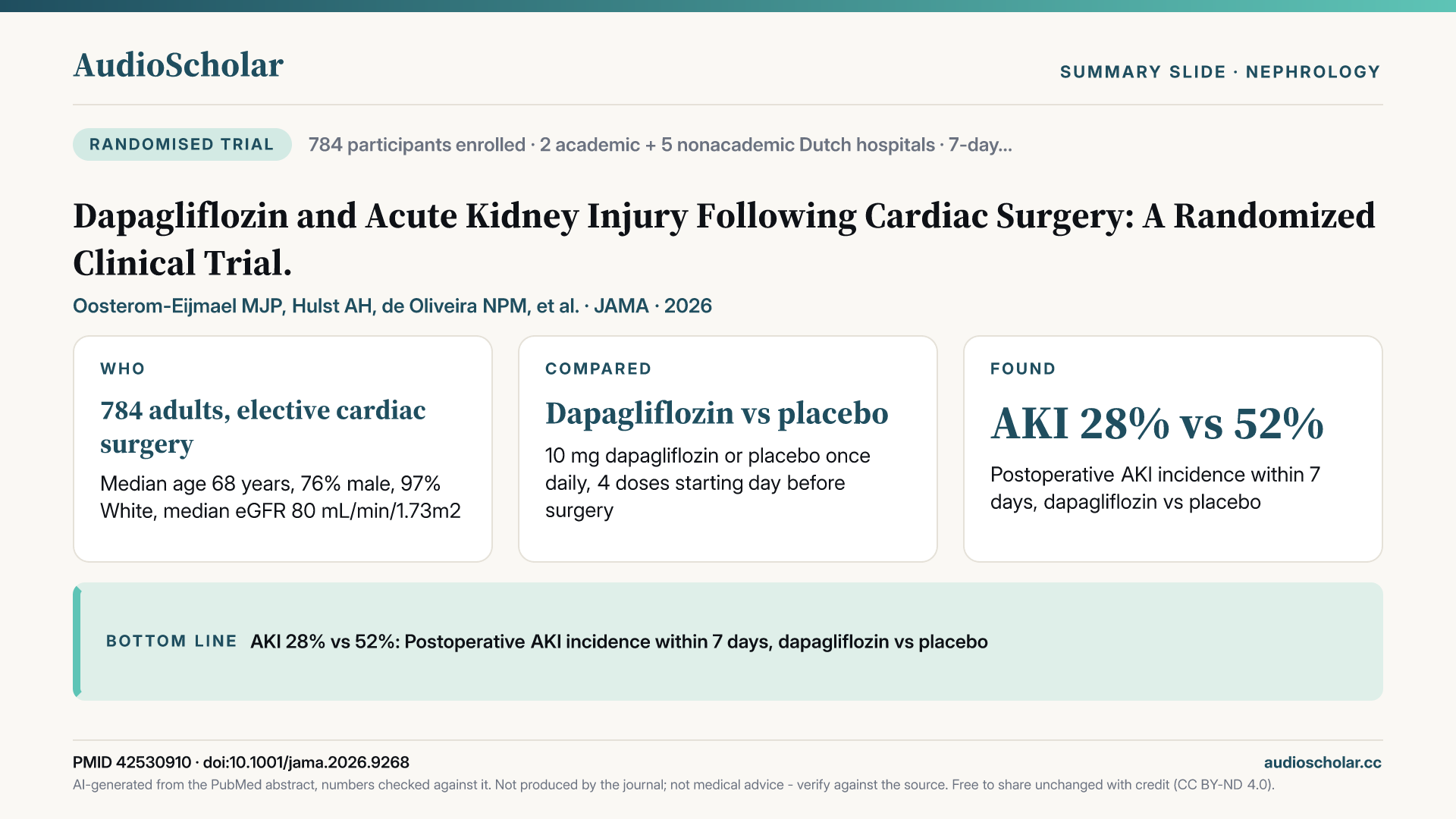
We begin with the expanding clinical footprint of cardiovascular-kidney-metabolic health, starting with a major trial published in JAMA that addresses postoperative acute kidney injury, a complication affecting up to half of all patients undergoing elective cardiac surgery. In a multicenter, double-blind, randomized controlled trial, researchers evaluated whether a short course of the sodium-glucose cotransporter two inhibitor dapagliflozin could prevent this common complication [1]. The study randomized seven hundred eighty-four adults undergoing elective cardiac surgery in the Netherlands to receive either ten milligrams of oral dapagliflozin or a placebo once daily for a total of four doses, beginning the day before surgery and continuing through the second postoperative day. Remarkably, dapagliflozin nearly halved the risk of developing acute kidney injury within seven days of surgery, with an incidence of twenty-eight percent in the treatment group compared to fifty-two percent in the placebo group. Crucially, there was no increase in adverse events like atrial fibrillation or the need for reoperation. This simple, short perioperative intervention could represent a practice-changing strategy for preventing postoperative acute kidney injury, though further studies are needed to confirm these findings in broader surgical populations. This focus on integrated cardiorenal protection is mirrored in a consensus report from the International Society of Nephrology published in Kidney International, which synthesizes the proceedings of an expert forum on cardiovascular-kidney-metabolic health [5]. The forum emphasized the urgent need to break down clinical silos and implement early, integrated case-finding and joint risk assessments to combat therapeutic inertia and global inequities. However, risk assessment itself requires validated tools in patients with chronic kidney disease, a need addressed by a nationwide United States Veterans study published in the Clinical Journal of the American Society of Nephrology [3]. The investigators validated the American Heart Association PREVENT equations in a large cohort of patients with chronic kidney disease across different levels of kidney function. They found that while the PREVENT equations demonstrated superior calibration compared to the older Pooled Cohort Equations, their ability to discriminate risk declined as kidney disease advanced. Interestingly, incorporating urine albumin-to-creatinine ratio add-on equations modestly improved risk discrimination, particularly in those with less advanced kidney disease, highlighting the importance of early intervention. Finally, a review in the Clinical Journal of the American Society of Nephrology brings this cardiorenal metabolic framework into the transplant setting, proposing four pharmacological pillars for improving combined heart-kidney outcomes in kidney transplant recipients: renin-angiotensin-aldosterone system inhibitors, statins, sodium-glucose cotransporter two inhibitors, and glucagon-like peptide-one receptor agonists [6]. The authors emphasize that while evidence is strong for these classes in the general population, we still face a critical shortage of randomized trials assessing their impact on joint heart and kidney outcomes specifically in transplant recipients, where drug-drug interactions with immunosuppressants must be carefully navigated.
Our second theme centers on the clinical realities of kidney transplantation, where long-term graft survival, antibody management, and chronic complications remain paramount. A landmark registry analysis over three decades, published in the Journal of the American Society of Nephrology, reveals a sobering trend in human leukocyte antigen matching in the United States [4]. Analyzing data from 1991 to 2023, the researchers found that the proportion of well-matched kidney transplants has declined substantially. In 2023, only five percent of transplants had zero human leukocyte antigen ABDR mismatches, compared to eleven percent in 1991. While this decline in deceased donor transplants was driven by allocation policy changes designed to improve equity, the decline in living donor transplants paralleled a decrease in biologically related donors. Alarmingly, children and racial minorities currently experience the lowest levels of matching. Although the association between matching and graft survival has weakened in the modern era of immunosuppression, poor matching remains strongly associated with higher panel reactive antibody levels at repeat waitlisting, which complicates retransplantation. When high antibody levels do occur, finding novel ways to deplete human leukocyte antigen antibodies is critical. A study published in The New England Journal of Medicine explores a novel approach using T-cell engager-mediated human leukocyte antigen antibody depletion before kidney transplantation, offering a potential breakthrough in desensitizing highly sensitized candidates [2]. Once transplantation is achieved, managing rejection is the next hurdle. A study in Transplantation characterizes plasma cell-rich rejection, an ill-defined subtype of T-cell mediated rejection [8]. By analyzing clinical outcomes and bulk RNA sequencing from kidney transplant biopsies, the authors found that plasma cell-rich rejection is characterized by high chronic tissue injury and pathway activation related to endothelial injury, fibrosis, and mast-cell activation. Molecularly, it does not form a distinct transcriptional cluster but instead shares the greatest similarity with chronic-active T-cell mediated rejection, suggesting it sits along the continuum of late allograft rejection rather than being a unique entity. Finally, a review in Kidney International Reports reminds us of the systemic metabolic complications that follow transplantation, focusing on the rapid loss of bone mineral density in the first post-transplant year [10]. The authors highlight the limitations of dual-energy X-ray absorptiometry alone in predicting fractures and advocate for advanced imaging like high-resolution peripheral quantitative computed tomography and bone-turnover markers to guide individualized bone preservation strategies.
Our final theme looks at innovative strategies to improve patient-centered care and outcomes in peritoneal dialysis and autosomal dominant polycystic kidney disease. In the Clinical Journal of the American Society of Nephrology, a multi-national survey across Australia, Canada, and Thailand investigated the clinical use of incremental peritoneal dialysis, which involves prescribing a less-than-standard starting dose [7]. While clinicians recognized major benefits, including improved patient satisfaction and preservation of residual kidney function, incremental peritoneal dialysis is prescribed in fewer than ten percent of patients in most units. The study highlighted a significant barrier: sixty-two percent of clinicians reported concern about patient or caregiver resistance when it eventually comes time to escalate the dialysis dose, and there remains a lack of international consensus on how to define and monitor these patients. For patients with autosomal dominant polycystic kidney disease, managing large kidney cysts is a frequent clinical challenge. A study in Kidney360 evaluated the long-term efficacy of sodium tetradecyl sulfate sclerotherapy in over three hundred patients [9]. Over a mean follow-up of nearly four years, ninety-nine percent of treated cysts showed an initial volume reduction, with a sustained mean reduction of eighty-eight percent. Furthermore, the therapy was associated with a reduction in overall kidney volume and a slower decline in kidney function. To understand the mechanism, the researchers used a porcine bladder model, which revealed that sodium tetradecyl sulfate causes near-complete denudation of the epithelial lining and superficial inflammation without causing deep tissue injury, explaining its safety and long-term efficacy.
If you only have time for one paper this week, make it the randomized controlled trial of dapagliflozin to prevent acute kidney injury after cardiac surgery, published in JAMA [1]. This study provides high-quality clinical evidence for a simple, low-cost, four-dose perioperative intervention that nearly halved the incidence of postoperative acute kidney injury, addressing a major unmet clinical need in surgical nephrology with immediate implications for practice.
Here are the key takeaways from this week in Nephrology. First, a short, four-dose course of dapagliflozin initiated the day before elective cardiac surgery significantly reduces the risk of postoperative acute kidney injury and should be considered in perioperative planning. Second, human leukocyte antigen matching in the United States has declined over three decades, particularly affecting children and racial minorities, highlighting a trade-off between allocation equity and long-term immunological matching. Third, the American Heart Association PREVENT equations provide better calibration for cardiovascular risk in chronic kidney disease than older equations, but their performance declines in advanced kidney disease, and incorporating albuminuria improves their accuracy. Fourth, incremental peritoneal dialysis is highly valued by clinicians for preserving residual kidney function and improving quality of life, but concerns over patient resistance to future dose escalation remain a major barrier to its widespread adoption. Finally, sodium tetradecyl sulfate sclerotherapy offers a safe, highly effective, and durable method for reducing cyst volume and managing mass-effect symptoms in patients with autosomal dominant polycystic kidney disease.
That is your roundup for This Week in Nephrology. The full transcript and references are available on the episode page in your AudioScholar library. This is an AI-curated summary — for clinical decisions, always consult primary sources and current guidelines. See you next week.
If this weekly briefing is useful, follow the show in your podcast app so new episodes arrive automatically. And if you have a paper you have been meaning to read, upload the PDF, or paste any link, at audioscholar dot C C. We will turn it into audio like this one, in any of thirty-one languages.
This is an automated summary generated by artificial intelligence, which can make mistakes. Always review the original source materials.
Spot something worth flagging?
Get this every week in your podcast app — free.
New nephrology episodes land in your feed automatically — listen on your commute.