This Week in Gastroenterology — Oct 13, 2026
Generated Oct 14, 2026 · 11:28
The week's practice-changing Gastroenterology research, summarized for clinicians.
If the audio fails to play, refresh the page to renew the link.
Get next week’s Gastroenterology briefing — free.
In your podcast app, or readable in your inbox with the audio one tap away.
Duodenal involvement in MUTYH-associated polyposis: findings from an international study and implications for endoscopic surveillance.
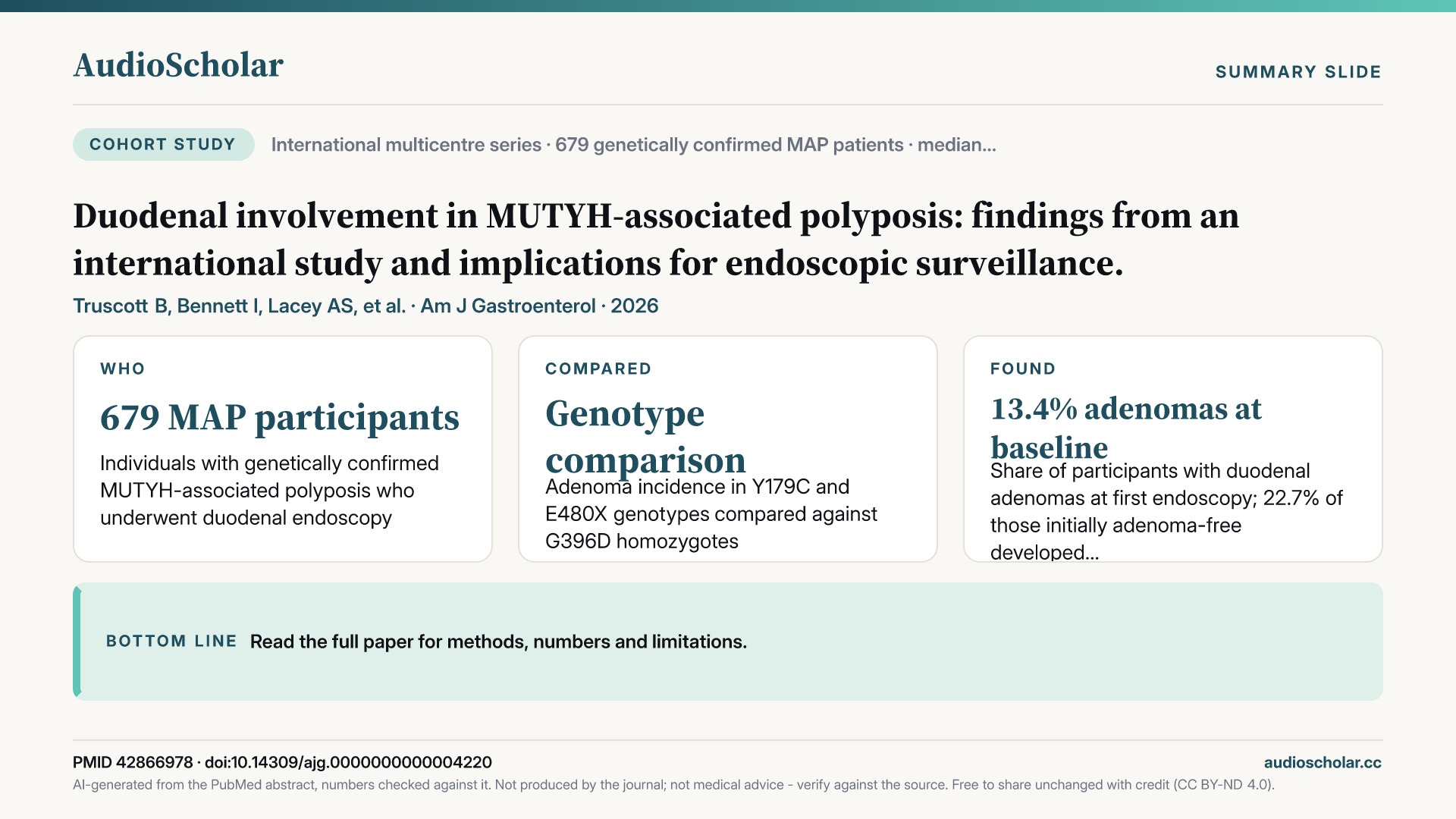
In 679 MUTYH-associated polyposis patients, duodenal adenoma risk varied strongly by genotype and the few cancers arose mostly in the distal duodenum within a year of surveillance endoscopy.
American Journal of Gastroenterology · 2026 · PubMed

This week’s papers
- 01
Dupilumab Improves Esophageal Distensibility in EoE: 24-Week Results From the REMODEL Randomized Trial.
In 69 adults with eosinophilic esophagitis, dupilumab widened esophageal distensibility by about 1.3 mm over placebo at 24 weeks, with larger gains in narrow esophagi.
Dellon ES et al. · American Journal of Gastroenterology · 2026
- 02
Diffuse esophageal eosinophilia is associated with increased endoscopic severity and topical steroid non-response in patients with eosinophilic esophagitis.
Among 888 eosinophilic esophagitis patients, diffuse proximal and distal eosinophilia was linked to more severe endoscopic disease and poorer histologic and endoscopic response to topical corticosteroids.
Aleman S et al. · Clinical Gastroenterology and Hepatology · 2026
- 03
Modern Approach to Reflux Testing: When, Which, and How?
A review framing wireless pH versus pH-impedance monitoring by symptom phenotype and therapy status, favouring pH-impedance for regurgitation, belching, and refractory proven reflux on acid suppression.
Chan WW et al. · American Journal of Gastroenterology · 2026
- 04
Differential long-term efficacy of biologic and small-molecule therapies by disease location in moderate-to-severe luminal Crohn's disease: a systematic review and network meta-analysis.
Across 18 Crohn's trials, isolated ileal disease had the lowest one-year remission, only guselkumab beat placebo there, and upadacitinib performed markedly better in colonic than ileal disease.
Dalsgarð SP et al. · Inflammatory Bowel Diseases · 2026
- 05
Clinical management of relapse in type 1 autoimmune pancreatitis: a systematic review and meta-analysis.
Pooling 37 studies of type 1 autoimmune pancreatitis, maintenance therapy was associated with about 40 percent fewer relapses, while rituximab's apparent advantage for relapse rests on low-certainty evidence.
Liu Z et al. · American Journal of Gastroenterology · 2026
- 06
Duodenal involvement in MUTYH-associated polyposis: findings from an international study and implications for endoscopic surveillance.
In 679 MUTYH-associated polyposis patients, duodenal adenoma risk varied strongly by genotype and the few cancers arose mostly in the distal duodenum within a year of surveillance endoscopy.
Truscott B et al. · American Journal of Gastroenterology · 2026
- 07
Population-Based Cohort Study: Colorectal Cancer Risk Stratification in Symptomatic Patients Using the Faecal Immunochemical Test, Blood Results and Patient Characteristics in Wales.
In nearly 167,000 symptomatic Welsh patients, a faecal immunochemical test of at least 10 µgHb/g signalled over 3 percent one-year colorectal cancer risk at all ages, higher than English and Scottish cohorts.
Malcolm FL et al. · Alimentary Pharmacology and Therapeutics · 2026
- 08
AASLD EXPO: Liver biopsy.
An AASLD expert opinion affirms liver biopsy's ongoing diagnostic and staging role, describing percutaneous, transjugular, and endoscopic ultrasound approaches as similarly safe and adequate in expert hands.
Verna EC et al. · Hepatology · 2026
- 09
Alcohol-associated liver disease.
A review emphasising noninvasive staging, alcohol use disorder treatment as core management, steroids for severe alcohol-associated hepatitis, and transplantation for advanced disease unresponsive to abstinence.
Lee BP et al. · Clinical Gastroenterology and Hepatology · 2026
- 10
Role of remimazolam in gastrointestinal endoscopy: American Society for Gastrointestinal Endoscopy clinical practice update.
An ASGE practice update positions remimazolam, an ultra-short-acting benzodiazepine with organ-independent metabolism, as an alternative to midazolam and propofol for endoscopic sedation, especially in higher-risk patients.
Ramai D et al. · Gastrointestinal Endoscopy · 2026
The full briefing
This AudioScholar briefing is generated by artificial intelligence for healthcare professionals and trainees. It is not medical advice.
Welcome to This Week in Gastroenterology. This week we're covering 10 notable papers spanning eosinophilic esophagitis and reflux evaluation, the tailoring of immune-directed therapy in Crohn's disease and autoimmune pancreatitis, and cancer risk stratification, with a closing look at liver biopsy, alcohol-associated liver disease and endoscopic sedation. Let's dive in.
The esophagus leads this week, with two papers on eosinophilic esophagitis that both point toward phenotype mattering for treatment response. In the American Journal of Gastroenterology, Dellon and colleagues report 24-week results from REMODEL, a phase 4 trial that randomized 69 adults with eosinophilic esophagitis two to one to dupilumab 300 milligrams weekly or placebo, with esophageal distensibility measured by functional lumen imaging probe as the primary endpoint [1]. Dupilumab widened the distensibility plateau by about 1.3 millimetres more than placebo, and in patients who started with a narrow esophagus, below 17 millimetres, the gain was larger, at a little over 2 millimetres. Endoscopic and histologic scores also improved substantially, and no new safety signals emerged. The trial is small and the low-distensibility subgroup result is nominal, but it adds functional, remodeling-level evidence to the existing symptom and histology data, suggesting the biologic may act on the fibrostenotic component rather than inflammation alone. A retrospective cohort from Aleman and colleagues in Clinical Gastroenterology and Hepatology adds a complementary angle [2]. Among 888 newly diagnosed patients in the University of North Carolina database, about seventy percent of patients had diffuse eosinophilia involving both the proximal and distal esophagus, and that diffuse group had more inflammatory endoscopic findings, more strictures and higher severity scores. After topical corticosteroids, patients with diffuse disease had lower histologic and endoscopic response at every threshold than patients with localized disease. This is single-centre observational data, but it raises the possibility that sampling both esophageal levels could identify patients less likely to respond to steroids, a question a prospective study would need to settle. Also in the American Journal of Gastroenterology, Chan and colleagues offer a practical review of reflux testing [3]. They frame the choice between prolonged wireless pH monitoring, which captures up to 96 hours of day-to-day variability but only distal acid, and 24-hour pH-impedance, which detects nonacid reflux and proximal extent at the cost of comfort. Within the Lyon Consensus 2.0 framework, the authors favour testing off acid suppression for unproven reflux disease, pH-impedance on therapy for proven disease with persistent symptoms, and pH-impedance for predominant regurgitation and belching, while noting that post-surgical thresholds remain without consensus.
Our second theme is matching immune-directed therapy to the individual patient, and two meta-analyses push in that direction. In Inflammatory Bowel Diseases, Dalsgarð and colleagues performed a Bayesian network meta-analysis of 18 randomized trials, about 4,700 patients, stratifying one-year outcomes in moderate-to-severe Crohn's disease by Montreal location [4]. Isolated ileal disease had the lowest remission rates overall, and in that group only guselkumab was statistically superior to placebo for maintaining clinical remission at week 52, with roughly a threefold higher likelihood of remission. In isolated colonic disease, upadacitinib 30 milligrams ranked highest, and its efficacy in colonic disease was several times greater than in ileal disease, a location dependence not seen with the other agents. These are subgroup comparisons drawn from trials not designed around location, so the findings are hypothesis-generating, but they lend support to the idea that disease location belongs in the conversation when choosing an advanced therapy. A similar personalization question arises in the American Journal of Gastroenterology, where Liu and colleagues pooled 37 studies and more than 5,700 patients with type 1 autoimmune pancreatitis [5]. Maintenance therapy was associated with about a forty percent lower relapse risk, and in Asian cohorts longer glucocorticoid courses roughly halved relapse compared with shorter ones. Maintenance doses of at least 5 milligrams a day showed only a trend toward fewer relapses, not a statistically significant difference. Relapse risk accumulated over time, the pancreas was the site in about seven in ten relapses, and male sex, jaundice, diabetes, elevated IgG4 and bile duct or other organ involvement each marked higher risk. For treating relapse, rituximab had the most favourable estimates, but the authors are clear that its superiority is uncertain, since only two of the included studies were randomized and most network comparisons rest on low- or very-low-certainty evidence.
The third theme is cancer risk, both in a hereditary syndrome and in symptomatic primary care patients. In the American Journal of Gastroenterology, Truscott and colleagues describe duodenal disease in 679 people with genetically confirmed MUTYH-associated polyposis followed through more than 1,300 surveillance endoscopies [6]. About thirteen percent of participants had duodenal adenomas at first endoscopy, and among those who started clear, close to a quarter of patients developed non-ampullary adenomas during follow-up. High-grade dysplasia was found in 38 adenomas, and over half of the sized lesions with high-grade dysplasia were 10 millimetres or smaller. Duodenal cancer was rare, five cases, but it arose at a median of one year after a surveillance endoscopy, and at least four of the five cancers were in the third or fourth part of the duodenum, beyond the usual reach of a standard examination. Genotype mattered: Y179C and E480X carriers had roughly four to five times the adenoma incidence of G396D homozygotes. The authors argue that future guidelines should consider genotype-specific surveillance, examination of the distal duodenum and removal of all detectable adenomas; this is a large international cohort for a rare condition, though still observational. In Alimentary Pharmacology and Therapeutics, Malcolm and colleagues analyzed nearly 167,000 symptomatic patients in Wales who had a faecal immunochemical test [7]. About one in five patients had a result of at least 10 micrograms of haemoglobin per gram, and those positive tests accounted for about ninety percent of the cancers diagnosed within a year. In contrast to English and Scottish cohorts, that threshold alone identified more than a three percent cancer risk across all age groups. Iron deficiency anaemia raised risk further, most usefully in women under fifty, where a positive test plus anaemia roughly tripled the one-year risk compared with a positive test without anaemia. The cohort supports the existing threshold in the Welsh population, but the reasons for higher baseline risk in Wales were not explained by demographics or blood results.
We close the thematic run with three practice documents on liver disease and endoscopy. In Hepatology, an AASLD Expert Practice Opinion led by Verna reaffirms liver biopsy as foundational despite the rise of noninvasive testing [8]. The writing group describes percutaneous, transjugular and endoscopic ultrasound-guided approaches as broadly similar in safety and tissue yield in expert hands, with transjugular access suited to ascites, coagulopathy or pressure measurement, and endoscopic ultrasound attractive when variceal assessment or portal pressure gradient measurement is planned. In Clinical Gastroenterology and Hepatology, Lee and colleagues review alcohol-associated liver disease, the leading cause of liver-related death in Western countries [9]. They note that elastography and blood tests have largely replaced biopsy for staging, that treating alcohol use disorder is the core of management, that corticosteroids for severe alcohol-associated hepatitis remain the only disease-specific therapy, and that transplantation is the only effective option when advanced disease fails to improve despite abstinence. Finally, in Gastrointestinal Endoscopy, a clinical practice update from Ramai and colleagues addresses remimazolam, the ultra-short-acting benzodiazepine approved for procedural sedation in 2020 [10]. The update synthesizes trial, meta-analytic and real-world data on its rapid onset, short duration and organ-independent metabolism, positioning it as an alternative to midazolam and propofol, particularly in higher-risk patients, and filling a gap left by the 2018 sedation guidance.
If you only have time for one paper this week, make it the MUTYH-associated polyposis duodenal study from Truscott and colleagues in the American Journal of Gastroenterology [6]. It reopens the question of whether current duodenal surveillance in this syndrome looks far enough or often enough, given cancers appearing distally within a year of a scope.
Here is what this week's evidence adds up to in Gastroenterology. First, in eosinophilic esophagitis, a small randomized trial now shows dupilumab improves esophageal distensibility, most in narrow esophagi, while single-centre cohort data link diffuse eosinophilia to poorer topical steroid response; whether either finding should steer first-line choice is not yet established. Second, a network meta-analysis suggests Crohn's disease location modifies response to advanced therapy, with ileal disease hardest to treat, but this rests on post hoc subgroup data rather than location-specific trials. Third, in type 1 autoimmune pancreatitis, maintenance therapy is consistently associated with fewer relapses, while the optimal steroid dose and the place of rituximab remain uncertain because of low-certainty evidence. Fourth, in MUTYH-associated polyposis, observational data point to genotype-dependent duodenal risk and distal cancers, and guidelines have not yet incorporated genotype-specific surveillance. Fifth, in Wales the standard faecal immunochemical test threshold carries more than three percent cancer risk at every age, with iron deficiency anaemia sharpening risk in younger women.
That's your roundup for This Week in Gastroenterology. The full transcript and references are available on the episode page. This is an AI-curated summary — for clinical decisions, always consult primary sources and current guidelines. See you next week.
If this weekly briefing is useful, follow the show in your podcast app so new episodes arrive automatically. And a quick rating on Apple Podcasts or Spotify helps other physicians discover the show.
This is an automated summary generated by artificial intelligence, which can make mistakes. Always review the original source materials.
Spot something worth flagging?
Get this every week in your podcast app — free.
New gastroenterology episodes land in your feed automatically — listen on your commute.