This Week in Psychiatry — Oct 19, 2026
Generated Oct 19, 2026 · 11:31
The week's practice-changing Psychiatry research, summarized for clinicians.
If the audio fails to play, refresh the page to renew the link.
Get next week’s Psychiatry briefing — free.
In your podcast app, or readable in your inbox with the audio one tap away.
Effectiveness of rTMS vs. Pharmacotherapy in Late-Life Treatment-Resistant Depression: An Observational Study of Individual Participant Data From Two Randomized Clinical Trials.
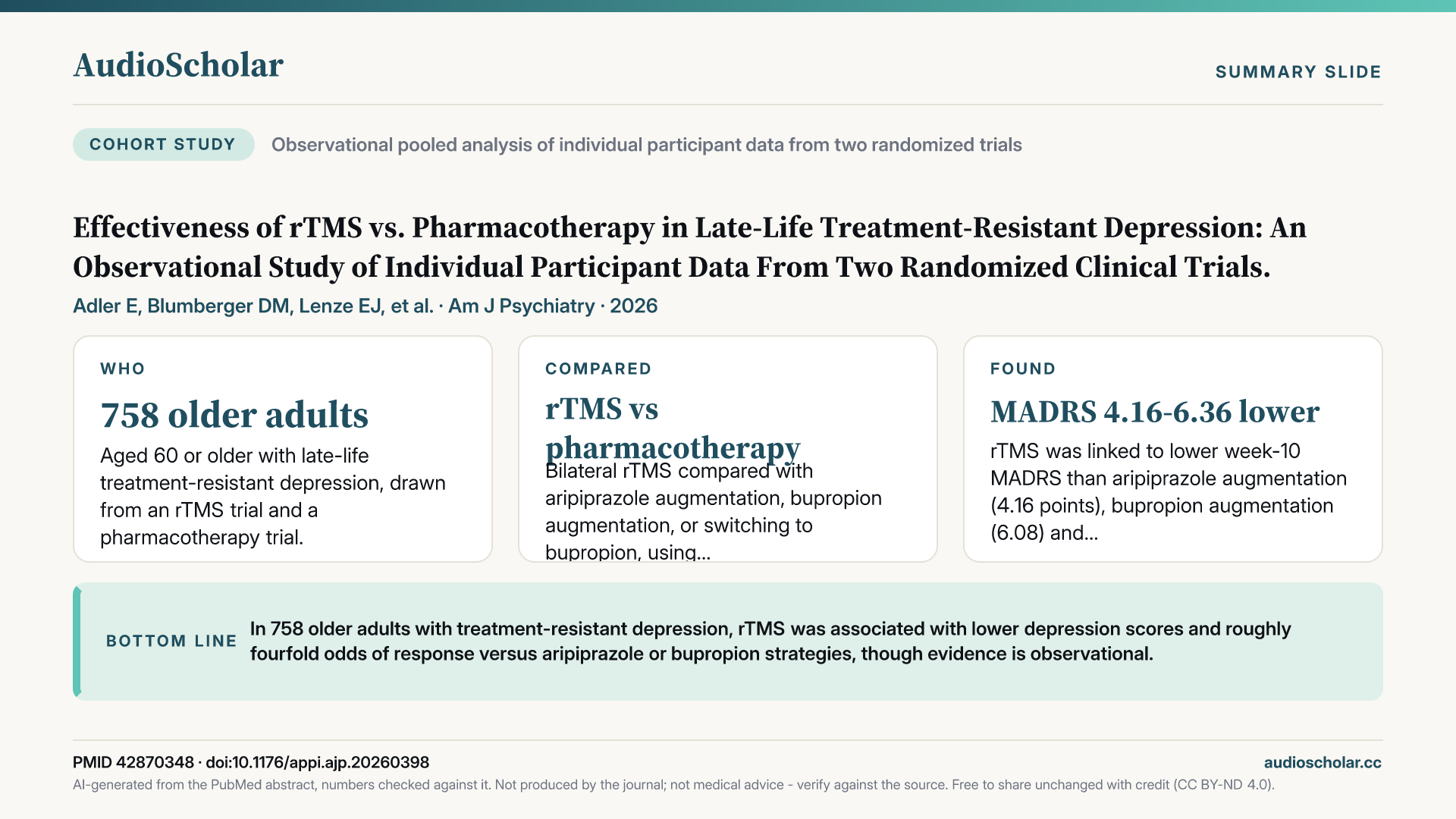
In 758 older adults with treatment-resistant depression, rTMS was associated with lower depression scores and roughly fourfold odds of response versus aripiprazole or bupropion strategies, though evidence is observational.
American Journal of Psychiatry · 2026 · PubMed

This week’s papers
- 01
Effectiveness of rTMS vs. Pharmacotherapy in Late-Life Treatment-Resistant Depression: An Observational Study of Individual Participant Data From Two Randomized Clinical Trials.
In 758 older adults with treatment-resistant depression, rTMS was associated with lower depression scores and roughly fourfold odds of response versus aripiprazole or bupropion strategies, though evidence is observational.
Adler E et al. · American Journal of Psychiatry · 2026
From the briefingIn the American Journal of Psychiatry, Adler and colleagues pooled individual participant data on 758 adults aged 60 or older with late-life treatment-resistant depression from two separate randomized trials, one testing once-daily bilateral rTMS for four to six weeks, the other comparing aripiprazole augmentation, bupropion augmentation, and a switch to bupropion [1]. Using restriction, propensity weighting and regression adjustment to bridge the two trials, they found rTMS was associated with depression scores about four to six points lower at ten weeks than each drug strategy, and with roughly four times the odds of response. Headache was more common with rTMS. The authors conclude this supports moving rTMS earlier in the late-life algorithm, but this remains an observational comparison across trials with different designs and eligibility, so residual confounding is a real possibility and a head-to-head randomized trial has not been done.
If you only have time for one paper this week, make it the late-life rTMS comparison from Adler and colleagues in the American Journal of Psychiatry [1]. It directly reopens the question of where neurostimulation belongs in the treatment sequence for older adults with resistant depression, a common and difficult population, while leaving the door open for a definitive randomized test.
Written by AI from the published abstract, for healthcare professionals. Not medical advice; check the paper before acting on it.
- 02
Long-term effectiveness of transdiagnostic cognitive-behavioural therapy for anxiety and depression in primary care: the PsicAP-CV trial.
Group transdiagnostic CBT in Spanish primary care produced large, durable symptom reductions, while a three-month treatment delay raised nine-month dropout to about 64 percent versus 44 percent.
Muñoz-Navarro R et al. · Psychotherapy and Psychosomatics · 2026
From the briefingFrom Psychotherapy and Psychosomatics, Muñoz-Navarro and colleagues report the PsicAP-CV stepped wedge cluster trial in Spanish primary care, where 316 patients with mild to moderate anxiety and depression received group transdiagnostic CBT either immediately or after a three-month wait [2]. Symptom reductions were large and held to nine months, with roughly half of participants achieving reliable recovery and little deterioration. Gains in work and family functioning lasted, though broader quality of life and social functioning were less consistent. The striking finding was retention: delay did not blunt efficacy among completers, but nearly two thirds of patients in the delayed group had dropped out by nine months, against under half of patients treated immediately. The authors read this as an argument for immediate access within public systems.
Written by AI from the published abstract, for healthcare professionals. Not medical advice; check the paper before acting on it.
- 03
Computerized Cognitive Training in People with Depression: A Systematic Review and Meta-analysis of Randomized Clinical Trials.
Across 53 randomized trials, computerized cognitive training yielded small gains in cognition and depressive symptoms in depression, but no improvement in broader psychiatric symptoms or daily functioning.
Gefen E et al. · Psychotherapy and Psychosomatics · 2026
From the briefingAlso in Psychotherapy and Psychosomatics, Gefen and colleagues meta-analysed 53 randomized trials with about 3,800 participants testing computerized cognitive training in people with clinically significant depressive symptoms [3]. Training produced small improvements in overall cognition and in depressive symptoms, with substantial heterogeneity, and benefits did not extend to broader psychiatric symptoms or daily function. Multidomain programs, higher doses and sessions longer than thirty minutes were linked to bigger cognitive gains. The evidence positions this as a modest adjunct rather than a functional treatment.
Written by AI from the published abstract, for healthcare professionals. Not medical advice; check the paper before acting on it.
- 04
Change in HbA1c and weight after initiation of antipsychotic treatment in people with severe mental illness in England: an individual-level interrupted time-series analysis.
Weight and HbA1c rose fastest in the first 90 days after starting antipsychotics, most with olanzapine, and about 19 percent of people with prediabetes developed diabetes within two years.
Bazo-Alvarez JC et al. · The Lancet Psychiatry · 2026
From the briefingBazo-Alvarez and colleagues used English primary care records on nearly 97,000 people aged 18 to 59 with severe mental illness starting an oral second-generation antipsychotic, in an individual-level interrupted time-series design [4]. In the first ninety days after starting treatment, weight rose by about 0.2 kilograms a week, roughly ten times the pre-treatment rate, and HbA1c climbed sharply as well, before both slowed considerably out to two years. Olanzapine showed the steepest rises, women tended to fare worse, and quetiapine was notable for weight gain with minimal HbA1c change, which is why the authors stress that weight and glucose do not move in lockstep. Among people with prediabetes at baseline, the estimated two-year incidence of type 2 diabetes was about one in five, compared with about three percent among people with normal HbA1c. The authors argue this supports baseline and twelve-week checks of both measures, then risk-stratified monitoring, and the timing data give that interval a concrete rationale.
Written by AI from the published abstract, for healthcare professionals. Not medical advice; check the paper before acting on it.
- 05
GLP-1 receptor agonist initiation and risk of psychiatric hospitalisation and emergency department presentation in adults with schizophrenia and type 2 diabetes in the USA: an observational cohort study using electronic health records data.
Among about 70,000 adults with schizophrenia and type 2 diabetes, starting a GLP-1 agonist was associated with fewer psychiatric hospitalisations and emergency visits than non-initiation or other diabetes drugs.
Davoodian N et al. · The Lancet Psychiatry · 2026
From the briefingOn the treatment side, Davoodian and colleagues analysed electronic health records on about 70,000 adults in the United States with schizophrenia and type 2 diabetes [5]. Starting a GLP-1 receptor agonist was associated with about a quarter lower risk of psychiatric hospitalisation than not starting a glucose-lowering agent, and somewhat smaller reductions of under a fifth compared with starting a DPP-4 or SGLT2 inhibitor, with a similar pattern for psychiatric emergency department visits. The active comparators strengthen the analysis, but the authors themselves flag residual confounding and selection bias, and they frame any psychiatric benefit as a possible secondary dividend when these drugs are already indicated metabolically, not as grounds for psychiatric use without randomized evidence.
Written by AI from the published abstract, for healthcare professionals. Not medical advice; check the paper before acting on it.
- 06
Caring Letters and Suicide Mortality Among US Veterans Who Contacted the Veterans Crisis Line: A Prespecified Secondary Analysis.
Caring letters sent to veterans after crisis line contact were not associated with lower 12-month suicide mortality, and clinician versus peer signatories made no difference in outcomes.
Reger MA et al. · JAMA Psychiatry · 2026
From the briefingIn JAMA Psychiatry, Reger and colleagues report a prespecified secondary analysis of the Veterans Crisis Line caring letters program, covering about 227,500 veterans who contacted the line [6]. Roughly 88,000 veterans received nine letters over a year, signed by either a clinician or a peer veteran, and were compared with a historical control group. Suicide mortality at twelve months was essentially identical between the caring letters and control groups, at under a third of a percent in each, and the signatory made no difference. Caring letters have been cited as one of the few interventions ever to reduce suicide deaths in a randomized trial, so this large non-replication matters, although the comparison with untreated veterans was observational and the parent trial did report increased health care use.
Written by AI from the published abstract, for healthcare professionals. Not medical advice; check the paper before acting on it.
- 07
Genetic architecture and risk of suicide attempt across neurodevelopmental and psychiatric conditions.
Suicide attempt genetics looked similar across psychiatric diagnoses, and polygenic scores stratified absolute risk, reaching 48 percent in women with ADHD, high scores and comorbid substance use.
Starnawska A et al. · Biological Psychiatry · 2026
From the briefingIn Biological Psychiatry, Starnawska and colleagues examined the genetics of suicide attempt in the Danish iPSYCH cohort of about 98,000 people [7]. Suicide attempt occurred in one percent of controls but ranged from five percent in autism to 31 percent in schizophrenia, and the polygenic architecture looked similar across diagnoses, with scores for ADHD, depression and substance use elevated in attempters. Absolute risk differences by polygenic score were substantial: among women with ADHD in the top suicide-attempt score tertile, about 36 percent had attempted, rising to nearly half when substance use disorder co-occurred. These are research-grade stratifications, not validated clinical tools, but they underline sex and substance use as major amplifiers.
Written by AI from the published abstract, for healthcare professionals. Not medical advice; check the paper before acting on it.
- 08
Long-term health, criminal justice, and socioeconomic outcomes among people subject to compulsory mental health care in Norway: a nationwide registry cohort study.
Norwegians under compulsory mental health care had markedly worse long-term health, justice and socioeconomic outcomes, with the compulsory observation group showing the highest self-harm, suicide and substance use.
Hofstad T et al. · The Lancet Psychiatry · 2026
From the briefingBack in The Lancet Psychiatry, Hofstad and colleagues followed about 321,000 people in Norwegian registries, comparing community treatment orders, compulsory hospitalisation, compulsory observation, voluntary care and the general population [8]. Every compulsory care group had substantially worse long-term health, justice and socioeconomic outcomes. The compulsory observation group stood out, with the highest probabilities of self-harm or suicide and of substance use disorder, and more than half of their classified deaths were from suicide or other external causes, compared with under a fifth in the general population. About nine in ten people on community treatment orders were receiving disability benefits. This descriptive design cannot say whether compulsion causes these outcomes, but it identifies people briefly observed and released as a group the system may be underserving.
Written by AI from the published abstract, for healthcare professionals. Not medical advice; check the paper before acting on it.
- 09
Adult Attention Deficit-Hyperactivity Disorder.
Adult ADHD affects about 2.5 percent of adults, often goes undiagnosed, carries frequent psychiatric and somatic comorbidity, and is treated with psychoeducation, medication and psychosocial support.
Buitelaar JK et al. · New England Journal of Medicine · 2026
From the briefingIn the New England Journal of Medicine, Buitelaar and Newcorn review adult ADHD, estimated to affect about 2.5 percent of adults worldwide and still frequently undiagnosed [9]. They emphasise frequent psychiatric comorbidity and elevated risks of obesity, cardiovascular disease, diabetes and inflammatory conditions, and describe treatment built around psychoeducation, stimulant or nonstimulant medication, and psychosocial support.
Written by AI from the published abstract, for healthcare professionals. Not medical advice; check the paper before acting on it.
- 10
Attention deficit hyperactivity disorder: transition to psychotic disorders.
ADHD carries roughly five- to ninefold odds of later psychotic or bipolar disorders; methylphenidate appears not to raise this risk, while evidence on amphetamines remains uncertain.
Thapar A et al. · Molecular Psychiatry · 2026
From the briefingIn Molecular Psychiatry, Thapar and colleagues focus on a risk the authors say is often overlooked: people with ADHD have roughly five to nine times the odds of later bipolar disorder, psychosis or schizophrenia [10]. As ADHD care shifts toward primary care, they argue the highest-risk patients need prioritising for specialist follow-up, yet no validated stratification exists. Current data indicate methylphenidate is not associated with increased psychosis risk, while uncertainty remains for amphetamines.
Written by AI from the published abstract, for healthcare professionals. Not medical advice; check the paper before acting on it.
The full briefing
This AudioScholar briefing is generated by artificial intelligence for healthcare professionals and trainees. It is not medical advice.
Welcome to This Week in Psychiatry. This week we're covering 10 notable papers spanning treatment options for depression, the metabolic side of severe mental illness, suicide risk and compulsory care, and adult ADHD. Let's dive in.
We start with depression treatment, where three papers look at what works, for whom, and how delivery shapes the outcome. In the American Journal of Psychiatry, Adler and colleagues pooled individual participant data on 758 adults aged 60 or older with late-life treatment-resistant depression from two separate randomized trials, one testing once-daily bilateral rTMS for four to six weeks, the other comparing aripiprazole augmentation, bupropion augmentation, and a switch to bupropion [1]. Using restriction, propensity weighting and regression adjustment to bridge the two trials, they found rTMS was associated with depression scores about four to six points lower at ten weeks than each drug strategy, and with roughly four times the odds of response. Headache was more common with rTMS. The authors conclude this supports moving rTMS earlier in the late-life algorithm, but this remains an observational comparison across trials with different designs and eligibility, so residual confounding is a real possibility and a head-to-head randomized trial has not been done. From Psychotherapy and Psychosomatics, Muñoz-Navarro and colleagues report the PsicAP-CV stepped wedge cluster trial in Spanish primary care, where 316 patients with mild to moderate anxiety and depression received group transdiagnostic CBT either immediately or after a three-month wait [2]. Symptom reductions were large and held to nine months, with roughly half of participants achieving reliable recovery and little deterioration. Gains in work and family functioning lasted, though broader quality of life and social functioning were less consistent. The striking finding was retention: delay did not blunt efficacy among completers, but nearly two thirds of patients in the delayed group had dropped out by nine months, against under half of patients treated immediately. The authors read this as an argument for immediate access within public systems. Also in Psychotherapy and Psychosomatics, Gefen and colleagues meta-analysed 53 randomized trials with about 3,800 participants testing computerized cognitive training in people with clinically significant depressive symptoms [3]. Training produced small improvements in overall cognition and in depressive symptoms, with substantial heterogeneity, and benefits did not extend to broader psychiatric symptoms or daily function. Multidomain programs, higher doses and sessions longer than thirty minutes were linked to bigger cognitive gains. The evidence positions this as a modest adjunct rather than a functional treatment.
Our second theme is the metabolic burden of severe mental illness, with two papers, both in The Lancet Psychiatry, that bracket the problem from onset to intervention. Bazo-Alvarez and colleagues used English primary care records on nearly 97,000 people aged 18 to 59 with severe mental illness starting an oral second-generation antipsychotic, in an individual-level interrupted time-series design [4]. In the first ninety days after starting treatment, weight rose by about 0.2 kilograms a week, roughly ten times the pre-treatment rate, and HbA1c climbed sharply as well, before both slowed considerably out to two years. Olanzapine showed the steepest rises, women tended to fare worse, and quetiapine was notable for weight gain with minimal HbA1c change, which is why the authors stress that weight and glucose do not move in lockstep. Among people with prediabetes at baseline, the estimated two-year incidence of type 2 diabetes was about one in five, compared with about three percent among people with normal HbA1c. The authors argue this supports baseline and twelve-week checks of both measures, then risk-stratified monitoring, and the timing data give that interval a concrete rationale. On the treatment side, Davoodian and colleagues analysed electronic health records on about 70,000 adults in the United States with schizophrenia and type 2 diabetes [5]. Starting a GLP-1 receptor agonist was associated with about a quarter lower risk of psychiatric hospitalisation than not starting a glucose-lowering agent, and somewhat smaller reductions of under a fifth compared with starting a DPP-4 or SGLT2 inhibitor, with a similar pattern for psychiatric emergency department visits. The active comparators strengthen the analysis, but the authors themselves flag residual confounding and selection bias, and they frame any psychiatric benefit as a possible secondary dividend when these drugs are already indicated metabolically, not as grounds for psychiatric use without randomized evidence.
The third theme is suicide risk and the outcomes of people at the severe end of illness, and here one of the week's clearest findings is a null one. In JAMA Psychiatry, Reger and colleagues report a prespecified secondary analysis of the Veterans Crisis Line caring letters program, covering about 227,500 veterans who contacted the line [6]. Roughly 88,000 veterans received nine letters over a year, signed by either a clinician or a peer veteran, and were compared with a historical control group. Suicide mortality at twelve months was essentially identical between the caring letters and control groups, at under a third of a percent in each, and the signatory made no difference. Caring letters have been cited as one of the few interventions ever to reduce suicide deaths in a randomized trial, so this large non-replication matters, although the comparison with untreated veterans was observational and the parent trial did report increased health care use. In Biological Psychiatry, Starnawska and colleagues examined the genetics of suicide attempt in the Danish iPSYCH cohort of about 98,000 people [7]. Suicide attempt occurred in one percent of controls but ranged from five percent in autism to 31 percent in schizophrenia, and the polygenic architecture looked similar across diagnoses, with scores for ADHD, depression and substance use elevated in attempters. Absolute risk differences by polygenic score were substantial: among women with ADHD in the top suicide-attempt score tertile, about 36 percent had attempted, rising to nearly half when substance use disorder co-occurred. These are research-grade stratifications, not validated clinical tools, but they underline sex and substance use as major amplifiers. Back in The Lancet Psychiatry, Hofstad and colleagues followed about 321,000 people in Norwegian registries, comparing community treatment orders, compulsory hospitalisation, compulsory observation, voluntary care and the general population [8]. Every compulsory care group had substantially worse long-term health, justice and socioeconomic outcomes. The compulsory observation group stood out, with the highest probabilities of self-harm or suicide and of substance use disorder, and more than half of their classified deaths were from suicide or other external causes, compared with under a fifth in the general population. About nine in ten people on community treatment orders were receiving disability benefits. This descriptive design cannot say whether compulsion causes these outcomes, but it identifies people briefly observed and released as a group the system may be underserving.
Our final theme is adult ADHD, with a clinical review and a perspective that read well together. In the New England Journal of Medicine, Buitelaar and Newcorn review adult ADHD, estimated to affect about 2.5 percent of adults worldwide and still frequently undiagnosed [9]. They emphasise frequent psychiatric comorbidity and elevated risks of obesity, cardiovascular disease, diabetes and inflammatory conditions, and describe treatment built around psychoeducation, stimulant or nonstimulant medication, and psychosocial support. In Molecular Psychiatry, Thapar and colleagues focus on a risk the authors say is often overlooked: people with ADHD have roughly five to nine times the odds of later bipolar disorder, psychosis or schizophrenia [10]. As ADHD care shifts toward primary care, they argue the highest-risk patients need prioritising for specialist follow-up, yet no validated stratification exists. Current data indicate methylphenidate is not associated with increased psychosis risk, while uncertainty remains for amphetamines. Read alongside the iPSYCH genetics work [7], it reinforces that ADHD is not a low-acuity diagnosis for a meaningful subset of patients.
If you only have time for one paper this week, make it the late-life rTMS comparison from Adler and colleagues in the American Journal of Psychiatry [1]. It directly reopens the question of where neurostimulation belongs in the treatment sequence for older adults with resistant depression, a common and difficult population, while leaving the door open for a definitive randomized test.
Here is what this week's evidence adds up to in Psychiatry. First, for late-life treatment-resistant depression, observational data suggest rTMS may outperform standard medication strategies, a signal strong enough to motivate trials but not yet randomized proof. Second, antipsychotic-related weight and glucose changes concentrate in the first ninety days, and they diverge by drug, which gives concrete support to early twelve-week monitoring of both weight and HbA1c; GLP-1 agonists may carry psychiatric acute-care benefits in schizophrenia with diabetes, though that remains observational. Third, caring letters did not reduce suicide deaths among veterans contacting a crisis line, weakening confidence in one of the field's few mortality-tested interventions. Fourth, people under compulsory care, especially those only briefly observed, carry heavy long-term risk, and ADHD carries meaningful links to psychosis and suicide attempt, with stratification tools still unvalidated. And fifth, timely access to group CBT appears to matter more for retention than for efficacy.
That's your roundup for This Week in Psychiatry. The full transcript and references are available on the episode page. This is an AI-curated summary — for clinical decisions, always consult primary sources and current guidelines. See you next week.
If this weekly briefing is useful, follow the show in your podcast app so new episodes arrive automatically. And think of one colleague — in any specialty — who never has time to keep up with the literature. Tell them about AudioScholar: a free ten-minute weekly for every specialty, to listen to in any podcast app, or to read at audioscholar dot C C.
This is an automated summary generated by artificial intelligence, which can make mistakes. Always review the original source materials.
Spot something worth flagging?
Get this every week in your podcast app — free.
New psychiatry episodes land in your feed automatically — listen on your commute.