This Week in Urology — Oct 9, 2026
Generated Oct 9, 2026 · 11:08
The week's practice-changing Urology research, summarized for clinicians.
If the audio fails to play, refresh the page to renew the link.
Get next week’s Urology briefing — free.
In your podcast app, or readable in your inbox with the audio one tap away.
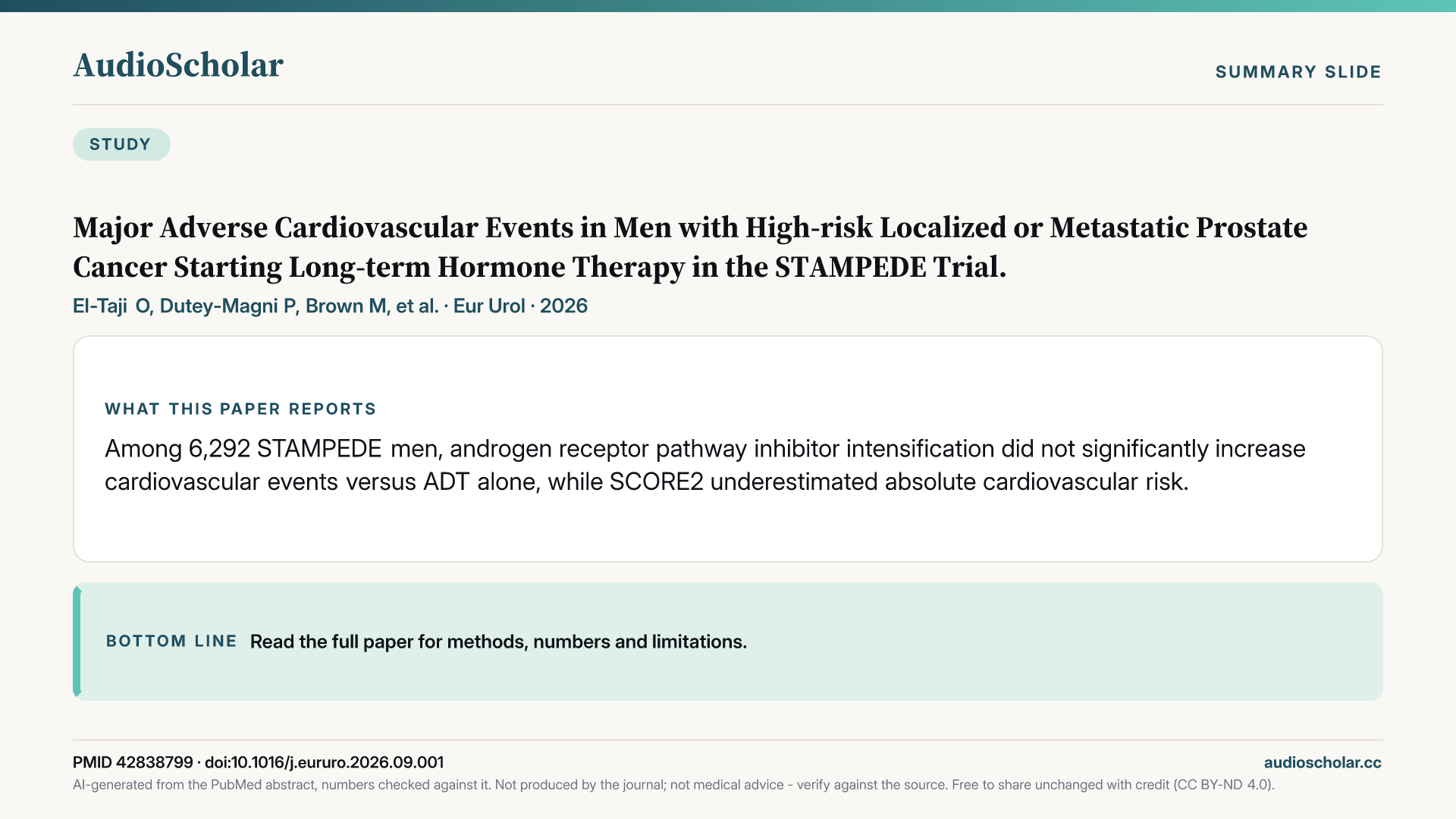
Major Adverse Cardiovascular Events in Men with High-risk Localized or Metastatic Prostate Cancer Starting Long-term Hormone Therapy in the STAMPEDE Trial.
Among 6,292 STAMPEDE men, androgen receptor pathway inhibitor intensification did not significantly increase cardiovascular events versus ADT alone, while SCORE2 underestimated absolute cardiovascular risk.
European Urology · 2026 · PubMed

This week’s papers
- 01
Diagnostic Value of Prostate-specific Membrane Antigen Positron Emission Tomography / Magnetic Resonance Imaging in Selected Men with Equivocal Prostate Imaging Reporting and Data System Category 3 Lesion (PANDORA): A Prospective Paired Diagnostic Study.
In 66 men with equivocal PI-RADS 3 lesions, PSMA PET-targeted biopsy found more significant cancer than MRI targeting, and no man with a negative scan had significant cancer.
Diamand R et al. · The Journal of Urology · 2026
- 02
Gleason pattern 4 length and active surveillance eligibility in Grade Group 2-4 prostate cancer.
Men with under 2 mm of Gleason pattern 4 had outcomes matching favourable intermediate-risk disease, suggesting this threshold could roughly double active surveillance eligibility pending validation.
Fletcher SA et al. · BJU International · 2026
- 03
PSMA-PET/CT-guided Intensification of Radiation Therapy for Prostate Cancer (PSMAgRT): 5-yr Analysis of a Phase 2 Randomized Controlled Trial.
PSMA-guided radiotherapy intensification did not significantly improve five-year failure-free survival, though biochemical control favoured it in high-risk and post-prostatectomy patients, now being tested in phase 3.
Belliveau C et al. · European Urology · 2026
- 04
Major Adverse Cardiovascular Events in Men with High-risk Localized or Metastatic Prostate Cancer Starting Long-term Hormone Therapy in the STAMPEDE Trial.
Among 6,292 STAMPEDE men, androgen receptor pathway inhibitor intensification did not significantly increase cardiovascular events versus ADT alone, while SCORE2 underestimated absolute cardiovascular risk.
El-Taji O et al. · European Urology · 2026
- 05
Testosterone breakthrough and outcomes during intensified therapy in metastatic hormone-sensitive prostate cancer: the ARASENS and LATITUDE trials.
Testosterone breakthrough above 35 ng/dL was linked to worse survival with abiraterone in LATITUDE but not significantly in ARASENS, findings that remain exploratory and non-causal.
Xiao X et al. · BJU International · 2026
- 06
Urine cell-free RNA for bladder cancer detection and treatment response prediction.
Urine cell-free RNA sequencing detected localised bladder cancer with 95 percent sensitivity at 90 percent specificity and predicted BCG response, though prospective validation is still required.
Liu KJ et al. · Nature Medicine · 2026
- 07
Accumulating Evidence Supports NECTIN4 as a Predictive Biomarker for Enfortumab Vedotin: The Compartment Still Matters.
Membranous nectin-4 expression appears predictive of enfortumab vedotin activity, but low expression signals poorer outcomes rather than no benefit, requiring standardised prospective validation before clinical use.
Klümper N et al. · European Urology · 2026
- 08
Surrogacy of intermediate clinical endpoints for overall survival in BCG-naïve high-risk non-muscle-invasive bladder cancer.
In over 3,000 BCG-naive high-risk NMIBC patients, progression-free and event-free survival correlated with survival individually but failed trial-level surrogacy thresholds, cautioning interpretation of event-free survival-driven trials.
Scilipoti P et al. · World Journal of Urology · 2026
- 09
Post-chemotherapy retroperitoneal lymph node dissection following first-line treatment in patients with advanced pure seminoma of the testis.
In 108 seminoma patients, post-chemotherapy RPLND found mostly necrosis, FDG-PET discriminated poorly, and five-year progression-free survival for viable seminoma was 44 percent, supporting only selective use.
Heidenreich A et al. · The Journal of Urology · 2026
- 10
Lymphocele After Radical Prostatectomy: A Systematic Review of Risk Factors and Quantitative Synthesis Preventive Strategies.
Pooled randomised data showed peritoneal flap reconstruction reduced symptomatic lymphocele after radical prostatectomy by over forty percent, the most consistent modifiable preventive strategy identified.
Çavdar ÖF et al. · World Journal of Urology · 2026
The full briefing
This AudioScholar briefing is generated by artificial intelligence for healthcare professionals and trainees. It is not medical advice.
Welcome to This Week in Urology. This week we're covering 10 notable papers spanning prostate cancer imaging and risk stratification, the safety and biology of hormonal intensification, and new tools and endpoints in bladder cancer, with a closing look at two surgical questions. Let's dive in.
We start with the way PSMA imaging and pathology detail are reshaping who gets biopsied, who goes on surveillance, and who gets intensified radiation. In The Journal of Urology, Diamand and colleagues ran PANDORA, a single-centre prospective paired study in men with an equivocal PI-RADS 3 lesion plus at least one high-risk feature [1]. Every man had PSMA PET/MRI after his diagnostic MRI, then transperineal MRI-targeted, PSMA-targeted, and systematic biopsy. Of the 66 men who completed the protocol, PSMA-targeted biopsy found clinically significant cancer in 10 men versus 4 with MRI targeting, a statistically significant difference. PSMA PET was negative in about two thirds of men, and none of those men had significant cancer, so in principle roughly two thirds of biopsies could have been avoided. The numbers are small and from one centre, and the authors themselves frame biopsy deferral after a negative scan as something for larger multicentre studies to test, not a settled pathway. Staying with the biopsy specimen, Fletcher and colleagues in BJU International asked whether total Gleason pattern 4 length beats the current favourable intermediate-risk definition for judging surveillance eligibility [2]. Across nearly 2,500 men with Grade Group 2 to 4 disease who went to prostatectomy, men with under 2 millimetres of pattern 4, regardless of grade group, had rates of adverse pathology and five-year biochemical recurrence essentially identical to favourable intermediate-risk patients. Using that cut-point would roughly double the number of men classed as surveillance-eligible, which the authors estimate at about 50,000 men a year in the United States. This is a surgical cohort, not a surveillance cohort, and the authors are explicit that the measurement method and threshold need refinement before implementation. Then to treatment: in European Urology, Belliveau and colleagues report five-year results of the phase 2 PSMAgRT trial, randomising 253 treated men to standard radiotherapy or PSMA-guided radiotherapy to all detected sites [3]. The primary endpoint, failure-free survival, was not met, at 66 versus 62 percent. Freedom from biochemical progression did favour the PSMA-guided arm, most clearly in high-risk and post-prostatectomy salvage patients, where estimates suggested roughly a halving of biochemical events, and toxicity from dose escalation was minimal. Those subgroup signals are hypothesis-generating, and they are what the phase 3 PATRON trial is now testing. Taken together, PSMA is clearly improving detection, but whether that changes hard outcomes remains open.
Our second theme is hormonal intensification, both its cardiovascular cost and its biology. El-Taji and colleagues, also in European Urology, linked STAMPEDE trial data to English health records for 6,292 men [4]. Five-year major cardiovascular event rates with androgen receptor pathway inhibitor intensification were about 9 percent in non-metastatic and 7 percent in metastatic disease, comparable to androgen deprivation alone, and neither abiraterone nor abiraterone plus enzalutamide, nor docetaxel, zoledronic acid or prostate radiotherapy produced a statistically significant increase. The point estimates leaned upward, though, and men with severe cardiovascular disease were underrepresented, so this is reassurance for trial-eligible men rather than a clean bill of health for everyone. Prior cardiovascular disease was the strongest predictor of events, and the widely used SCORE2 tool discriminated only modestly and underestimated absolute risk, which the authors read as an argument for prostate-cancer-specific risk models. In BJU International, Xiao and colleagues looked at testosterone breakthrough above 35 nanograms per decilitre during intensified therapy, using the experimental arms of LATITUDE and ARASENS [5]. In LATITUDE, with abiraterone, breakthrough was associated with roughly fifty percent higher risk of death after the landmark; in ARASENS, with darolutamide plus docetaxel, there was no statistically significant association with survival or castration resistance. The authors stress these are exploratory, within-cohort findings that establish neither causality nor a testosterone target, so monitoring castrate levels on intensified therapy remains a question rather than an answer.
Turning to bladder cancer, three papers address how we detect disease, select therapy, and measure benefit. The highest-profile paper of the week comes from Nature Medicine, where Liu and colleagues describe uRARE-seq, a urine cell-free RNA sequencing method applied to 683 samples [6]. It detected localised bladder cancer with about 95 percent sensitivity at 90 percent specificity, outperformed urine tumour DNA, and was not confounded by field-effect mutations. It also picked up minimal residual disease, and pretreatment urine from BCG complete responders carried immune and T-cell signatures, while non-responders showed proliferation signals. A classifier built on 114 patients discriminated likely response to BCG versus chemotherapy with an area under the curve of 0.93. This is a discovery and development study, and the authors call for prospective validation before any clinical use. On the advanced end, a brief European Urology piece from Klümper and colleagues argues that accumulating data support nectin-4, particularly membranous expression, as a predictive biomarker for enfortumab vedotin [7]. Low expression identifies patients with poorer outcomes but not an absence of benefit, so the authors argue against using it to withhold treatment until standardised prospective validation exists. Finally, in the World Journal of Urology, Scilipoti and colleagues tackled a methodological question with real consequences for the BCG-plus-immunotherapy trials now reading out [8]. In over 3,000 BCG-naive high-risk non-muscle-invasive patients from 18 centres, adequate BCG was associated with about a third lower risk of death, and progression-free and event-free survival tracked strongly with survival at the individual level. But at the pseudo-trial level, neither endpoint reached the prespecified threshold for adequate surrogacy. In other words, an event-free survival win in this setting may not translate into a survival win, and the authors urge caution interpreting such trials, while acknowledging their own analysis is exploratory and retrospective.
Two surgical papers round out the week. In The Journal of Urology, Heidenreich and colleagues report a multi-institutional retrospective series of 108 men undergoing post-chemotherapy retroperitoneal lymph node dissection for pure seminoma [9]. Roughly 60 percent of specimens showed only necrosis or fibrosis, about 38 percent had viable seminoma, and FDG-PET was a weak discriminator, with a positive predictive value of only about 56 percent. Serious complications occurred in about one in ten patients, and adjunctive surgery was needed in over 40 percent of cases. Five-year progression-free survival after surgery alone for viable seminoma was 44 percent, and marker-negative progression predicted worse outcomes. The authors position surgery as an option only for highly selected, completely resectable disease, with high-dose chemotherapy remaining the standard otherwise. Then a World Journal of Urology systematic review by Çavdar and colleagues on lymphocele after radical prostatectomy [10]. Across 31 studies, peritoneal flap reconstruction cut symptomatic lymphocele by over forty percent in pooled randomised data, with a much larger apparent effect in observational studies that the authors treat cautiously because of confounding. Octreotide and lymphatic embolisation appeared effective for established leaks. The authors call for further multicentre randomised trials.
If you only have time for one paper this week, make it the STAMPEDE cardiovascular analysis by El-Taji and colleagues in European Urology [4]. It addresses the cardiovascular safety concern that shadows nearly every intensification conversation, using randomised trial data linked to real-world records, and it questions whether our general-population risk calculators are fit for these patients.
Here is what this week's evidence adds up to in Urology. First, PSMA imaging continues to outperform MRI in detection, both for equivocal PI-RADS 3 lesions and for radiotherapy planning, but the PSMAgRT trial missed its primary endpoint, and outcome benefit awaits phase 3 data. Second, quantifying Gleason pattern 4 length may safely widen surveillance eligibility, though the evidence comes from prostatectomy cohorts and the threshold is not yet standardised. Third, in trial-eligible men, androgen receptor pathway inhibitor intensification did not significantly raise cardiovascular events, yet standard risk scores underestimated risk, and men with severe heart disease remain understudied. Fourth, urine RNA and nectin-4 expression are promising bladder cancer biomarkers that still lack prospective validation, and event-free survival may be an imperfect stand-in for survival in BCG-naive high-risk disease. Fifth, surgery for residual seminoma and peritoneal flaps for lymphocele prevention both have supportive but largely observational or modest-sized evidence.
That's your roundup for This Week in Urology. The full transcript and references are available on the episode page. This is an AI-curated summary — for clinical decisions, always consult primary sources and current guidelines. See you next week.
If this weekly briefing is useful, follow the show in your podcast app so new episodes arrive automatically. And if you have a paper you have been meaning to read, upload the PDF, or paste any link, at audioscholar dot C C. We will turn it into audio like this one, in any of thirty-one languages.
This is an automated summary generated by artificial intelligence, which can make mistakes. Always review the original source materials.
Spot something worth flagging?
Get this every week in your podcast app — free.
New urology episodes land in your feed automatically — listen on your commute.