Peritoneal Dialysis Update — Oct 1, 2026
Generated Oct 8, 2026 · 11:05
The latest research on this topic, summarized for clinicians.
If the audio fails to play, refresh the page to renew the link.
Get this every week in your podcast app — free.
New research episodes land in your feed automatically — listen on your commute.
Association between Glycemic Control and Survival in Patients with Type 2 Diabetes on Peritoneal Dialysis: Results from the PDOPPS.
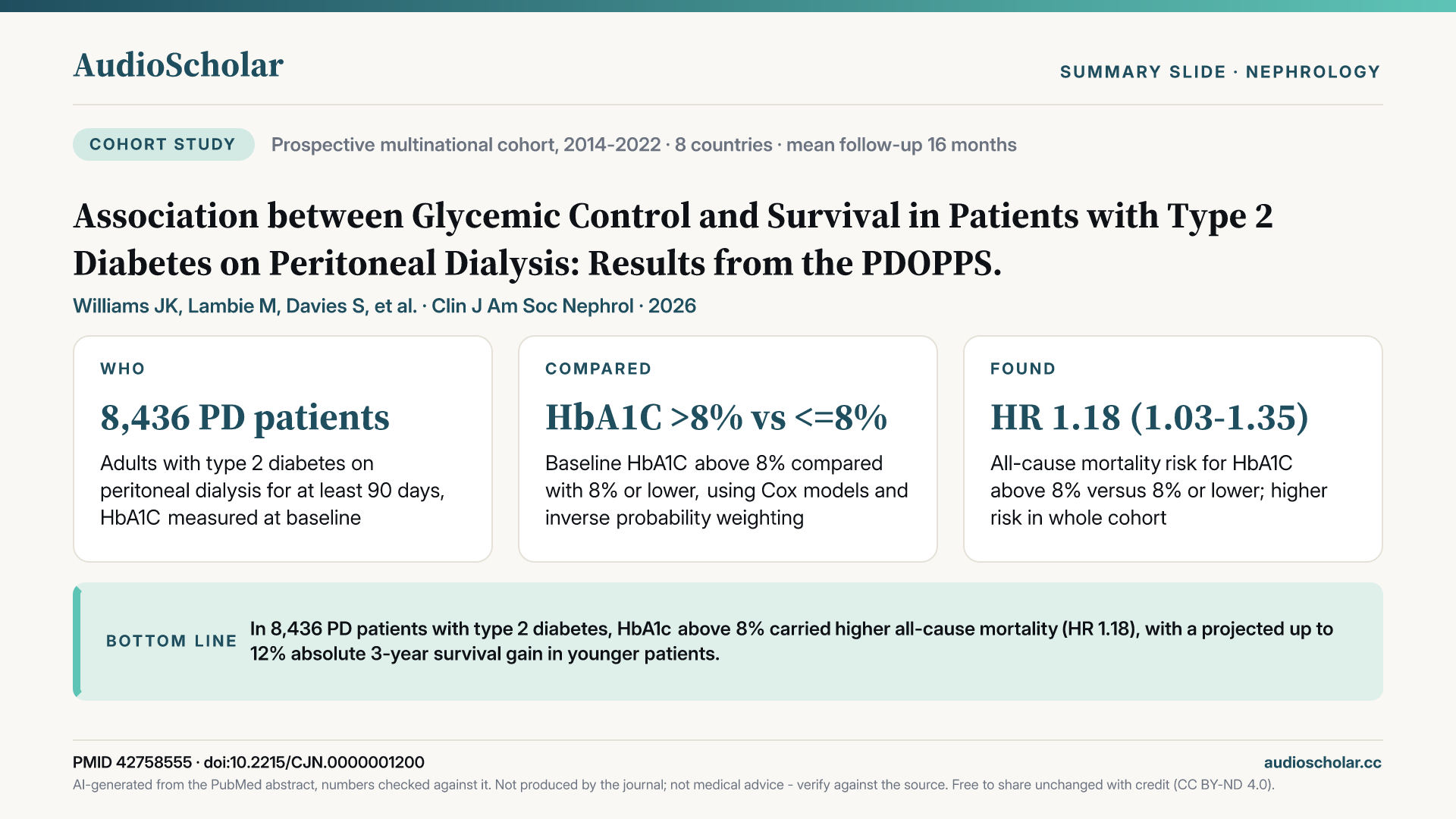
In 8,436 PD patients with type 2 diabetes, HbA1c above 8% carried higher all-cause mortality (HR 1.18), with a projected up to 12% absolute 3-year survival gain in younger patients.
Clinical Journal of the American Society of Nephrology · 2026 · PubMed

Papers in this briefing
- 01
Association between Glycemic Control and Survival in Patients with Type 2 Diabetes on Peritoneal Dialysis: Results from the PDOPPS.
In 8,436 PD patients with type 2 diabetes, HbA1c above 8% carried higher all-cause mortality (HR 1.18), with a projected up to 12% absolute 3-year survival gain in younger patients.
Clinical Journal of the American Society of Nephrology · 2026
- 02
Joint International Society of Renal Nutrition and Metabolism (ISRNM) and International Society for Peritoneal Dialysis (ISPD) practice recommendation on nutrition management in peritoneal dialysis.
An inaugural GRADE-based ISRNM/ISPD practice recommendation provides unified guidance on nutrition screening, dietary advice, complication-related interventions, supplementation and education to prevent protein-energy wasting in PD patients.
Peritoneal Dialysis International · 2026
- 03
Global, Regional, and Country Incidence of Peritoneal Dialysis-Associated Peritonitis in the Contemporary Peritoneal Dialysis Practice: A Systematic Review and Meta-Analysis.
Pooled global PD peritonitis incidence was 0.31 episodes per patient-year, ranging from 0.21 in the Western Pacific to 0.99 in Africa, with 10 of 37 countries exceeding the ISPD 0.40 benchmark.
Medical sciences · 2026
- 04
Clinical characteristics, pain trajectories, and outcomes of peritoneal dialysis-related peritonitis: a multicenter retrospective study.
In 156 PD peritonitis patients, gram-negative infection brought greater inflammation, pain and treatment failure (22.7% vs 10.9% vs 0%), while mortality did not differ and hypoalbuminemia was the only mortality factor.
BMC Nephrology · 2026
- 05
Effects of automated peritoneal dialysis and continuous ambulatory peritoneal dialysis on residual kidney function in Chinese patients with new-onset end stage kidney disease.
In 53 new-onset ESKD patients, APD was associated with faster residual kidney function decline than CAPD (-6.6 vs -4.3 mL/min/1.73 m2/year, p=0.002), though the study was small and single-center.
Renal failure · 2026
- 06
Early Peritonitis Within the First Six Months and One-Year Mortality in Elderly Peritoneal Dialysis Patients: A Multicentre Retrospective Study.
Early peritonitis occurred in 30.8% of 227 elderly PD patients and was independently associated with one-year mortality (OR 11.4, wide CI 1.35-96.7), though few events limit precision.
Medicina · 2026
- 07
Association of serum chloride concentration with the risk of major adverse cardiovascular events in patients undergoing peritoneal dialysis: the Fukuoka peritoneal dialysis registry (F-PDR).
In 1,043 PD patients, the lowest serum chloride tertile had higher MACE risk (HR 2.38), independent of serum sodium, suggesting chloride adds prognostic information.
Clinical and experimental nephrology · 2026
- 08
An approach to treat refractory catheter-related infections in patients undergoing peritoneal dialysis: tunnel-reconstruction operation.
In 10 PD patients with refractory catheter infections, tunnel reconstruction produced no infections at 3 months and only two late exit-site infections at 33 and 41 months, though prospective validation is needed.
Renal failure · 2026
- 09
Nighttime Systolic Blood Pressure and Cardiovascular and All-Cause Mortality in Peritoneal Dialysis Patients: A Single-Center Prospective Cohort Study.
Among 165 PD patients, each 1 SD higher nighttime systolic BP raised cardiovascular mortality (SHR 1.53) and all-cause mortality (HR 1.42), supporting ambulatory monitoring in PD.
Journal of clinical medicine · 2026
- 10
Development and validation of a nomogram for peritoneal dialysis-associated peritonitis.
A nine-variable nomogram predicted peritonitis-free survival with moderate discrimination (C-index 0.707), but validation-cohort performance fell at 12 and 24 months, so external validation is required.
Renal failure · 2026
The full briefing
This AudioScholar briefing is generated by artificial intelligence for healthcare professionals and trainees. It is not medical advice.
Welcome to your bi-weekly update in Peritoneal Dialysis. Peritonitis dominates this period, and the picture spans a new global benchmark, a prediction tool, a look at how gram-negative infection behaves differently, and a worrying signal about early infection in older patients. Running underneath all of it is nutrition. Low albumin keeps surfacing as a risk marker, and the first joint international nutrition recommendation for dialysis patients has arrived. We also have a large cohort reframing glycemic targets, two cheap cardiovascular risk markers, and fresh data on whether automated cycling costs patients their residual kidney function.
Peritonitis is still the complication that ends more peritoneal dialysis careers than any other, so it helps to start with how common it actually is. Nochaiwong and colleagues, writing in Medical Sciences, pooled 153 study populations covering more than 132,000 patients across 37 countries [3]. They set out to estimate contemporary peritonitis rates using International Society for Peritoneal Dialysis criteria. The global rate came out at roughly one episode every three patient-years, which sits inside the society's target. That average hides a wide spread. The Western Pacific region performed best, with South Korea, mainland China and Japan lowest. Africa ran at nearly one episode per patient-year, and ten of the 37 countries exceeded the benchmark. Gram-positive organisms led the causes, but culture-negative peritonitis came second, ahead of gram-negative infection. That finding says as much about laboratory practice as about microbiology. The heterogeneity was substantial and the search was limited to English-language papers, so country-level figures are best read as rough benchmarks rather than league tables.
The next question is who will get peritonitis. Tian and colleagues, in Renal Failure, built a nomogram from nine routine variables in 372 incident patients at a single centre [10]. The independent predictors were lower education, lower hemoglobin, lower albumin and, less intuitively, lower phosphorus. The authors read low phosphorus as a nutritional signal rather than a protective one. Discrimination was moderate, and in the internal validation cohort the model's accuracy fell away noticeably at two years. The authors are candid that the tool needs external, multicentre validation before it belongs in clinic.
Once infection occurs, the organism matters. Liu and colleagues, in BMC Nephrology, compared gram-negative, gram-positive and culture-negative peritonitis in 156 hospitalized patients across three Chinese centres [4]. Gram-negative episodes ran hotter on every measure, with higher effluent cell counts, procalcitonin several times higher, and more abdominal pain that persisted for nearly two weeks. Treatment failure, defined as catheter removal or death, occurred in a little over a fifth of gram-negative cases, about twice the gram-positive rate. No culture-negative patient failed treatment. Mortality did not differ by organism. In multivariable analysis, hypoalbuminemia was the only factor tied to death, and it joined gram-negative infection and high C-reactive protein as predictors of treatment failure. This was a retrospective study limited to hospitalized patients, so milder episodes managed at home are missing.
The consequences may be steepest in older patients. Tanburoğlu and colleagues, in Medicina, followed 227 patients aged 65 and over across nine Turkish centres [6]. Close to a third of these patients developed peritonitis within six months of starting dialysis. In the adjusted model, early peritonitis was associated with roughly elevenfold higher odds of death at one year. That number deserves real caution. The model rested on only 17 events, the uncertainty around the estimate was enormous, and the number of early episodes did not itself predict death. That tension sits awkwardly with a strong causal reading. A dose-response pattern would be expected if early peritonitis were truly driving mortality, so its absence could reflect low power or confounding by frailty. A prospective elderly cohort with enough deaths to model comorbidity properly would settle it. For now, the study supports the idea that the first six months are a vulnerable window in older patients, but it falls well short of quantifying the risk.
Hypoalbuminemia keeps reappearing across these infection papers, which brings us to nutrition, now addressed by an international consensus for the first time. Writing in Peritoneal Dialysis International, Wang and colleagues present the joint recommendation of the International Society of Renal Nutrition and Metabolism and the International Society for Peritoneal Dialysis [2]. A globally representative group of nephrologists, dietitians and nurses developed it. It covers screening and monitoring, dietary patterns, nutrition during complications, supplementation, and patient education, with a strong emphasis on food literacy and self-management. Recommendations were graded using the GRADE framework, while practice points rest on expert consensus. That distinction matters, because much of the underlying evidence base in this field is observational and thin. Its value lies in giving multidisciplinary teams a shared framework for preventing protein-energy wasting where none existed before.
Glycemic control is where metabolic care meets survival. Williams and colleagues, in the Clinical Journal of the American Society of Nephrology, drew on the Peritoneal Dialysis Outcomes and Practice Patterns Study [1]. They examined 8,436 patients with type 2 diabetes across eight countries to ask whether hemoglobin A1c relates to mortality. An A1c above eight percent was associated with modestly higher mortality overall. The signal sharpened in younger patients, in those with normal albumin, in those without coronary disease, and in those early in their dialysis course. The projected three-year survival gap reached about sixteen percentage points in patients under 65 with normal albumin and no coronary disease. There is an interesting overlap with the infection data here. In the infection studies, low albumin marked patients at risk. In this cohort, the benefit of better glucose control concentrated in patients whose albumin was normal, which suggests that inflammation and wasting may swamp the glycemic effect in sicker patients. The design is prospective and large, and the weighted analysis tries to mimic a treatment effect. It remains observational, though, with a mean follow-up of only sixteen months, and A1c is known to be less reliable in dialysis. The authors conclude that the findings support tighter individualized targets in the younger, non-inflamed subgroup. That argument is stronger than the case for current blanket loosening, but it has not been tested in a trial.
Cardiovascular disease remains the leading killer in peritoneal dialysis, and two cohorts this period point to cheap, overlooked markers. Hamashoji and colleagues, in Clinical and Experimental Nephrology, analysed 1,043 patients from the Fukuoka registry [7]. Patients in the lowest chloride tertile had more than double the risk of major adverse cardiovascular events compared with the highest tertile, even after adjusting for sodium. About a third of the cohort was hypochloremic. Whether low chloride reflects volume status, dialysate losses, or something else is not answered, and this is a single Japanese registry.
Yu and colleagues, in the Journal of Clinical Medicine, followed 165 patients at one centre for nearly four years after ambulatory blood pressure monitoring [9]. Higher nighttime systolic pressure tracked with both cardiovascular and all-cause death. Each standard-deviation rise carried roughly forty to fifty percent more risk. The study handled competing risks appropriately, but it was small, with 28 cardiovascular deaths. The two papers agree in spirit, since each finds that routine or semi-routine measurements carry prognostic information beyond standard assessment. Neither shows that changing the marker changes outcomes.
Finally, two papers address keeping patients on the technique itself. Sun and colleagues, in Renal Failure, compared automated cycling with continuous ambulatory dialysis in 53 new Chinese patients at a single centre [5]. Residual function declined faster with automated dialysis, by roughly two millilitres per minute per year more. This reopens a long-running debate in which larger studies have often found no difference. With 19 patients on automated dialysis, a retrospective design, and six months of follow-up, this study cannot resolve that debate. A randomized or large propensity-matched comparison with longer follow-up would. Also in Renal Failure, Tian and colleagues describe tunnel reconstruction surgery in ten patients with refractory exit-site or tunnel infections [8]. No patient had recurrent infection or complications at three months, and none of the seven patients followed for a year had a recurrence. With ten patients and no comparator, it is a hypothesis-generating salvage technique and nothing more.
If you read only one paper from this period, make it the glycemic control analysis from the practice patterns study by Williams and colleagues. It reopens the assumption that looser A1c targets suit most diabetic patients on peritoneal dialysis, and it identifies a definable subgroup in whom the stakes appear substantial.
Here is what this period adds up to. First, global peritonitis rates broadly meet targets, but the variation between countries is wide enough that benchmarking alone cannot explain it. Second, low albumin is emerging as a common thread linking peritonitis risk, treatment failure, and who might benefit from metabolic control, and nutrition now has an international framework, though much of it rests on consensus. Third, gram-negative peritonitis looks distinctly more inflammatory and more likely to cost the catheter, while the reported mortality hit from early peritonitis in older patients remains statistically fragile. Fourth, the signals on chloride, nighttime blood pressure, and automated dialysis and residual function are all observational and largely single-centre. Each warrants confirmation before it reshapes anyone's thinking.
That's your Peritoneal Dialysis update for this period. Until next time.
This is an automated summary generated by artificial intelligence, which can make mistakes. Always review the original source materials.
Spot something worth flagging?
Get this every week in your podcast app — free.
New research episodes land in your feed automatically — listen on your commute.