This Week in Rheumatology — Oct 22, 2026
Generated Oct 22, 2026 · 10:54
The week's practice-changing Rheumatology research, summarized for clinicians.
If the audio fails to play, refresh the page to renew the link.
Get next week’s Rheumatology briefing — free.
In your podcast app, or readable in your inbox with the audio one tap away.
Ten-year outcomes after treat-to-target therapy in early rheumatoid arthritis.
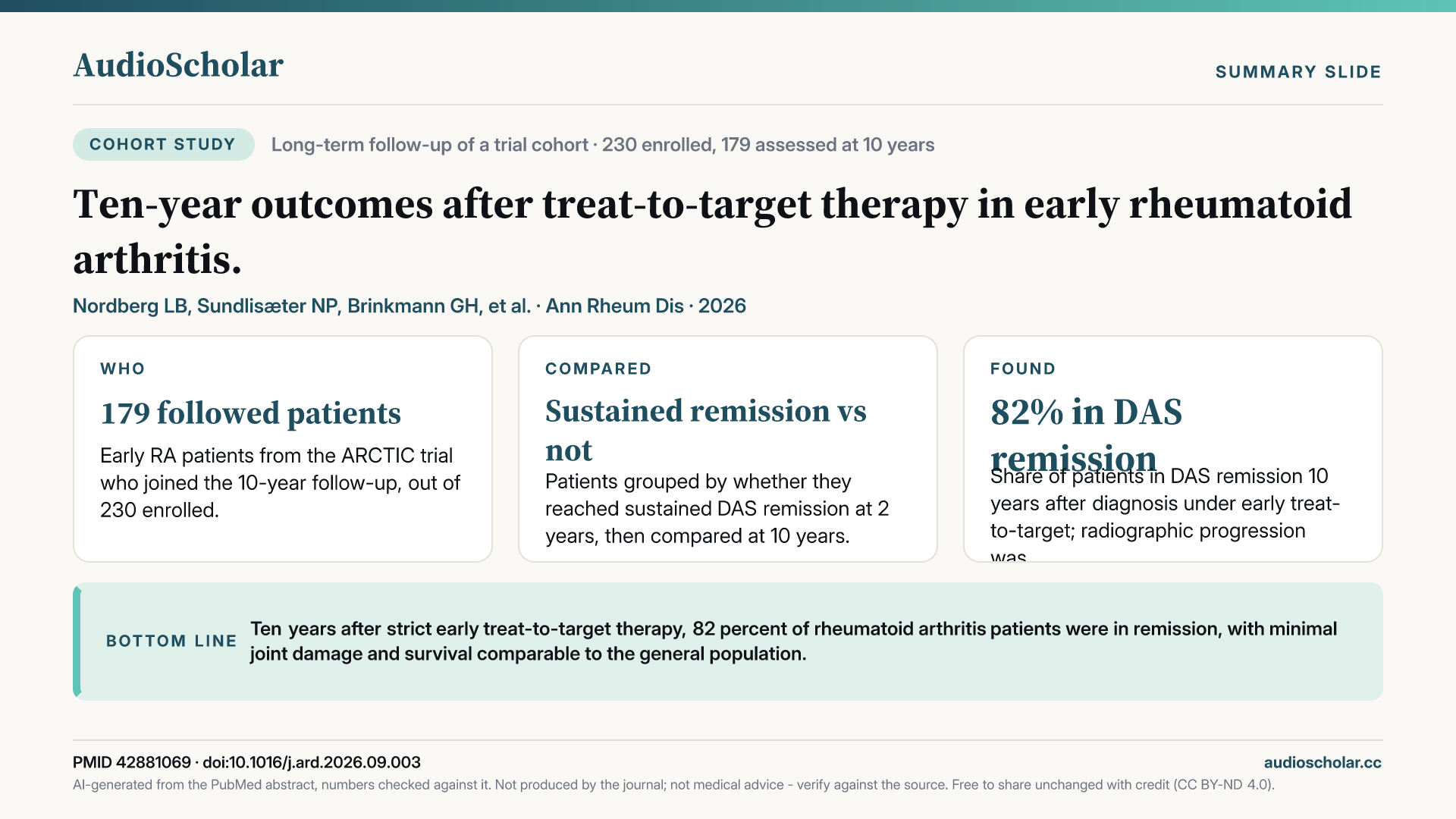
Ten years after strict early treat-to-target therapy, 82 percent of rheumatoid arthritis patients were in remission, with minimal joint damage and survival comparable to the general population.
Annals of the Rheumatic Diseases · 2026 · PubMed

This week’s papers
- 01
Ten-year outcomes after treat-to-target therapy in early rheumatoid arthritis.
Ten years after strict early treat-to-target therapy, 82 percent of rheumatoid arthritis patients were in remission, with minimal joint damage and survival comparable to the general population.
Nordberg LB et al. · Annals of the Rheumatic Diseases · 2026
From the briefingWe start with rheumatoid arthritis, where this week's papers stretch from a decade of follow-up after treat-to-target care to therapies that aim to reset the immune system altogether. In the Annals of the Rheumatic Diseases, Nordberg and colleagues returned to the 230 patients from the ARCTIC trial, who received a strict treat-to-target strategy for two years after diagnosis, and invited them back at ten years [1]. Ninety-five percent of the original cohort were alive, and 82 percent of the patients who took part were in remission by disease activity score a decade after diagnosis. Radiographic progression was minimal, with a median change of about two points on the modified Sharp score over ten years, physical function and quality of life approached population norms, and survival matched the general population. Patients who had reached sustained remission by two years had lower disease activity and better function at ten years. This is a single trial cohort without an untreated comparator, and the remission link is an association, but it is reassuring long-term evidence that the early tight-control model underpinning current recommendations delivers durable results.
If you only have time for one paper this week, make it the ten-year ARCTIC follow-up in the Annals of the Rheumatic Diseases [1]. It offers rare decade-long evidence that early treat-to-target care in rheumatoid arthritis translates into lasting remission, preserved joints and normal survival.
Written by AI from the published abstract, for healthcare professionals. Not medical advice; check the paper before acting on it.
- 02
Cardiovascular risk associated with first-line Janus kinase inhibitors versus TNF inhibitors in patients with RA: a nationwide cohort study.
In Korean nationwide data on about 6,200 rheumatoid arthritis patients, first-line Janus kinase inhibitors showed no significant difference in major cardiovascular events compared with TNF inhibitors.
Kwon OC et al. · Rheumatology · 2026
From the briefingKwon and colleagues used Korean nationwide claims data on about 6,200 patients starting their first advanced therapy and found that major cardiovascular events were rare, around four per thousand patient-years, and did not differ significantly between those starting a Janus kinase inhibitor and those starting a TNF inhibitor, including in patients with baseline cardiovascular risk factors and after propensity matching [2]. The authors read this as real-world support for first-line Janus kinase inhibitor safety, though the Janus kinase group was small, event counts were low, and the estimates were imprecise, so the study cannot exclude a meaningful difference.
Written by AI from the published abstract, for healthcare professionals. Not medical advice; check the paper before acting on it.
- 03
Reasons-stratified treatment retention after JAK inhibitor discontinuation in rheumatoid arthritis: the ANSWER cohort study.
After Janus kinase inhibitor failure, abatacept was stopped for ineffectiveness more often than a second Janus kinase inhibitor, while after toxicity, TNF and interleukin-6 blockers were better tolerated.
Fujisawa Y et al. · Rheumatology · 2026
From the briefingFrom the Japanese ANSWER cohort, Fujisawa and colleagues looked at what happens after a Janus kinase inhibitor is stopped, across 500 treatment courses [3]. When the first Janus kinase inhibitor failed for lack of effect, abatacept was linked to nearly three times the risk of stopping for ineffectiveness compared with cycling to another Janus kinase inhibitor, while after a toxic adverse event, TNF inhibitors and interleukin-6 receptor blockers were less likely than a second Janus kinase inhibitor to be stopped for toxicity. Disease activity trajectories over a year did not differ between groups. This is observational and hypothesis-generating, but it supports the idea that the reason for discontinuation, not just the fact of it, should shape sequencing.
Written by AI from the published abstract, for healthcare professionals. Not medical advice; check the paper before acting on it.
- 04
Innovative therapies in rheumatoid arthritis: CAR T cells and bispecific antibodies.
Early evidence suggests CD19-directed T-cell engagers and CAR T cells may induce drug-free remission in some refractory rheumatoid arthritis patients, but safety and positioning remain unestablished.
Avouac J et al. · Lancet Rheumatology · 2026
From the briefingLooking further ahead, a Review by Avouac and colleagues in Lancet Rheumatology appraises CD19-directed T-cell engagers and CAR T cells for refractory rheumatoid arthritis, noting early reports of profound immune remodelling and drug-free remission in some individuals [4]. The authors are clear that this evidence is early and that harms, feasibility and positioning remain open, and they set out a research agenda built on careful trial design and long-term safety surveillance.
Written by AI from the published abstract, for healthcare professionals. Not medical advice; check the paper before acting on it.
- 05
Sustained Inhibition of Structural Damage Progression and Improvements in Disease Activity With Guselkumab in Biologic-Naïve Participants with Active and Erosive Psoriatic Arthritis: Results Through Week 48 of the Phase 3b Randomized, Double-Blind, Placebo-Controlled APEX Study.
Through 48 weeks, guselkumab sustained joint and skin responses and low radiographic progression in erosive psoriatic arthritis, and slowed damage in patients switched from placebo.
Ritchlin CT et al. · Arthritis & Rheumatology · 2026
From the briefingIn Arthritis and Rheumatology, Ritchlin and colleagues reported 48-week results from the phase 3b APEX trial of guselkumab in about a thousand biologic-naive adults with active, erosive psoriatic arthritis [5]. Response rates held steady through a year, with roughly seven in ten patients reaching ACR20 and three quarters or more achieving near-complete skin clearance, and radiographic progression stayed low. Patients switched from placebo at week 24 saw their rate of structural progression fall by more than half in the second six months. Safety was stable. The longer-term extension is uncontrolled after week 24, but it strengthens the case that interleukin-23 inhibition slows joint damage, not just symptoms, in this erosive population.
Written by AI from the published abstract, for healthcare professionals. Not medical advice; check the paper before acting on it.
- 06
The ASAS core set for the assessment of axial spondyloarthritis in clinical practice.
An ASAS-endorsed core set defines five domains for routine axial spondyloarthritis visits and four additional domains for extended visits, standardising clinical assessment.
van Tubergen A et al. · Annals of the Rheumatic Diseases · 2026
From the briefingIn the Annals of the Rheumatic Diseases, van Tubergen and colleagues present the ASAS core set for assessing axial spondyloarthritis in routine practice [6]. Developed through a literature review and Delphi process involving rheumatologists and patients, and endorsed by a majority of ASAS members, it defines five domains for every routine visit: disease activity, pain, peripheral manifestations, extra-musculoskeletal manifestations, and treatment aspects, each with one recommended instrument. Extended visits add structural damage, overall functioning, comorbidities and mobility. This is consensus rather than outcome data, but it offers a common minimum framework that aligns with management recommendations.
Written by AI from the published abstract, for healthcare professionals. Not medical advice; check the paper before acting on it.
- 07
Emerging therapies for knee osteoarthritis.
Knee osteoarthritis therapies are diversifying, with semaglutide showing substantial pain and function benefits and gene and anabolic therapies promising, while stromal cell therapies remain inconsistent.
Courties A et al. · Nature Reviews Rheumatology · 2026
From the briefingRounding out the theme, a Nature Reviews Rheumatology piece by Courties and colleagues surveys emerging therapies for knee osteoarthritis [7]. They describe semaglutide as the first incretin-based therapy to show substantial benefits for pain and function, and highlight encouraging signals from locally delivered GLP-1 receptor agonists, the anabolic agent TPX-100 and intra-articular interleukin-1 receptor antagonist gene therapy, while noting that mesenchymal stromal cell therapies have been inconsistent across phase three trials. Much of this pipeline remains investigational, and true disease modification is still unproven.
Written by AI from the published abstract, for healthcare professionals. Not medical advice; check the paper before acting on it.
- 08
Deep clinical renal response in lupus nephritis treated with belimumab: a real-world cohort study.
In a small single-centre lupus nephritis cohort on add-on belimumab, just over half reached a stringent deep renal response by 24 months, though long-term benefit is unproven.
Xipell M et al. · Rheumatology · 2026
From the briefingOur final theme is connective tissue disease and antiphospholipid syndrome, where three papers question how we define response, severity and diagnosis. In Rheumatology, Xipell and colleagues studied 43 patients with biopsy-proven lupus nephritis given add-on belimumab at a single centre [8]. They tested a stricter target they call deep clinical renal response, requiring protein-to-creatinine ratio below 200 milligrams per gram, no active glomerular haematuria and stable function. Just over half of the patients reached it by 24 months, compared with about three quarters meeting conventional complete response, and deep responses took more than twice as long to appear, still accruing in the second year. In eight repeat biopsies, histological activity fell, though chronicity rose. The authors call these findings exploratory: the cohort is small, retrospective and uncontrolled, and whether deeper response protects kidneys long term is unknown.
Written by AI from the published abstract, for healthcare professionals. Not medical advice; check the paper before acting on it.
- 09
Initial treatment strategies and outcomes across haemodynamic thresholds and risk stratification in incident systemic sclerosis-associated pulmonary arterial hypertension: a EUSTAR analysis.
In scleroderma pulmonary hypertension, sustained initial therapy was linked to lower mortality and progression in as-treated but not intention-to-treat analyses, and milder cases were often untreated.
Bjørkekjær HJ et al. · Arthritis & Rheumatology · 2026
From the briefingIn Arthritis and Rheumatology, Bjørkekjær and colleagues analysed about 300 treatment-naive patients with scleroderma-associated pulmonary arterial hypertension in the EUSTAR registry [9]. Only about a third of patients with milder haemodynamics, a mean pulmonary pressure of 21 to 24 or resistance of 2 to 3 Wood units, started therapy, compared with nearly four in five meeting the older definition. Over about four years, 42 percent of patients died. In as-treated analyses, sustained initial therapy was linked to roughly half the mortality risk and about a third the risk of progression, but intention-to-treat analyses showed no association. The authors flag that contrast as a warning about observational treatment comparisons, and say the milder subgroup needs dedicated prospective trials.
Written by AI from the published abstract, for healthcare professionals. Not medical advice; check the paper before acting on it.
- 10
Clinical performance of obstetric antiphospholipid syndrome classification criteria: an ambispective cohort study.
The 2006 Sydney criteria identified about four in five expert-diagnosed obstetric antiphospholipid cases, while the 2023 ACR/EULAR criteria caught only about a quarter, marking a higher-risk subset.
Liu H et al. · Rheumatology · 2026
From the briefingFinally, Liu and colleagues, also in Rheumatology, compared antiphospholipid syndrome classification criteria in about 1,700 women in a single-centre Chinese cohort [10]. Against expert diagnosis, the 2006 Sydney criteria caught about four in five obstetric cases, while the 2023 ACR and EULAR criteria caught only about a quarter, though with near-perfect specificity. Women meeting the newer criteria had worse pregnancy outcomes, suggesting they identify a high-risk subset. Live birth rates after treatment were similar across expert-defined groups. The authors conclude that the Sydney criteria remain better suited to clinical identification, a reminder that classification criteria built for research can miss patients in the clinic, though this is one centre's experience.
Written by AI from the published abstract, for healthcare professionals. Not medical advice; check the paper before acting on it.
The full briefing
This AudioScholar briefing is generated by artificial intelligence for healthcare professionals and trainees. It is not medical advice.
Welcome to This Week in Rheumatology. This week we're covering 10 notable papers spanning long-term strategy and drug sequencing in rheumatoid arthritis, new data and new standards in psoriatic arthritis, axial spondyloarthritis and osteoarthritis, and diagnostic and treatment questions in lupus, scleroderma and antiphospholipid syndrome. Let's dive in.
We start with rheumatoid arthritis, where this week's papers stretch from a decade of follow-up after treat-to-target care to therapies that aim to reset the immune system altogether. In the Annals of the Rheumatic Diseases, Nordberg and colleagues returned to the 230 patients from the ARCTIC trial, who received a strict treat-to-target strategy for two years after diagnosis, and invited them back at ten years [1]. Ninety-five percent of the original cohort were alive, and 82 percent of the patients who took part were in remission by disease activity score a decade after diagnosis. Radiographic progression was minimal, with a median change of about two points on the modified Sharp score over ten years, physical function and quality of life approached population norms, and survival matched the general population. Patients who had reached sustained remission by two years had lower disease activity and better function at ten years. This is a single trial cohort without an untreated comparator, and the remission link is an association, but it is reassuring long-term evidence that the early tight-control model underpinning current recommendations delivers durable results. Two papers in Rheumatology then turn to Janus kinase inhibitors. Kwon and colleagues used Korean nationwide claims data on about 6,200 patients starting their first advanced therapy and found that major cardiovascular events were rare, around four per thousand patient-years, and did not differ significantly between those starting a Janus kinase inhibitor and those starting a TNF inhibitor, including in patients with baseline cardiovascular risk factors and after propensity matching [2]. The authors read this as real-world support for first-line Janus kinase inhibitor safety, though the Janus kinase group was small, event counts were low, and the estimates were imprecise, so the study cannot exclude a meaningful difference. From the Japanese ANSWER cohort, Fujisawa and colleagues looked at what happens after a Janus kinase inhibitor is stopped, across 500 treatment courses [3]. When the first Janus kinase inhibitor failed for lack of effect, abatacept was linked to nearly three times the risk of stopping for ineffectiveness compared with cycling to another Janus kinase inhibitor, while after a toxic adverse event, TNF inhibitors and interleukin-6 receptor blockers were less likely than a second Janus kinase inhibitor to be stopped for toxicity. Disease activity trajectories over a year did not differ between groups. This is observational and hypothesis-generating, but it supports the idea that the reason for discontinuation, not just the fact of it, should shape sequencing. Looking further ahead, a Review by Avouac and colleagues in Lancet Rheumatology appraises CD19-directed T-cell engagers and CAR T cells for refractory rheumatoid arthritis, noting early reports of profound immune remodelling and drug-free remission in some individuals [4]. The authors are clear that this evidence is early and that harms, feasibility and positioning remain open, and they set out a research agenda built on careful trial design and long-term safety surveillance.
Our second theme covers psoriatic disease, axial spondyloarthritis and osteoarthritis, where the focus is on durable structural protection and on standardising how we measure disease. In Arthritis and Rheumatology, Ritchlin and colleagues reported 48-week results from the phase 3b APEX trial of guselkumab in about a thousand biologic-naive adults with active, erosive psoriatic arthritis [5]. Response rates held steady through a year, with roughly seven in ten patients reaching ACR20 and three quarters or more achieving near-complete skin clearance, and radiographic progression stayed low. Patients switched from placebo at week 24 saw their rate of structural progression fall by more than half in the second six months. Safety was stable. The longer-term extension is uncontrolled after week 24, but it strengthens the case that interleukin-23 inhibition slows joint damage, not just symptoms, in this erosive population. In the Annals of the Rheumatic Diseases, van Tubergen and colleagues present the ASAS core set for assessing axial spondyloarthritis in routine practice [6]. Developed through a literature review and Delphi process involving rheumatologists and patients, and endorsed by a majority of ASAS members, it defines five domains for every routine visit: disease activity, pain, peripheral manifestations, extra-musculoskeletal manifestations, and treatment aspects, each with one recommended instrument. Extended visits add structural damage, overall functioning, comorbidities and mobility. This is consensus rather than outcome data, but it offers a common minimum framework that aligns with management recommendations. Rounding out the theme, a Nature Reviews Rheumatology piece by Courties and colleagues surveys emerging therapies for knee osteoarthritis [7]. They describe semaglutide as the first incretin-based therapy to show substantial benefits for pain and function, and highlight encouraging signals from locally delivered GLP-1 receptor agonists, the anabolic agent TPX-100 and intra-articular interleukin-1 receptor antagonist gene therapy, while noting that mesenchymal stromal cell therapies have been inconsistent across phase three trials. Much of this pipeline remains investigational, and true disease modification is still unproven.
Our final theme is connective tissue disease and antiphospholipid syndrome, where three papers question how we define response, severity and diagnosis. In Rheumatology, Xipell and colleagues studied 43 patients with biopsy-proven lupus nephritis given add-on belimumab at a single centre [8]. They tested a stricter target they call deep clinical renal response, requiring protein-to-creatinine ratio below 200 milligrams per gram, no active glomerular haematuria and stable function. Just over half of the patients reached it by 24 months, compared with about three quarters meeting conventional complete response, and deep responses took more than twice as long to appear, still accruing in the second year. In eight repeat biopsies, histological activity fell, though chronicity rose. The authors call these findings exploratory: the cohort is small, retrospective and uncontrolled, and whether deeper response protects kidneys long term is unknown. In Arthritis and Rheumatology, Bjørkekjær and colleagues analysed about 300 treatment-naive patients with scleroderma-associated pulmonary arterial hypertension in the EUSTAR registry [9]. Only about a third of patients with milder haemodynamics, a mean pulmonary pressure of 21 to 24 or resistance of 2 to 3 Wood units, started therapy, compared with nearly four in five meeting the older definition. Over about four years, 42 percent of patients died. In as-treated analyses, sustained initial therapy was linked to roughly half the mortality risk and about a third the risk of progression, but intention-to-treat analyses showed no association. The authors flag that contrast as a warning about observational treatment comparisons, and say the milder subgroup needs dedicated prospective trials. Finally, Liu and colleagues, also in Rheumatology, compared antiphospholipid syndrome classification criteria in about 1,700 women in a single-centre Chinese cohort [10]. Against expert diagnosis, the 2006 Sydney criteria caught about four in five obstetric cases, while the 2023 ACR and EULAR criteria caught only about a quarter, though with near-perfect specificity. Women meeting the newer criteria had worse pregnancy outcomes, suggesting they identify a high-risk subset. Live birth rates after treatment were similar across expert-defined groups. The authors conclude that the Sydney criteria remain better suited to clinical identification, a reminder that classification criteria built for research can miss patients in the clinic, though this is one centre's experience.
If you only have time for one paper this week, make it the ten-year ARCTIC follow-up in the Annals of the Rheumatic Diseases [1]. It offers rare decade-long evidence that early treat-to-target care in rheumatoid arthritis translates into lasting remission, preserved joints and normal survival.
Here is what this week's evidence adds up to in Rheumatology. First, early tight control in rheumatoid arthritis now has ten-year data behind it, though from one cohort without a comparison arm. Second, observational data suggest first-line Janus kinase inhibitors carry no excess cardiovascular risk compared with TNF inhibitors in a lower-risk Asian population, and that sequencing after Janus kinase inhibitor failure may depend on why the drug was stopped; neither question is settled by trial evidence. Third, guselkumab maintains clinical response and structural protection through a year in erosive psoriatic arthritis. Fourth, in lupus nephritis and scleroderma pulmonary hypertension, deeper targets and earlier treatment look promising but rest on small or observational data with conflicting analyses. And fifth, the 2023 antiphospholipid criteria appear to miss many obstetric cases that clinicians would recognise, which raises questions about their use outside research.
That's your roundup for This Week in Rheumatology. The full transcript and references are available on the episode page. This is an AI-curated summary — for clinical decisions, always consult primary sources and current guidelines. See you next week.
If this weekly briefing is useful, follow the show in your podcast app so new episodes arrive automatically. And think of one colleague — in any specialty — who never has time to keep up with the literature. Tell them about AudioScholar: a free ten-minute weekly for every specialty, to listen to in any podcast app, or to read at audioscholar dot C C.
This is an automated summary generated by artificial intelligence, which can make mistakes. Always review the original source materials.
Spot something worth flagging?
Get this every week in your podcast app — free.
New rheumatology episodes land in your feed automatically — listen on your commute.