This Week in Nephrology — Oct 7, 2026
Generated Oct 7, 2026 · 11:47
The week's practice-changing Nephrology research, summarized for clinicians.
If the audio fails to play, refresh the page to renew the link.
Get next week’s Nephrology briefing — free.
In your podcast app, or readable in your inbox with the audio one tap away.
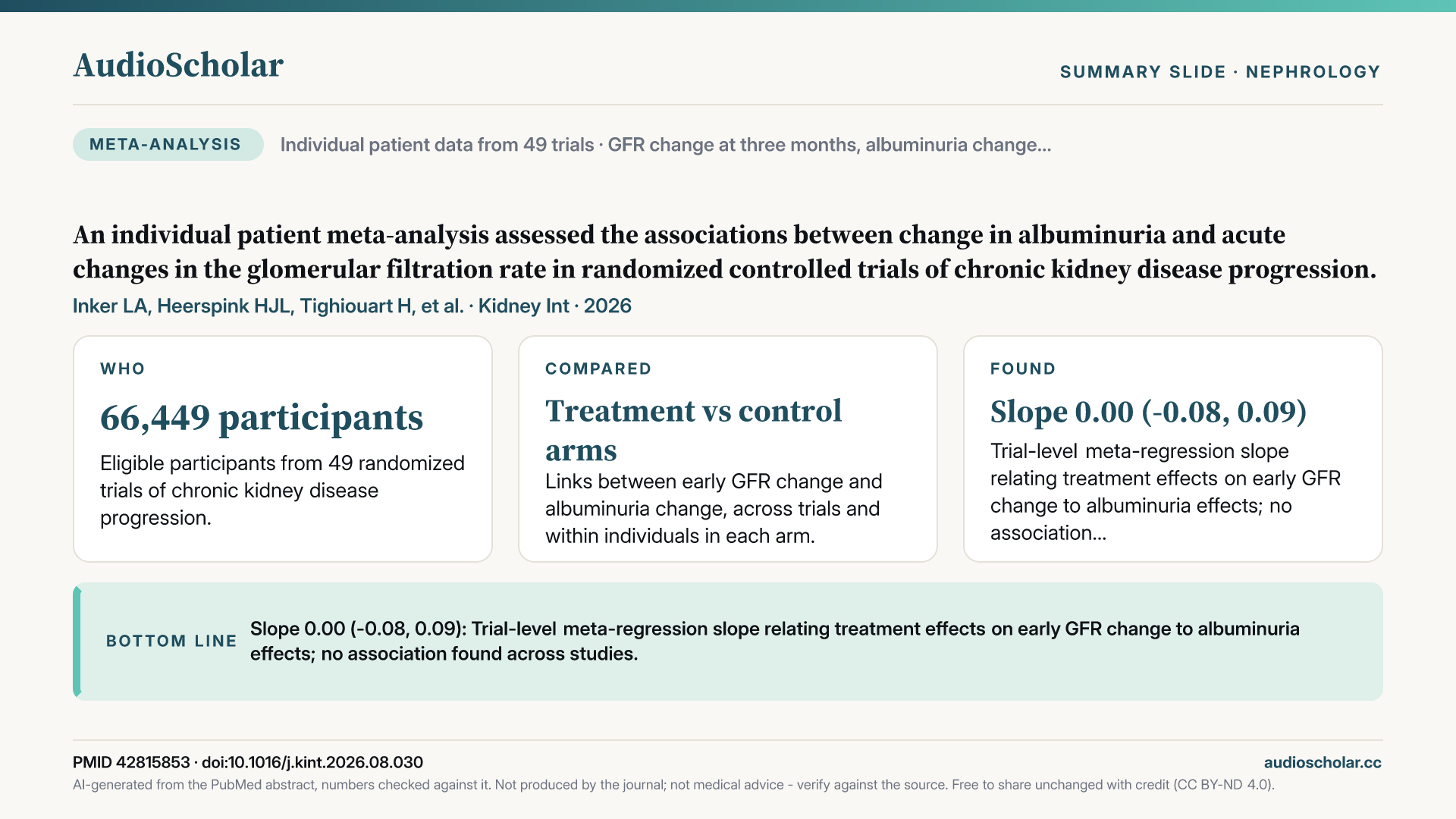
An individual patient meta-analysis assessed the associations between change in albuminuria and acute changes in the glomerular filtration rate in randomized controlled trials of chronic kidney disease progression.
Across 49 trials and over 66,000 participants, early GFR and albuminuria changes were similarly linked in treatment and placebo arms, suggesting they reflect disease course rather than drug effect.
Kidney International · 2026 · PubMed

This week’s papers
- 01
Effects of semaglutide on kidney disease in type 2 diabetes: a randomized placebo-controlled trial.
Semaglutide did not change coprimary MRI measures of kidney oxygenation, perfusion or inflammation, but secondary data suggested lower vascular resistance, halted fibrosis progression and improved glomerular endothelial programs.
Tuttle KR et al. · Nature Medicine · 2026
- 02
Superimposed FSGS Lesions Worsen Kidney Prognosis in Diabetic Nephropathy.
In 67 patients with biopsy-proven diabetic nephropathy, superimposed FSGS lesions were associated with roughly threefold higher risk of kidney failure, though the small retrospective cohort limits certainty.
Vargas-Brochero MJ et al. · Kidney360 · 2026
- 03
An individual patient meta-analysis assessed the associations between change in albuminuria and acute changes in the glomerular filtration rate in randomized controlled trials of chronic kidney disease progression.
Across 49 trials and over 66,000 participants, early GFR and albuminuria changes were similarly linked in treatment and placebo arms, suggesting they reflect disease course rather than drug effect.
Inker LA et al. · Kidney International · 2026
- 04
Comparative Cardiovascular Outcomes of Lanthanum Carbonate and Sevelamer in Dialysis.
In a Chinese target trial emulation of over 10,000 dialysis patients, lanthanum carbonate was associated with about a fifth fewer major cardiovascular events and lower mortality than sevelamer.
Liu J et al. · Journal of the American Society of Nephrology · 2026
- 05
Beyond Kt/V: Redefining Dialysis Adequacy as Targeted Cardiovascular Risk Reduction.
Hemodiafiltration, intensive schedules, membranes and individualized dialysate show promise for cardiovascular protection in dialysis, but hard-outcome evidence is mostly lacking and mechanism-matched trials are needed.
Zoccali C et al. · Nephrology Dialysis Transplantation · 2026
- 06
Heart failure in chronic kidney disease: what the second universal definition changes.
The 2026 universal heart failure definition, moving beyond ejection fraction thresholds toward trajectories and stages, offers nephrology a shared vocabulary but risks diagnostic inflation in kidney disease and dialysis.
Zoccali C et al. · Nephrology Dialysis Transplantation · 2026
- 07
Systematic Review of Persistent Microscopic Hematuria and Kidney Outcomes in IgAN.
Pooled cohort data show persistent microscopic hematuria in IgA nephropathy is associated with more than doubled risk of kidney disease progression, supporting it as an added prognostic marker.
Berti GM et al. · Kidney International Reports · 2026
- 08
Clinical and Pathologic Characteristics of Patients With ANCA-Associated Vasculitis With Renal Arteritis.
Renal arteritis, present in about one in seven Chinese patients with ANCA vasculitis, independently predicted end-stage kidney disease among those rated low or moderate risk by the ANCA kidney risk score.
Li YJ et al. · Kidney International Reports · 2026
- 09
Resistant Hypertension: State of the Art Review.
Resistant hypertension management centres on excluding pseudo-resistance, triple therapy then a mineralocorticoid receptor antagonist, with aprocitentan, baxdrostat and renal denervation expanding options for uncontrolled patients.
Khan MS et al. · Clinical Journal of the American Society of Nephrology · 2026
- 10
Delisting Strategies in Highly Sensitised Kidney Transplant Candidates.
HLA antigen delisting can expand transplant offers for highly sensitised candidates, but transplanting across donor-specific antibodies raises rejection risk and centre practices remain unstandardised.
D'Angelo M et al. · Nephrology Dialysis Transplantation · 2026
The full briefing
This AudioScholar briefing is generated by artificial intelligence for healthcare professionals and trainees. It is not medical advice.
Welcome to This Week in Nephrology. This week we're covering 10 notable papers spanning diabetic kidney disease and what our markers really tell us, cardiovascular risk in dialysis, and prognosis in glomerular disease, with two practical reviews on resistant hypertension and transplant access. Let's dive in.
We start with diabetic kidney disease, where this week's papers ask how our therapies work and how much we can read from the numbers and biopsies we follow. In Nature Medicine, Tuttle and colleagues report a 52-week randomized trial of semaglutide 1 milligram weekly versus placebo in 106 people with type 2 diabetes and chronic kidney disease, combining multiparametric kidney MRI with biopsy, single-nucleus and spatial transcriptomics [1]. The headline is a negative one: none of the three coprimary imaging outcomes, kidney oxygenation, global perfusion, and tissue inflammation on T1 mapping, changed significantly with semaglutide. The signals came from secondary outcomes. Semaglutide lowered the renal artery resistive index, stabilized a diffusion measure the authors interpret as halting fibrosis progression, and produced pronounced transcriptomic changes in glomerular endothelial cells, with fewer immune cells clustered near those cells. The authors propose reduced vascular resistance, fibrosis prevention and healthier endothelial programs as plausible mechanisms. These are hypothesis-generating findings from small biopsy subsets, so they add biological texture to the established kidney benefit rather than new clinical guidance. From the other end of the diabetic spectrum, a small retrospective cohort in Kidney360 from Vargas-Brochero and colleagues examined 67 patients with biopsy-confirmed diabetic nephropathy [2]. More than half of those patients had superimposed focal segmental glomerulosclerosis lesions, and those patients had heavier albuminuria, more interstitial fibrosis and more advanced diabetic classes. After adjustment, FSGS lesions were associated with roughly a threefold higher risk of kidney failure, alongside prior stroke and lower serum albumin. With so few patients and a single biopsy series, this is best read as a prompt to look carefully at FSGS on diabetic biopsies, not yet a validated risk tool.
That question of what our markers mean gets a much larger answer in Kidney International. Inker, Heerspink and colleagues pooled individual data from 49 randomized trials and more than 66,000 participants to ask whether the early drop in GFR and the early fall in albuminuria after starting a drug reflect treatment effect [3]. At the trial level, there was no association at all between a treatment's effect on early GFR and its effect on albuminuria. Within individual patients, a steeper early GFR decline did go with a modest fall in albumin-to-creatinine ratio, but the relationship was nearly identical in the placebo arms as in the treatment arms, and it disappeared in immunosuppression trials. The authors conclude that these early paired changes likely reflect natural disease history or other factors rather than drug action. For the practising nephrologist, this challenges the common habit of reading an individual patient's early eGFR dip or albuminuria response as proof that a drug is working, although the analysis addresses early markers and not long-term outcomes.
Our second theme is cardiovascular risk in dialysis, where one large observational study and two thoughtful reviews converge on the same problem. In the Journal of the American Society of Nephrology, Liu and colleagues used the China Renal Data System to emulate a target trial comparing lanthanum carbonate with sevelamer in dialysis patients with hyperphosphatemia and no prior major cardiovascular events [4]. Among more than 10,000 propensity-matched new users followed for three years, lanthanum initiation was associated with about a fifth lower risk of myocardial infarction, stroke or cardiovascular death, with cumulative incidence of about 9.5 percent versus 12 percent, which the authors translate to treating roughly 37 patients to prevent one event. All-cause and cardiovascular mortality were also lower, and results held across sensitivity and competing-risk analyses. This is the most direct comparative evidence we have between these two binders, but it remains observational, in a single national population, and residual confounding in who receives which binder cannot be excluded; it is enough to justify a randomized comparison, not to settle the question. Writing in Nephrology Dialysis Transplantation, Zoccali, Strippoli, Locatelli and colleagues argue that dialysis adequacy should be redefined around cardiovascular protection rather than small-solute clearance [5]. They note that high-dose hemodiafiltration has shown survival benefit in some trials but with variable results, that frequent and nocturnal schedules improve left ventricular mass and blood pressure without firm hard-outcome data, and that medium cut-off membranes, individualized dialysate potassium and sodium, and incremental dialysis all remain physiologically appealing but unproven. Their call is for phenotype-enriched trials with endpoints matched to mechanism. Also in Nephrology Dialysis Transplantation, Zoccali and Mallamaci interpret the 2026 Second Universal Definition of Heart Failure for nephrology [6]. The new framework moves beyond rigid ejection fraction thresholds, recognizes at-risk and pre-heart-failure stages, and tracks trajectories such as worsening versus decompensation. The authors point out that in kidney disease, dyspnoea, oedema, raised biomarkers and structural cardiac changes are common but individually non-diagnostic, especially in dialysis, and they caution against diagnostic inflation while welcoming a shared vocabulary for cardiac and kidney teams.
Our third theme is prognosis in immune-mediated glomerular disease, where two papers in Kidney International Reports refine risk beyond our standard tools. Berti and colleagues systematically reviewed persistent microscopic hematuria in IgA nephropathy, identifying eight cohorts with nearly 4,800 participants [7]. Pooling six studies, persistent microhematuria was associated with a little more than a doubling, approaching two and a half times, of the risk of kidney disease progression, with low heterogeneity, and the finding held when an updated cohort was swapped in and when any single study was removed. Definitions of hematuria varied, and continuous measures could not be pooled, so the evidence supports longitudinal hematuria as an added prognostic signal alongside proteinuria and eGFR, while its role in guiding treatment awaits prospective study. Li and colleagues examined renal arteritis in 511 Chinese patients with biopsy-proven ANCA-associated vasculitis [8]. About one in seven patients had arteritis, and those patients were older, more inflamed systemically and had more extrarenal disease, with fewer crescents but more necrotizing lesions. They responded better to immunosuppression, yet overall renal survival was similar. The notable finding is that among patients classed as low or moderate risk by the ANCA kidney risk score, arteritis was independently associated with a higher risk of end-stage kidney disease, suggesting the score may underestimate risk in this subgroup. This is retrospective work from a single population and needs external validation.
Two reviews round out the week. In the Clinical Journal of the American Society of Nephrology, Khan, Arshad, Hall and colleagues review resistant hypertension, which affects over 140 million people globally [9]. They emphasize excluding pseudo-resistance with ambulatory and home monitoring and screening for secondary causes, then describe guideline-directed triple therapy followed by a mineralocorticoid receptor antagonist as preferred fourth-line agent, with particular attention to volume, diuretic choice and hyperkalemia in kidney disease. They highlight newly approved aprocitentan and baxdrostat, renal denervation for selected patients, and investigational RNA-based therapies. In Nephrology Dialysis Transplantation, D'Angelo and colleagues review HLA antigen delisting for highly sensitised transplant candidates, the practice of removing selected lower-risk antigens from the unacceptable list to increase offers [10]. They describe stepwise approaches but stress that transplanting across pre-existing donor-specific antibodies carries more antibody-mediated rejection and poorer graft outcomes, and that definitions and thresholds vary widely between centres.
If you only have time for one paper this week, make it the individual patient meta-analysis from Inker, Heerspink and colleagues in Kidney International [3]. Drawing on dozens of trials, it reopens a question nephrologists face daily, namely whether an individual patient's early eGFR dip or albuminuria response actually tells us anything about the drug they have just started.
Here is what this week's evidence adds up to in Nephrology. First, large pooled trial data suggest that early changes in GFR and albuminuria in an individual patient mostly reflect disease course rather than drug effect, which weakens their use as personal markers of treatment response, though long-term outcome implications were not tested. Second, observational target trial evidence associates lanthanum carbonate with fewer cardiovascular events and deaths than sevelamer in dialysis, a signal strong enough to warrant a randomized trial but not to settle binder choice. Third, semaglutide's kidney benefit gains mechanistic support around vascular resistance, fibrosis and endothelial health, even though the trial's primary imaging outcomes were negative. Fourth, biopsy and urinary findings, including FSGS lesions in diabetic nephropathy, persistent hematuria in IgA nephropathy, and renal arteritis in lower-risk ANCA vasculitis, each appear to add prognostic information, all from observational data still awaiting prospective validation. And finally, reviews on dialysis adequacy and heart failure definitions agree that cardiovascular protection in kidney failure remains under-tested by adequately powered trials.
That's your roundup for This Week in Nephrology. The full transcript and references are available on the episode page in your AudioScholar library. This is an AI-curated summary — for clinical decisions, always consult primary sources and current guidelines. See you next week.
If this weekly briefing is useful, follow the show in your podcast app so new episodes arrive automatically. And if you have a paper you have been meaning to read, upload the PDF, or paste any link, at audioscholar dot C C. We will turn it into audio like this one, in any of thirty-one languages.
This is an automated summary generated by artificial intelligence, which can make mistakes. Always review the original source materials.
Spot something worth flagging?
Get this every week in your podcast app — free.
New nephrology episodes land in your feed automatically — listen on your commute.