This Week in Allergy & Immunology — Oct 11, 2026
Generated Oct 12, 2026 · 11:39
The week's practice-changing Allergy & Immunology research, summarized for clinicians.
If the audio fails to play, refresh the page to renew the link.
Get next week’s Allergy & Immunology briefing — free.
In your podcast app, or readable in your inbox with the audio one tap away.
Efficacy of Dupilumab for Patients with Chronic Rhinosinusitis without Nasal Polyps: a Randomized Double-Blind Placebo Controlled Phase II Study.
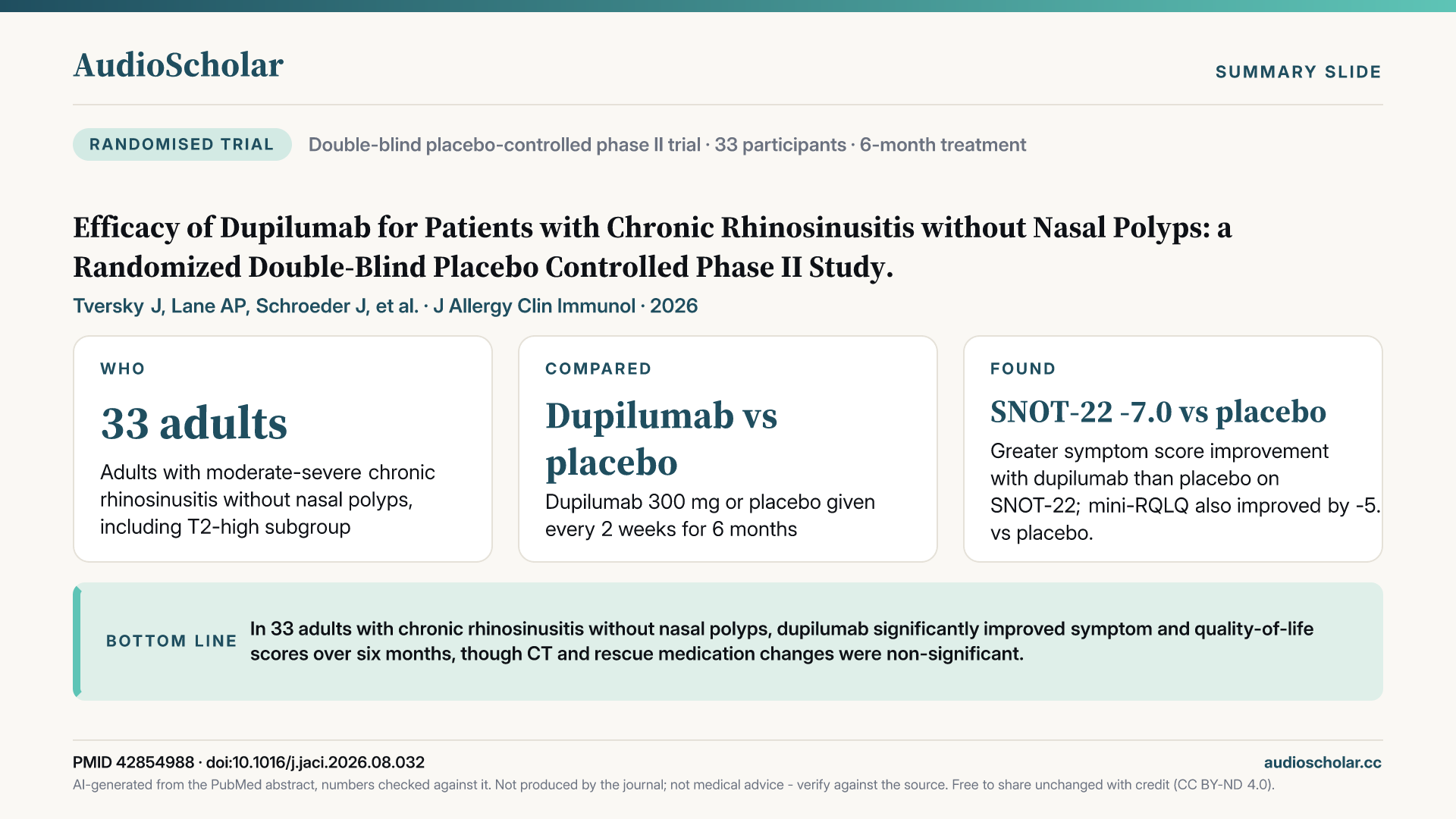
In 33 adults with chronic rhinosinusitis without nasal polyps, dupilumab significantly improved symptom and quality-of-life scores over six months, though CT and rescue medication changes were non-significant.
Journal of Allergy and Clinical Immunology · 2026 · PubMed

This week’s papers
- 01
Efficacy of Dupilumab for Patients with Chronic Rhinosinusitis without Nasal Polyps: a Randomized Double-Blind Placebo Controlled Phase II Study.
In 33 adults with chronic rhinosinusitis without nasal polyps, dupilumab significantly improved symptom and quality-of-life scores over six months, though CT and rescue medication changes were non-significant.
Tversky J et al. · Journal of Allergy and Clinical Immunology · 2026
- 02
Integrated-omics endotyping of patients with chronic rhinosinusitis with nasal polyps and their response to glucocorticoid therapy.
Combining nasal transcriptomics and microbiota identified four nasal polyp endotypes, with a Staphylococcus-dominated type 2 cluster showing the highest response to add-on systemic corticosteroids at about 94 percent.
Yan B et al. · Journal of Allergy and Clinical Immunology · 2026
- 03
Comparative Efficacy of Biologics for Patients with Severe Eosinophilic Asthma: A Network Meta-analysis.
Across 17 trials in severe eosinophilic asthma, tezepelumab and mepolizumab ranked highest for reducing exacerbations, but low certainty for indirect comparisons means head-to-head trials are still needed.
Ren X et al. · International Archives of Allergy and Immunology · 2026
- 04
Tryptase Locus Variation Contributes to Normal-Range Basal Serum Tryptase Variability and Is Associated With Anaphylaxis.
In venom-allergic patients without mastocytosis or hereditary alpha-tryptasemia, active tryptase allele number explained normal-range tryptase variation, and four active beta alleles were linked to less anaphylaxis.
Svetina M et al. · Clinical and Experimental Allergy · 2026
- 05
Mast cell activation syndrome: Global perspectives from a World Allergy Organization survey on knowledge, diagnosis, and access to care.
A global allergist survey found a consistent gap between suspected and confirmed mast cell activation syndrome, driven by limited biomarker access and possibly diagnostic overextension, with largely empiric treatment.
Giavina-Bianchi P et al. · World Allergy Organization Journal · 2026
- 06
Pharmacokinetics, pharmacodynamics, and safety of AQST-109 epinephrine 12mg sublingual film: A Phase I pediatric study.
A single 12 mg sublingual epinephrine film in 32 children aged 7 to 17 was rapidly absorbed with median peak at 10 minutes and no serious adverse events.
Golden DBK et al. · The Journal of Allergy and Clinical Immunology: In Practice · 2026
- 07
Standards for practical management of drug hypersensitivity reactions to intravenous drugs and proactive early allergy involvement before referral: A WAO Statement.
A World Allergy Organization statement advocates proactive allergist involvement in intravenous drug hypersensitivity through standardized protocols, inpatient consult teams, and penicillin delabeling, based on expert opinion and institutional examples.
Madrigal-Burgaleta R et al. · World Allergy Organization Journal · 2026
- 08
Short-term early exposure to cow's milk formula increases the risk of cow's milk allergy: A critical window in early life.
In a retrospective case-control study, infants given cow's milk formula in the first 72 hours then stopped within two weeks had about eightfold higher odds of cow's milk allergy.
Pakel A et al. · Pediatric Allergy and Immunology · 2026
- 09
Oral 5-HT3 receptor antagonist for at-home management of acute FPIES episodes in adults: A real-world observational study.
In 33 adult FPIES episodes treated at home with oral granisetron, median symptom resolution came at 50 minutes with no emergency care needed, though without a control group.
Watanabe S et al. · World Allergy Organization Journal · 2026
- 10
World Allergy Organization Sublingual Immunotherapy Position Paper: 2026 update: Global expert consensus on efficacy, safety, disease modification, and implementation.
A Delphi consensus of 78 global experts strongly endorsed sublingual immunotherapy efficacy, safety, and at least three years of treatment, with stronger agreement on disease modification in children than adults.
Canonica GW et al. · World Allergy Organization Journal · 2026
The full briefing
This AudioScholar briefing is generated by artificial intelligence for healthcare professionals and trainees. It is not medical advice.
Welcome to This Week in Allergy & Immunology. This week we're covering 10 notable papers spanning type 2 airway disease and endotype-guided therapy, mast cells and the anaphylaxis pathway from genetics to rescue medication, and food allergy prevention alongside immunotherapy. Let's dive in.
We start in the upper and lower airway, where the theme this week is matching biology to treatment. In the Journal of Allergy and Clinical Immunology, Tversky and colleagues report a small randomized, double-blind, placebo-controlled phase two trial of dupilumab in chronic rhinosinusitis without nasal polyps, a condition with no approved biologic [1]. Thirty-three adults with moderate to severe disease received dupilumab 300 milligrams or placebo every two weeks for six months. Dupilumab improved both primary patient-reported outcomes, with the sino-nasal outcome test score falling about seven points more than with placebo, along with a significant gain in rhinoconjunctivitis quality of life. In the prespecified type 2 high subgroup, defined by strong skin test positivity or elevated blood eosinophils, the quality of life benefit was larger and significant, while the sino-nasal score improvement was numerically bigger but did not reach significance. CT scores and rescue medication use moved in dupilumab's favour without reaching significance, and every participant completed the study. This is a first signal rather than a settled answer: a single trial of 33 patients supports the idea that the polyp-free phenotype may respond to type 2 blockade, and the authors themselves call for larger studies before it shapes practice. Also in the Journal of Allergy and Clinical Immunology, Yan and colleagues looked at the polyp side of the disease, integrating nasal brushing transcriptomics with microbiota data from 132 patients across 20 hospitals in China [2]. They identified four endotypes: one non-type 2 cluster, and three type 2 clusters distinguished by bacteria, dominated by Corynebacterium, by Staphylococcus, or by a mixed community. Among patients who needed add-on systemic steroids after four weeks of intranasal therapy, the Staphylococcus-dominated cluster had the highest observed response, around 94 percent, while the non-type 2 cluster responded in just over half of cases. These are hypothesis-generating clusters from a single country, but together with the dupilumab trial they reinforce that inflammatory endotype, and perhaps the microbiome, may predict who benefits from which therapy.
Moving to the lower airway, Ren and colleagues in the International Archives of Allergy and Immunology report a Bayesian network meta-analysis of 17 randomized trials with just over seven thousand patients with severe eosinophilic asthma, comparing mepolizumab, benralizumab, dupilumab, and tezepelumab [3]. For exacerbation reduction, tezepelumab and mepolizumab ranked highest, essentially neck and neck, with benralizumab next and dupilumab last; tezepelumab also ranked top for pre-bronchodilator lung function. Mepolizumab and benralizumab ranked favourably for fewer serious adverse events, but the authors flag possible publication bias there. Two cautions matter a great deal: certainty of evidence ranged from very low to high, and the tezepelumab estimate rests on a single trial, so removing it erased that comparison entirely. Rankings like these describe probabilities across indirect comparisons, not proven superiority, and the authors conclude that head-to-head trials are still needed.
Our second theme follows the mast cell, from genetics through diagnosis to rescue treatment. In Clinical and Experimental Allergy, Svetina, Lyons and colleagues genotyped the tryptase locus in 464 people with Hymenoptera venom allergy, after excluding anyone with the KIT D816V mutation or hereditary alpha-tryptasemia [4]. The number of active tryptase alleles correlated modestly with basal serum tryptase, and every value sat within the normal range, so inherited variation explains part of the spread we see in ordinary tryptase levels. Patients with systemic reactions had higher basal tryptase than those with large local reactions or sensitization alone. Counterintuitively, people carrying four active beta-tryptase alleles were less likely to have had anaphylaxis, about 27 percent versus 42 percent among those with two or three. The findings add nuance to interpreting a normal but higher tryptase, though they come from one venom-allergic cohort and need replication. That diagnostic theme carries into a World Allergy Organization Journal survey led by Giavina-Bianchi on mast cell activation syndrome [5]. Allergists and clinical immunologists worldwide reported a consistent gap between patients suspected of having the syndrome and those who meet all consensus criteria. Documenting a dynamic tryptase rise and access to urinary mediator metabolites were the main bottlenecks, yet the gap persisted even where testing was more available, which the authors read as a sign of possible diagnostic overextension alongside under-recognition. Management was largely empiric and often started without full confirmation. As a survey, it describes practice patterns rather than outcomes, but it frames a real tension in the field.
On the treatment end, Golden and colleagues report in The Journal of Allergy and Clinical Immunology: In Practice a phase one open-label study of a 12 milligram sublingual epinephrine film in 32 children aged seven to seventeen [6]. Absorption was rapid, with a median time to peak concentration of 10 minutes, heart rate and blood pressure rose modestly, and no severe or serious adverse events occurred. The study establishes a pharmacokinetic bridge to adult data; it does not show clinical efficacy in anaphylaxis, but it moves a needle-free option a step closer for children. Rounding out this theme, a World Allergy Organization statement led by Madrigal-Burgaleta addresses hypersensitivity to intravenous drugs, including antibiotics, chemotherapy, biologics, anaesthetic agents and contrast media [7]. It argues for allergists to be involved before reactions happen, through standardized protocols, inpatient allergy consult teams and penicillin delabeling programmes, drawing on institutional examples. This is expert guidance rather than trial evidence, but it articulates a model of care many centres are building toward.
Our third theme covers food allergy and immunotherapy across the lifespan. In Pediatric Allergy and Immunology, Pakel and colleagues ran a retrospective case-control study of 376 children, 182 with IgE-mediated cow's milk allergy [8]. Among infants given cow's milk formula within the first 72 hours, those whose exposure stopped within two weeks had roughly eight times the odds of developing cow's milk allergy compared with those who continued for 15 days or more, independent of delivery mode. The authors conclude that brief, discontinuous exposure, rather than early exposure itself, appears to drive sensitization. The pattern echoes other work on early feeding, but this is retrospective, observational data from a single design, open to recall and selection bias, so it supports a hypothesis about a window of vulnerability rather than settling neonatal feeding policy. At the other end of life, Watanabe and colleagues in the World Allergy Organization Journal describe adults with food protein-induced enterocolitis syndrome who used oral granisetron, one milligram, at home after accidental trigger ingestion [9]. Across 33 episodes in 12 adults, the median time from taking the drug to symptom resolution was 50 minutes, and just over 80 percent of episodes had resolved by one hour. No episode needed emergency transport or intravenous treatment, and mild constipation occurred twice. Without a control group, it is impossible to separate drug effect from natural resolution, so this is an early, uncontrolled signal for a patient-initiated rescue strategy in adult disease. Finally, the World Allergy Organization's 2026 sublingual immunotherapy position paper, led by Canonica, used a two-round Delphi process with 78 experts from all regions [10]. Strong consensus emerged on effectiveness, safety, careful patient selection, a minimum treatment duration of three years, a supervised first dose followed by home administration, and the centrality of adherence and follow-up. Agreement on disease modification was stronger for children and adolescents than for adults, and consensus was weaker for regional allergens. Consensus reflects expert opinion informed by the literature, and the document is most useful for showing where agreement is firm and where it remains conditional.
If you only have time for one paper this week, make it the dupilumab trial in chronic rhinosinusitis without nasal polyps from Tversky and colleagues [1]. It is the first controlled evidence that a type 2 biologic may help a common, polyp-free sinus disease that currently has no approved biologic, and it reopens the question of how we endotype these patients.
Here is what this week's evidence adds up to in Allergy & Immunology. First, type 2 biology is increasingly defining treatment response across sinus disease, but both the dupilumab trial and the polyp endotyping study are small or exploratory, and larger confirmatory work is still needed. Second, comparative rankings of asthma biologics place tezepelumab and mepolizumab at the top for exacerbations, yet low certainty and a single-trial tezepelumab node mean head-to-head data are still missing. Third, mast cell diagnostics remain unsettled: inherited tryptase variation shapes normal-range levels and anaphylaxis risk in unexpected ways, and clinicians worldwide report a wide gap between suspected and confirmed mast cell activation syndrome. Fourth, new options for rescue therapy, sublingual epinephrine in children and oral granisetron for adult enterocolitis syndrome, look promising but rest on early-phase or uncontrolled data. And fifth, observational data suggest brief neonatal formula exposure may be riskier than continued exposure for cow's milk allergy, a hypothesis that prospective studies have yet to test.
That's your roundup for This Week in Allergy & Immunology. The full transcript and references are available on the episode page. This is an AI-curated summary — for clinical decisions, always consult primary sources and current guidelines. See you next week.
If this weekly briefing is useful, follow the show in your podcast app so new episodes arrive automatically. And a quick rating on Apple Podcasts or Spotify helps other physicians discover the show.
This is an automated summary generated by artificial intelligence, which can make mistakes. Always review the original source materials.
Spot something worth flagging?
Get this every week in your podcast app — free.
New allergy_immunology episodes land in your feed automatically — listen on your commute.