This Week in Neurology — Oct 21, 2026
Generated Oct 22, 2026 · 11:26
The week's practice-changing Neurology research, summarized for clinicians.
If the audio fails to play, refresh the page to renew the link.
Get next week’s Neurology briefing — free.
In your podcast app, or readable in your inbox with the audio one tap away.
Initial Direct Oral Anticoagulants Versus Warfarin After Cerebral Venous Thrombosis: A Target Trial Emulation.
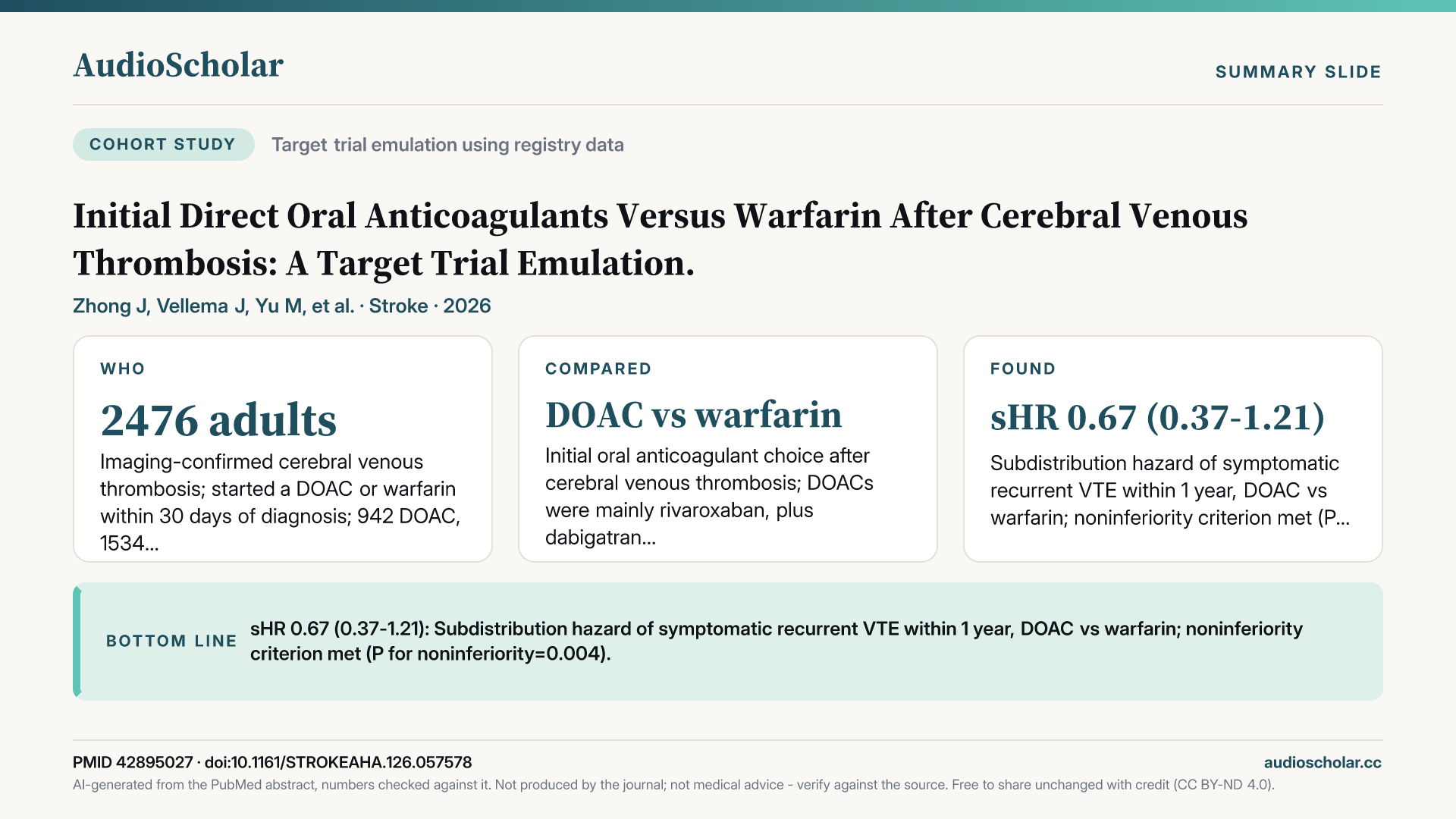
In nearly 2,500 registry patients with cerebral venous thrombosis, DOACs met noninferiority to warfarin for one-year recurrent venous thromboembolism, while bleeding comparisons remained exploratory and inconclusive.
Stroke · 2026 · PubMed

This week’s papers
- 01
Initial Direct Oral Anticoagulants Versus Warfarin After Cerebral Venous Thrombosis: A Target Trial Emulation.
In nearly 2,500 registry patients with cerebral venous thrombosis, DOACs met noninferiority to warfarin for one-year recurrent venous thromboembolism, while bleeding comparisons remained exploratory and inconclusive.
Zhong J, Vellema J, Yu M, et al. · Stroke · 2026
From the briefingIn Stroke, Zhong and colleagues used a large Chinese multicenter registry to emulate a target trial comparing direct oral anticoagulants with warfarin after cerebral venous thrombosis [1]. Among nearly 2,500 patients who started oral anticoagulation within 30 days of diagnosis, most of them on rivaroxaban in the DOAC group, symptomatic recurrent venous thromboembolism at one year occurred in about 3.7 percent of DOAC-treated patients versus about 5.5 percent on warfarin after weighting. That difference was not statistically significant in its own right, but it met the prespecified noninferiority margin of one and a half percentage points. Major bleeding was too rare to compare, and the authors are explicit that the bleeding data are exploratory and cannot support safety conclusions. This is observational, not randomized, but it is a large and carefully designed analysis that adds weight to the growing use of DOACs in this condition.
If you only have time for one paper this week, make it the Stroke target trial emulation of DOACs versus warfarin after cerebral venous thrombosis [1]. It brings a large, carefully designed comparison to a question many neurologists face regularly, and it strengthens the evidence base for a practice that has been running ahead of the data.
Written by AI from the published abstract, for healthcare professionals. Not medical advice; check the paper before acting on it.
- 02
Recanalization After Acute Cervical Artery Dissection: A Multicenter International Study.
Almost 60 percent of stenotic cervical artery dissections fully recanalized by six months; older age, diabetes, smoking and initial occlusion predicted incomplete healing, independent of antithrombotic choice.
Romoli M, Muppa J, Lee EM, et al. · Neurology · 2026
From the briefingAlso in Neurology, Romoli and colleagues report a planned subanalysis of an international cohort of cervical artery dissection from 63 sites, focusing on roughly 1,100 patients with stenosis at presentation and imaging at six months [2]. Just under 60 percent of these patients achieved complete recanalization. Older age, diabetes, active smoking, and complete occlusion at presentation each made full recanalization less likely, with occlusion roughly halving the odds and also slowing the time to reopening. Antiplatelet versus anticoagulant therapy made no detectable difference to recanalization. Recurrent stroke was numerically higher with incomplete recanalization, about 5 percent versus 3.5 percent, but this did not reach significance, so the link between vessel healing and recurrence remains unproven. The authors frame this as hypothesis-generating for tailored imaging surveillance rather than a basis for changing secondary prevention.
Written by AI from the published abstract, for healthcare professionals. Not medical advice; check the paper before acting on it.
- 03
Intracerebral Hemorrhage Expansion in Late Presenters: Proposed Target Expansion Criteria.
An imaging score combining ultra-early growth, CT hypodensities and spot sign identified intracerebral hemorrhage patients presenting two to twelve hours after onset at high expansion risk, aiding trial enrichment.
Morotti A, Pensato U, Nawabi J, et al. · Neurology · 2026
From the briefingRounding out this theme, Morotti and colleagues, also in Neurology, tackle hematoma expansion in intracerebral hemorrhage patients presenting between two and twelve hours after onset, a group largely excluded from expansion-targeted trials [3]. Their four-point score gives one point for fast ultra-early hematoma growth, one point for hypodensities on noncontrast CT, and two points for a CT angiography spot sign. Expansion rose steeply with the score, from about one in ten patients at zero to close to nine in ten at the top score, and a score of two or more had specificity of about 85 percent in both development and validation cohorts, with moderate sensitivity of around 60 percent. This is a retrospective derivation built for trial enrichment, not a bedside treatment rule, but it could meaningfully widen the pool of patients eligible for future hemostatic trials.
Written by AI from the published abstract, for healthcare professionals. Not medical advice; check the paper before acting on it.
- 04
Vascular Risk Factors and Late-Onset Epilepsy.
Across six pooled United States cohorts of over 42,000 older adults, prior stroke, diabetes, smoking, kidney disease, hypertension and APOE4 were each associated with higher late-onset epilepsy risk.
Choi H, Gutierrez J, Wang T, et al. · JAMA Neurology · 2026
From the briefingIn JAMA Neurology, Choi and colleagues pooled individual data from six population-based cohorts across the United States, more than 42,000 older adults followed for about nine years on average, to look at late-onset epilepsy beginning at 65 or older [4]. About 3.5 percent of participants developed epilepsy. Prior stroke roughly doubled the risk, and diabetes, current smoking, chronic kidney disease, and hypertension each carried more modest increases. Carrying two copies of the apolipoprotein E epsilon 4 allele was associated with nearly double the risk as well. The associations held across age, sex, and racial and ethnic groups. The authors interpret late-onset epilepsy as a possible marker of cumulative brain vascular disease, which strengthens the case for viewing new seizures in older adults through a vascular lens, though these observational data cannot show that controlling risk factors prevents epilepsy.
Written by AI from the published abstract, for healthcare professionals. Not medical advice; check the paper before acting on it.
- 05
A Primer on COL4A1/COL4A2-Related Cerebral Small Vessel Disease for Neurologists.
A narrative review frames COL4A1/2 small vessel disease as an underrecognized dual hemorrhagic-ischemic disorder, outlining imaging patterns, extracerebral red flags, genetic testing indications and individualized antithrombotic decisions.
Alten B, Ullman NL, Porcari G, et al. · Neurology · 2026
From the briefingComplementing that population view at the genetic end of the spectrum, Alten and colleagues contribute a narrative review in Neurology on COL4A1 and COL4A2-related cerebral small vessel disease [5]. They describe a type IV collagen basement membrane disorder with a dual hemorrhagic and ischemic phenotype, presenting anywhere from incidental imaging findings to perinatal brain injury, and highlight imaging clues such as microhemorrhages, white matter hyperintensities, lacunes, and dilated perivascular spaces, along with ocular, renal, and musculoskeletal red flags. The review emphasizes individualized decisions around antithrombotic therapy and aneurysm surveillance, and it is expert synthesis rather than new outcome data.
Written by AI from the published abstract, for healthcare professionals. Not medical advice; check the paper before acting on it.
- 06
Lymphocytosis as a biomarker for natalizumab treatment response in multiple sclerosis: The link with anti-drug antibodies.
Absence of the expected lymphocyte rise on natalizumab tracked with persistent anti-drug antibodies, and a threshold rise identified antibody-free patients with high sensitivity and specificity in trial and registry data.
Valero-Hernandez E, Mathur J, Baker D, et al. · Multiple Sclerosis Journal · 2026
From the briefingIn Multiple Sclerosis Journal, Valero-Hernandez and colleagues revisited the pivotal AFFIRM trial and a Cardiff real-world register to ask whether the expected rise in blood lymphocytes on natalizumab could flag anti-drug antibodies [6]. Natalizumab produced a clear lymphocyte rise by week 12 that was essentially absent in patients with persistent anti-drug antibodies. A rise of at least 0.8 times ten to the ninth cells per liter identified antibody-free patients with sensitivity of at least 84 percent and specificity of at least 91 percent. Current guidance reserves antibody testing for suspected loss of efficacy, and these authors propose that a missing lymphocytosis could prompt earlier testing, an inexpensive idea that would still benefit from prospective confirmation.
Written by AI from the published abstract, for healthcare professionals. Not medical advice; check the paper before acting on it.
- 07
Predictors of Antiamyloid Medication Utilization and Adherence Among People With Alzheimer Disease and Mild Cognitive Impairment.
Among 1.2 million patients with cognitive impairment, only 0.2 percent received anti-amyloid antibodies, with markedly lower odds for older, sicker, socioeconomically vulnerable, Black and Hispanic patients.
Reynolds EL, Elafros MA, Muthukumar L, et al. · Neurology · 2026
From the briefingIn Neurology, Reynolds and colleagues used the Vizient database of nearly 1.2 million patients with mild cognitive impairment or dementia to examine who receives anti-amyloid antibodies [7]. Only about 0.2 percent of patients were prescribed one. Older age, more comorbidity, and greater neighborhood socioeconomic vulnerability were each associated with lower odds of receipt, and non-Hispanic Black and Hispanic patients had dramatically lower odds than non-Hispanic White patients, on the order of one fifth to one seventh. Once treatment began, only comorbidity burden predicted lower initial adherence. Some of this pattern may reflect appropriate eligibility selection, which administrative data cannot fully separate, but the racial gap is large enough to raise real concerns about access.
Written by AI from the published abstract, for healthcare professionals. Not medical advice; check the paper before acting on it.
- 08
Automated Magnetic Resonance Volumetry to Measure Multiple System Atrophy Disease Progression in Clinical Trials.
In placebo-treated multiple system atrophy patients, an MRI cerebellum-pons-putamen atrophy index outperformed clinical scales as a progression endpoint, requiring about 60 percent fewer trial participants per arm.
Quattrone A, Wilkens I, Zhu Z, et al. · Movement Disorders · 2026
From the briefingAnd in Movement Disorders, Quattrone and colleagues analyzed the placebo arm of the M-STAR trial in 129 patients with multiple system atrophy, comparing automated MRI volumetry with clinical scales and serum neurofilament light chain as progression endpoints [8]. A combined cerebellum, pons, and putamen volume index was the most sensitive marker in both cerebellar and parkinsonian subtypes, needing about 55 patients per arm to detect a 30 percent treatment effect, roughly 60 percent fewer than the best clinical measures. That supports imaging as an efficient trial endpoint, though whether slowed atrophy translates into clinical benefit remains to be established.
Written by AI from the published abstract, for healthcare professionals. Not medical advice; check the paper before acting on it.
- 09
Association Between Systemic Fluoroquinolones and Risk of Peripheral Neuropathy.
In nearly four million United Kingdom primary care patients, fluoroquinolones showed no meaningful increase in peripheral neuropathy versus cephalosporins, though tendon rupture risk was roughly doubled as expected.
Brown JP, Wing K, Mansfield KE, et al. · Neurology · 2026
From the briefingIn Neurology, Brown and colleagues studied nearly four million adults in two United Kingdom primary care databases, comparing fluoroquinolones with cephalosporins [9]. Peripheral neuropathy within 60 days showed no meaningful difference between the two antibiotic classes, whereas tendon rupture, used as a positive control, was roughly doubled with fluoroquinolones, which suggests the methods could detect a real signal. Residual confounding remains possible, and patients with diabetes were excluded, but the authors conclude the findings offer some reassurance about neuropathy specifically.
Written by AI from the published abstract, for healthcare professionals. Not medical advice; check the paper before acting on it.
- 10
Recommendations for the Management of Spontaneous Intracranial Hypotension With Spinal Longitudinal Epidural CSF Collection: A Delphi Study.
A small international expert Delphi panel endorsed semitargeted epidural blood patching, dynamic CT myelography and remission definitions for intracranial hypotension, but reached no consensus on repeat patches or persistent collections.
Choi S, Carroll I, Friedman DI, et al. · Neurology · 2026
From the briefingAlso in Neurology, Choi and colleagues report an international Delphi consensus on spontaneous intracranial hypotension with spinal longitudinal epidural CSF collection [10]. Nine experts in the final round agreed on bed rest before patching for recent severe orthostatic headache, a semitargeted epidural blood patch as initial management, dynamic CT myelography for localization, definitions of clinical and radiologic remission, and radiologic follow-up after clinical remission. There was no consensus on how many patches to try before invasive localization or surgery, or on persistent fluid despite clinical remission. With a small panel and no outcome data, this is structured expert opinion that maps uncertainty as much as it resolves it.
Written by AI from the published abstract, for healthcare professionals. Not medical advice; check the paper before acting on it.
The full briefing
This AudioScholar briefing is generated by artificial intelligence for healthcare professionals and trainees. It is not medical advice.
Welcome to This Week in Neurology. This week we're covering 10 notable papers spanning cerebrovascular treatment and prognosis, the vascular roots of other neurological disease, and the biomarkers and real-world realities shaping how we use our therapies. Let's dive in.
We start with three papers that each try to answer a practical question in cerebrovascular care where randomized evidence is thin. In Stroke, Zhong and colleagues used a large Chinese multicenter registry to emulate a target trial comparing direct oral anticoagulants with warfarin after cerebral venous thrombosis [1]. Among nearly 2,500 patients who started oral anticoagulation within 30 days of diagnosis, most of them on rivaroxaban in the DOAC group, symptomatic recurrent venous thromboembolism at one year occurred in about 3.7 percent of DOAC-treated patients versus about 5.5 percent on warfarin after weighting. That difference was not statistically significant in its own right, but it met the prespecified noninferiority margin of one and a half percentage points. Major bleeding was too rare to compare, and the authors are explicit that the bleeding data are exploratory and cannot support safety conclusions. This is observational, not randomized, but it is a large and carefully designed analysis that adds weight to the growing use of DOACs in this condition. Also in Neurology, Romoli and colleagues report a planned subanalysis of an international cohort of cervical artery dissection from 63 sites, focusing on roughly 1,100 patients with stenosis at presentation and imaging at six months [2]. Just under 60 percent of these patients achieved complete recanalization. Older age, diabetes, active smoking, and complete occlusion at presentation each made full recanalization less likely, with occlusion roughly halving the odds and also slowing the time to reopening. Antiplatelet versus anticoagulant therapy made no detectable difference to recanalization. Recurrent stroke was numerically higher with incomplete recanalization, about 5 percent versus 3.5 percent, but this did not reach significance, so the link between vessel healing and recurrence remains unproven. The authors frame this as hypothesis-generating for tailored imaging surveillance rather than a basis for changing secondary prevention. Rounding out this theme, Morotti and colleagues, also in Neurology, tackle hematoma expansion in intracerebral hemorrhage patients presenting between two and twelve hours after onset, a group largely excluded from expansion-targeted trials [3]. Their four-point score gives one point for fast ultra-early hematoma growth, one point for hypodensities on noncontrast CT, and two points for a CT angiography spot sign. Expansion rose steeply with the score, from about one in ten patients at zero to close to nine in ten at the top score, and a score of two or more had specificity of about 85 percent in both development and validation cohorts, with moderate sensitivity of around 60 percent. This is a retrospective derivation built for trial enrichment, not a bedside treatment rule, but it could meaningfully widen the pool of patients eligible for future hemostatic trials.
Our second theme is how vascular disease shapes the brain beyond stroke itself. In JAMA Neurology, Choi and colleagues pooled individual data from six population-based cohorts across the United States, more than 42,000 older adults followed for about nine years on average, to look at late-onset epilepsy beginning at 65 or older [4]. About 3.5 percent of participants developed epilepsy. Prior stroke roughly doubled the risk, and diabetes, current smoking, chronic kidney disease, and hypertension each carried more modest increases. Carrying two copies of the apolipoprotein E epsilon 4 allele was associated with nearly double the risk as well. The associations held across age, sex, and racial and ethnic groups. The authors interpret late-onset epilepsy as a possible marker of cumulative brain vascular disease, which strengthens the case for viewing new seizures in older adults through a vascular lens, though these observational data cannot show that controlling risk factors prevents epilepsy. Complementing that population view at the genetic end of the spectrum, Alten and colleagues contribute a narrative review in Neurology on COL4A1 and COL4A2-related cerebral small vessel disease [5]. They describe a type IV collagen basement membrane disorder with a dual hemorrhagic and ischemic phenotype, presenting anywhere from incidental imaging findings to perinatal brain injury, and highlight imaging clues such as microhemorrhages, white matter hyperintensities, lacunes, and dilated perivascular spaces, along with ocular, renal, and musculoskeletal red flags. The review emphasizes individualized decisions around antithrombotic therapy and aneurysm surveillance, and it is expert synthesis rather than new outcome data.
Our third theme concerns how we measure and deliver disease-modifying treatments. In Multiple Sclerosis Journal, Valero-Hernandez and colleagues revisited the pivotal AFFIRM trial and a Cardiff real-world register to ask whether the expected rise in blood lymphocytes on natalizumab could flag anti-drug antibodies [6]. Natalizumab produced a clear lymphocyte rise by week 12 that was essentially absent in patients with persistent anti-drug antibodies. A rise of at least 0.8 times ten to the ninth cells per liter identified antibody-free patients with sensitivity of at least 84 percent and specificity of at least 91 percent. Current guidance reserves antibody testing for suspected loss of efficacy, and these authors propose that a missing lymphocytosis could prompt earlier testing, an inexpensive idea that would still benefit from prospective confirmation. In Neurology, Reynolds and colleagues used the Vizient database of nearly 1.2 million patients with mild cognitive impairment or dementia to examine who receives anti-amyloid antibodies [7]. Only about 0.2 percent of patients were prescribed one. Older age, more comorbidity, and greater neighborhood socioeconomic vulnerability were each associated with lower odds of receipt, and non-Hispanic Black and Hispanic patients had dramatically lower odds than non-Hispanic White patients, on the order of one fifth to one seventh. Once treatment began, only comorbidity burden predicted lower initial adherence. Some of this pattern may reflect appropriate eligibility selection, which administrative data cannot fully separate, but the racial gap is large enough to raise real concerns about access. And in Movement Disorders, Quattrone and colleagues analyzed the placebo arm of the M-STAR trial in 129 patients with multiple system atrophy, comparing automated MRI volumetry with clinical scales and serum neurofilament light chain as progression endpoints [8]. A combined cerebellum, pons, and putamen volume index was the most sensitive marker in both cerebellar and parkinsonian subtypes, needing about 55 patients per arm to detect a 30 percent treatment effect, roughly 60 percent fewer than the best clinical measures. That supports imaging as an efficient trial endpoint, though whether slowed atrophy translates into clinical benefit remains to be established.
Two final papers address everyday clinical questions. In Neurology, Brown and colleagues studied nearly four million adults in two United Kingdom primary care databases, comparing fluoroquinolones with cephalosporins [9]. Peripheral neuropathy within 60 days showed no meaningful difference between the two antibiotic classes, whereas tendon rupture, used as a positive control, was roughly doubled with fluoroquinolones, which suggests the methods could detect a real signal. Residual confounding remains possible, and patients with diabetes were excluded, but the authors conclude the findings offer some reassurance about neuropathy specifically. Also in Neurology, Choi and colleagues report an international Delphi consensus on spontaneous intracranial hypotension with spinal longitudinal epidural CSF collection [10]. Nine experts in the final round agreed on bed rest before patching for recent severe orthostatic headache, a semitargeted epidural blood patch as initial management, dynamic CT myelography for localization, definitions of clinical and radiologic remission, and radiologic follow-up after clinical remission. There was no consensus on how many patches to try before invasive localization or surgery, or on persistent fluid despite clinical remission. With a small panel and no outcome data, this is structured expert opinion that maps uncertainty as much as it resolves it.
If you only have time for one paper this week, make it the Stroke target trial emulation of DOACs versus warfarin after cerebral venous thrombosis [1]. It brings a large, carefully designed comparison to a question many neurologists face regularly, and it strengthens the evidence base for a practice that has been running ahead of the data.
Here is what this week's evidence adds up to in Neurology. First, for cerebral venous thrombosis, DOACs now have large observational support for noninferiority to warfarin in preventing recurrence, though comparative bleeding safety remains unsettled. Second, after cervical artery dissection, roughly three in five stenotic vessels fully reopen by six months, older age, diabetes, smoking, and initial occlusion predict worse healing, and whether incomplete recanalization raises stroke risk is still unproven. Third, late-onset epilepsy appears closely tied to vascular risk and prior stroke, reinforcing a vascular framing of new seizures in older adults, based on observational cohort data. Fourth, simple biomarkers keep earning attention, from lymphocyte counts on natalizumab to MRI atrophy indices in multiple system atrophy, but both need prospective validation before routine use. And fifth, anti-amyloid therapy is reaching a very small and demographically narrow slice of eligible patients, a disparity that observational data can describe but not yet fully explain.
That's your roundup for This Week in Neurology. The full transcript and references are available on the episode page. This is an AI-curated summary — for clinical decisions, always consult primary sources and current guidelines. See you next week.
If this weekly briefing is useful, follow the show in your podcast app so new episodes arrive automatically. And think of one colleague — in any specialty — who never has time to keep up with the literature. Tell them about AudioScholar: a free ten-minute weekly for every specialty, to listen to in any podcast app, or to read at audioscholar dot C C.
This is an automated summary generated by artificial intelligence, which can make mistakes. Always review the original source materials.
Spot something worth flagging?
Get this every week in your podcast app — free.
New neurology episodes land in your feed automatically — listen on your commute.