This Week in Pathology — Oct 17, 2026
Generated Oct 17, 2026 · 11:16
The week's practice-changing Pathology research, summarized for clinicians.
If the audio fails to play, refresh the page to renew the link.
Get next week’s Pathology briefing — free.
In your podcast app, or readable in your inbox with the audio one tap away.
Nuclear grading of myxoid liposarcoma robustly predicts patient outcome: a study of 280 patients.
In 280 myxoid liposarcomas, low nuclear grade predicted better disease-specific, metastasis-free and disease-free survival while conventional round cell grading did not, including on needle core biopsies.
Virchows Archiv · 2026 · PubMed

This week’s papers
- 01
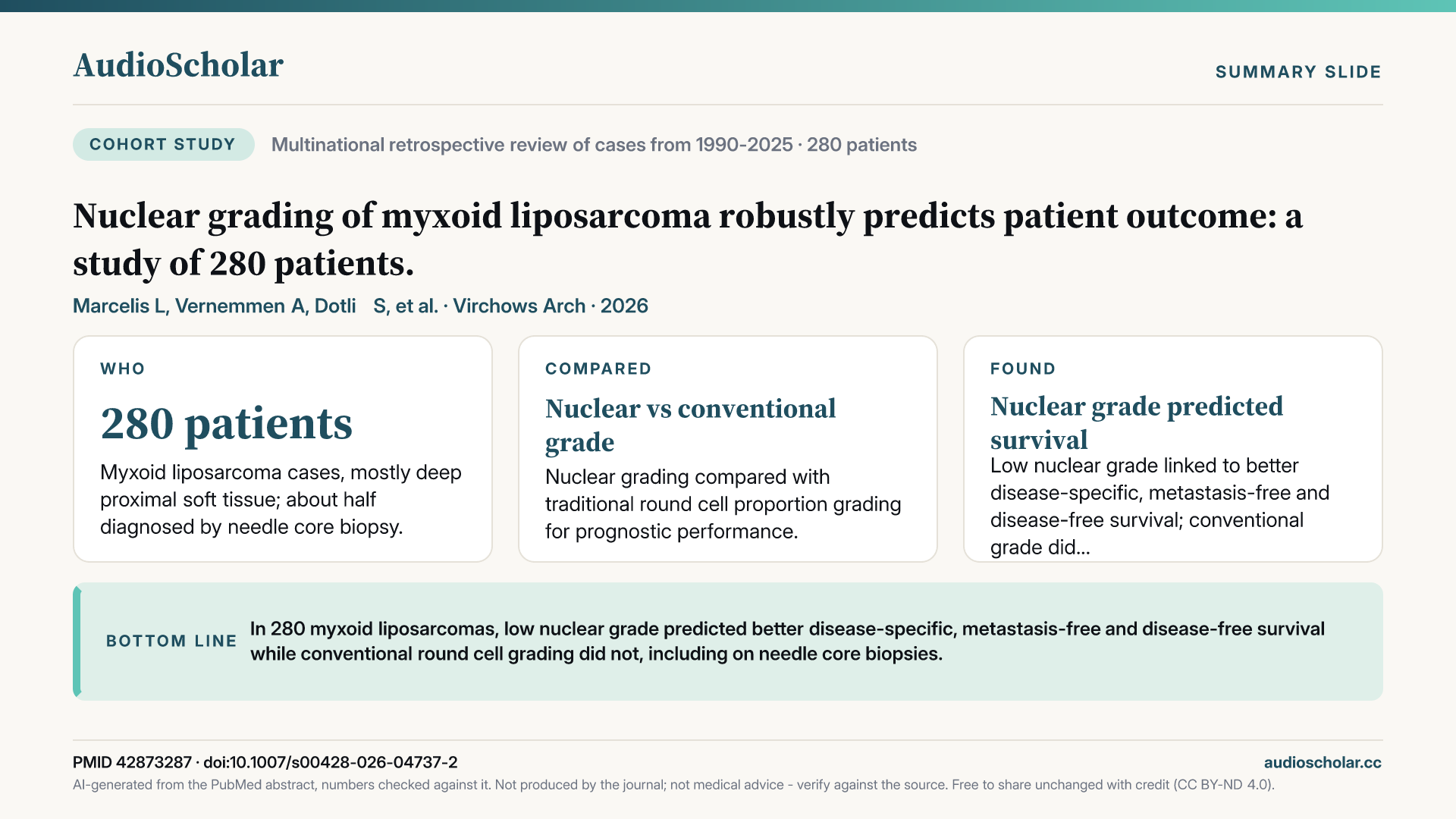
Nuclear grading of myxoid liposarcoma robustly predicts patient outcome: a study of 280 patients.
In 280 myxoid liposarcomas, low nuclear grade predicted better disease-specific, metastasis-free and disease-free survival while conventional round cell grading did not, including on needle core biopsies.
Marcelis L et al. · Virchows Archiv · 2026
From the briefingIn Virchows Archiv, Marcelis and colleagues reviewed 280 myxoid liposarcomas from a multinational cohort, with a median follow-up of more than five years, and compared a modified Kawaguchi nuclear grade against conventional grading based on the proportion of round cell areas [1]. The two systems split the cohort into roughly the same proportions, about seven in ten tumors low grade, though not always the same tumors. Low nuclear grade was associated with significantly better disease-specific, metastasis-free and disease-free survival, while low conventional grade was not, and the result held for the 149 tumors diagnosed on needle core biopsy, which is exactly where round cell quantitation is least reliable. Concordance statistics favored nuclear grading for all three endpoints. This is a retrospective series, but it is large for a rare sarcoma, and the authors conclude it supports wider adoption of nuclear grading.
If you only have time for one paper this week, make it the myxoid liposarcoma grading study from Marcelis and colleagues in Virchows Archiv [1]. It directly challenges the round cell proportion that underpins current grading, and it shows nuclear grade working on needle core biopsies, where most of these tumors are first diagnosed.
Written by AI from the published abstract, for healthcare professionals. Not medical advice; check the paper before acting on it.
- 02
Peritumoral Malignant Cellular Foci Performs Better Than Tumor Budding and Poorly Differentiated Cluster in Risk Stratification of Lymph Node Metastasis in pT1 Colorectal Cancer.
Across 2,611 pT1 colorectal cancers, non-glandular foci of one or more tumor cells at the invasive front independently predicted nodal metastasis, whereas tumor budding and poorly differentiated clusters were inconsistent.
Yuan C et al. · The American Journal of Surgical Pathology · 2026
From the briefingIn The American Journal of Surgical Pathology, Yuan and colleagues tackled the familiar inconsistency of tumor budding and poorly differentiated clusters in pT1 colorectal cancer [2]. They defined peritumoral malignant cellular foci as any non-glandular focus of one or more tumor cells at the invasive front, removing the arbitrary five-cell cutoff. Across 2,611 patients from six Chinese centers, neither budding nor clusters were consistently independent predictors of nodal metastasis, whereas the new feature was, in both training and validation cohorts and across subgroups by age, sex, site and body mass index. It also tracked with more involved nodes and was more strongly linked to the higher-tier D3 nodal stations. The authors suggest it could inform both the decision for completion surgery after endoscopic resection and the extent of lymphadenectomy, though this sits against established budding criteria and needs validation outside this population and by interobserver testing before it displaces them.
Written by AI from the published abstract, for healthcare professionals. Not medical advice; check the paper before acting on it.
- 03
Routine H&E Histology Encodes Postoperative Risk Heterogeneity in Resected Pancreatic Ductal Adenocarcinoma: A Multicohort Evaluation of TIGERS.
An H&E-derived nine-feature score stratified survival after pancreatic cancer resection in most cohorts and a prospective cohort, but its fixed cutoff failed to transport to one external cohort.
Shen Y et al. · Modern Pathology · 2026
From the briefingMoving to the pancreas, Modern Pathology carries Shen and colleagues' evaluation of TIGERS, a nine-feature score derived from routine whole-slide images of resected pancreatic ductal adenocarcinoma [3]. With a locked formula and cutoff, it stratified survival in the internal validation cohort and three of four retrospective test cohorts, and added modestly to a clinicopathologic model in all six. The candid caveat is that in one external cohort, almost every patient was classified as high risk, showing the fixed threshold does not always transport. In a prospectively accrued cohort, mortality in the high-risk group was roughly double that of the low-risk group, and high risk remained associated with substantially worse survival after adjustment, with a median turnaround of about thirteen minutes. The authors themselves state that interventional studies are needed before it guides treatment or surveillance.
Written by AI from the published abstract, for healthcare professionals. Not medical advice; check the paper before acting on it.
- 04
Aberrant HER2 Expression as a Specific and Feasible Diagnostic Marker for Fumarate Hydratase-Deficient Renal Cell Carcinoma.
HER2 4B5 immunostaining was positive in about 89 percent of fumarate hydratase-deficient renal carcinomas without gene amplification, with about 99 percent specificity, supporting a combined HER2 and FH screening panel.
Hu J et al. · Human Pathology · 2026
From the briefingIn Human Pathology, Hu and colleagues report an unexpected finding: HER2 immunostaining with the 4B5 clone was positive in close to nine in ten fumarate hydratase-deficient renal cell carcinomas, mostly with cytoplasmic and often nuclear staining, without HER2 amplification on FISH in any of the 30 positive tumors tested [4]. Across 440 other renal tumors, staining was essentially absent in clear cell, chromophobe and typical papillary carcinomas, with occasional positivity in TFE3-translocation and oncocytic papillary tumors, for a specificity of about 99 percent. HER2 was more sensitive than FH loss but less sensitive than 2SC and AKR1B10, and the authors found the HER2 and FH combination performed best as a screening panel. Importantly for interpretation, this is aberrant expression of an unamplified protein, a diagnostic signal rather than a therapeutic target.
Written by AI from the published abstract, for healthcare professionals. Not medical advice; check the paper before acting on it.
- 05
Whole-Exome and Whole-Genome Sequencing Identifies Driver CTNNB1 Mutations in Ossifying Renal Tumor of Infancy.
All four ossifying renal tumors of infancy carried the same CTNNB1 exon 3 hotspot mutation with nuclear beta-catenin, offering a diagnostic anchor against Wilms tumor and mesoblastic nephroma mimics.
Wang Y et al. · The American Journal of Surgical Pathology · 2026
From the briefingAlso in pediatric kidney, Wang and colleagues in The American Journal of Surgical Pathology sequenced four ossifying renal tumors of infancy and found the same activating CTNNB1 exon 3 hotspot mutation in every case, matching strong nuclear beta-catenin staining, with absent ETV6 to NTRK3 rearrangement and long disease-free survival after resection [5]. Four cases is a small series, but for a rare benign tumor that can mimic Wilms tumor and cellular congenital mesoblastic nephroma, a consistent driver and an accessible immunostain offer a concrete diagnostic anchor.
Written by AI from the published abstract, for healthcare professionals. Not medical advice; check the paper before acting on it.
- 06
Adamantinoma-like Ewing Sarcoma: An Underrecognized Mimicker in the Head and Neck With Divergent Clinicopathologic Features from Ewing Sarcoma.
Adamantinoma-like Ewing sarcoma arose mainly in older patients' head and neck, showed diffuse keratin and p40 mimicking carcinoma, and behaved better in salivary than thyroid sites in a small series.
Amin SE et al. · Modern Pathology · 2026
From the briefingIn head and neck pathology, Amin and colleagues in Modern Pathology reviewed 25 years of adamantinoma-like Ewing sarcoma [6]. Among 20 cases, the tumors arose in older patients than classic Ewing sarcoma, overwhelmingly in the head and neck, often in glandular sites, with diffuse cytokeratin and frequent p40 or p63 positivity, which explains their misdiagnosis as carcinoma. All carried EWSR1 rearrangements, and nodal metastases occurred in nine of twenty patients. Outcome appeared to vary by site, with salivary gland tumors mostly in remission while thyroid and non-head and neck tumors more often progressed, though the numbers are very small.
Written by AI from the published abstract, for healthcare professionals. Not medical advice; check the paper before acting on it.
- 07
Monomorphic Epitheliotropic Intestinal T-Cell Lymphoma: Clinicopathologic and Genetic Analysis of a Large Chinese Cohort.
In 120 patients with monomorphic epitheliotropic intestinal T-cell lymphoma, SETD2 loss-of-function mutations were universal, median survival was nine months, and high Ki-67 and B symptoms independently predicted worse outcome.
Li K et al. · The American Journal of Surgical Pathology · 2026
From the briefingRounding out this theme, Li and colleagues in The American Journal of Surgical Pathology describe 120 Chinese patients with monomorphic epitheliotropic intestinal T-cell lymphoma [7]. Every case sequenced carried loss-of-function SETD2 mutations, with STAT5B mutated in about two thirds of cases and JAK3 in half, alongside several novel fusions. Median overall survival among patients with follow-up was nine months, and a Ki-67 index above 50 percent and B symptoms independently predicted worse outcome. The molecular profile reinforces SETD2 as a defining feature, while the survival data underline how poorly current therapy serves these patients.
Written by AI from the published abstract, for healthcare professionals. Not medical advice; check the paper before acting on it.
- 08
Evaluating immunocytochemistry performance in lung cancer cytology: An IASLC Cytology Working Group study.
In a multi-laboratory study of lung cancer cytology immunostaining, Delaunay and methanol-based fixation performed well, while PreservCyt and air-dried preparations frequently yielded suboptimal TTF-1, p40, ALK and ROS1 staining.
Jain D et al. · Cancer Cytopathology · 2026
From the briefingIn Cancer Cytopathology, an IASLC Cytology Working Group study led by Jain tested immunocytochemistry for TTF-1, p40, ALK and ROS1 on non-cell block lung cancer preparations across seven laboratories representing common fixation protocols [8]. Delaunay-fixed Papanicolaou smears and methanol-fixed polyethylene glycol-coated preparations performed consistently well, whereas roughly four in five PreservCyt-fixed slides and well over half of air-dried slides stained suboptimally. The design is a structured ring study rather than a clinical outcome study, but it gives concrete evidence that fixation choice determines whether a cytology-only biomarker result is trustworthy, and the authors call for harmonized pre-analytics and external quality assessment.
Written by AI from the published abstract, for healthcare professionals. Not medical advice; check the paper before acting on it.
- 09
Validation of diagnostic artificial intelligence models for prostate pathology in a Middle Eastern cohort.
Prostate cancer AI models graded an Iraqi Kurdistan cohort with agreement matching pathologist-to-pathologist concordance and remained consistent across three scanners, including a low-cost compact device.
Muhammad Ali PJ et al. · Virchows Archiv · 2026
From the briefingOn the digital side, Muhammad Ali and colleagues in Virchows Archiv report what they describe as the first external validation of prostate pathology AI in a Middle Eastern setting, using 339 slides from Kurdistan, Iraq, each scanned on three scanners [9]. Agreement between AI and pathologists on Gleason grading matched agreement between pathologists, and cross-scanner agreement was high, including on a low-cost compact scanner.
Written by AI from the published abstract, for healthcare professionals. Not medical advice; check the paper before acting on it.
- 10
Myeloid neoplasms with unusual patterns of disease evolution and progression other than acute leukemia: a European Bone Marrow Working Group workshop report.
Expert workshop cases show myeloid neoplasms evolve through dysplasia, proliferation, fibrosis and extramedullary or histiocytic outgrowths, and the panel favors retaining the original diagnosis while documenting evolution.
Tzankov A et al. · Human Pathology · 2026
From the briefingFinally, Human Pathology publishes the European Bone Marrow Working Group workshop report from Tzankov and colleagues on myeloid neoplasms that evolve in ways other than leukemic transformation [10]. Workshop cases showed myeloproliferative neoplasms acquiring dysplasia, emerging monocytosis or neutrophilia, progressive fibrosis, extramedullary tumors and histiocytic outgrowths, with some apparent progression proving to be a second neoplasm or a reactive process. The panel's consensus is that the original diagnosis should generally be retained and evolution documented within an integrated report, rather than reclassifying on changed phenotype alone. This is expert opinion built on illustrative cases, not outcome data.
Written by AI from the published abstract, for healthcare professionals. Not medical advice; check the paper before acting on it.
The full briefing
This AudioScholar briefing is generated by artificial intelligence for healthcare professionals and trainees. It is not medical advice.
Welcome to This Week in Pathology. This week we're covering 10 notable papers spanning sharper prognostic grading and risk stratification, new diagnostic markers that help define difficult entities, and the pre-analytic and digital foundations our reports rest on. Let's dive in.
Our first theme is prognosis, and this week three papers argue that features already on the slide can stratify risk better than the systems many of us use now. In Virchows Archiv, Marcelis and colleagues reviewed 280 myxoid liposarcomas from a multinational cohort, with a median follow-up of more than five years, and compared a modified Kawaguchi nuclear grade against conventional grading based on the proportion of round cell areas [1]. The two systems split the cohort into roughly the same proportions, about seven in ten tumors low grade, though not always the same tumors. Low nuclear grade was associated with significantly better disease-specific, metastasis-free and disease-free survival, while low conventional grade was not, and the result held for the 149 tumors diagnosed on needle core biopsy, which is exactly where round cell quantitation is least reliable. Concordance statistics favored nuclear grading for all three endpoints. This is a retrospective series, but it is large for a rare sarcoma, and the authors conclude it supports wider adoption of nuclear grading. In The American Journal of Surgical Pathology, Yuan and colleagues tackled the familiar inconsistency of tumor budding and poorly differentiated clusters in pT1 colorectal cancer [2]. They defined peritumoral malignant cellular foci as any non-glandular focus of one or more tumor cells at the invasive front, removing the arbitrary five-cell cutoff. Across 2,611 patients from six Chinese centers, neither budding nor clusters were consistently independent predictors of nodal metastasis, whereas the new feature was, in both training and validation cohorts and across subgroups by age, sex, site and body mass index. It also tracked with more involved nodes and was more strongly linked to the higher-tier D3 nodal stations. The authors suggest it could inform both the decision for completion surgery after endoscopic resection and the extent of lymphadenectomy, though this sits against established budding criteria and needs validation outside this population and by interobserver testing before it displaces them. Moving to the pancreas, Modern Pathology carries Shen and colleagues' evaluation of TIGERS, a nine-feature score derived from routine whole-slide images of resected pancreatic ductal adenocarcinoma [3]. With a locked formula and cutoff, it stratified survival in the internal validation cohort and three of four retrospective test cohorts, and added modestly to a clinicopathologic model in all six. The candid caveat is that in one external cohort, almost every patient was classified as high risk, showing the fixed threshold does not always transport. In a prospectively accrued cohort, mortality in the high-risk group was roughly double that of the low-risk group, and high risk remained associated with substantially worse survival after adjustment, with a median turnaround of about thirteen minutes. The authors themselves state that interventional studies are needed before it guides treatment or surveillance.
Our second theme is diagnostic markers that sharpen the boundaries of difficult entities, largely in renal and soft tissue pathology. In Human Pathology, Hu and colleagues report an unexpected finding: HER2 immunostaining with the 4B5 clone was positive in close to nine in ten fumarate hydratase-deficient renal cell carcinomas, mostly with cytoplasmic and often nuclear staining, without HER2 amplification on FISH in any of the 30 positive tumors tested [4]. Across 440 other renal tumors, staining was essentially absent in clear cell, chromophobe and typical papillary carcinomas, with occasional positivity in TFE3-translocation and oncocytic papillary tumors, for a specificity of about 99 percent. HER2 was more sensitive than FH loss but less sensitive than 2SC and AKR1B10, and the authors found the HER2 and FH combination performed best as a screening panel. Importantly for interpretation, this is aberrant expression of an unamplified protein, a diagnostic signal rather than a therapeutic target. Also in pediatric kidney, Wang and colleagues in The American Journal of Surgical Pathology sequenced four ossifying renal tumors of infancy and found the same activating CTNNB1 exon 3 hotspot mutation in every case, matching strong nuclear beta-catenin staining, with absent ETV6 to NTRK3 rearrangement and long disease-free survival after resection [5]. Four cases is a small series, but for a rare benign tumor that can mimic Wilms tumor and cellular congenital mesoblastic nephroma, a consistent driver and an accessible immunostain offer a concrete diagnostic anchor. In head and neck pathology, Amin and colleagues in Modern Pathology reviewed 25 years of adamantinoma-like Ewing sarcoma [6]. Among 20 cases, the tumors arose in older patients than classic Ewing sarcoma, overwhelmingly in the head and neck, often in glandular sites, with diffuse cytokeratin and frequent p40 or p63 positivity, which explains their misdiagnosis as carcinoma. All carried EWSR1 rearrangements, and nodal metastases occurred in nine of twenty patients. Outcome appeared to vary by site, with salivary gland tumors mostly in remission while thyroid and non-head and neck tumors more often progressed, though the numbers are very small. Rounding out this theme, Li and colleagues in The American Journal of Surgical Pathology describe 120 Chinese patients with monomorphic epitheliotropic intestinal T-cell lymphoma [7]. Every case sequenced carried loss-of-function SETD2 mutations, with STAT5B mutated in about two thirds of cases and JAK3 in half, alongside several novel fusions. Median overall survival among patients with follow-up was nine months, and a Ki-67 index above 50 percent and B symptoms independently predicted worse outcome. The molecular profile reinforces SETD2 as a defining feature, while the survival data underline how poorly current therapy serves these patients.
Our third theme is the infrastructure behind diagnosis: specimen handling, digital tools, and how we report disease over time. In Cancer Cytopathology, an IASLC Cytology Working Group study led by Jain tested immunocytochemistry for TTF-1, p40, ALK and ROS1 on non-cell block lung cancer preparations across seven laboratories representing common fixation protocols [8]. Delaunay-fixed Papanicolaou smears and methanol-fixed polyethylene glycol-coated preparations performed consistently well, whereas roughly four in five PreservCyt-fixed slides and well over half of air-dried slides stained suboptimally. The design is a structured ring study rather than a clinical outcome study, but it gives concrete evidence that fixation choice determines whether a cytology-only biomarker result is trustworthy, and the authors call for harmonized pre-analytics and external quality assessment. On the digital side, Muhammad Ali and colleagues in Virchows Archiv report what they describe as the first external validation of prostate pathology AI in a Middle Eastern setting, using 339 slides from Kurdistan, Iraq, each scanned on three scanners [9]. Agreement between AI and pathologists on Gleason grading matched agreement between pathologists, and cross-scanner agreement was high, including on a low-cost compact scanner. That speaks to transportability, an issue that echoes the threshold problem seen with TIGERS [3], though here the models held up. Finally, Human Pathology publishes the European Bone Marrow Working Group workshop report from Tzankov and colleagues on myeloid neoplasms that evolve in ways other than leukemic transformation [10]. Workshop cases showed myeloproliferative neoplasms acquiring dysplasia, emerging monocytosis or neutrophilia, progressive fibrosis, extramedullary tumors and histiocytic outgrowths, with some apparent progression proving to be a second neoplasm or a reactive process. The panel's consensus is that the original diagnosis should generally be retained and evolution documented within an integrated report, rather than reclassifying on changed phenotype alone. This is expert opinion built on illustrative cases, not outcome data.
If you only have time for one paper this week, make it the myxoid liposarcoma grading study from Marcelis and colleagues in Virchows Archiv [1]. It directly challenges the round cell proportion that underpins current grading, and it shows nuclear grade working on needle core biopsies, where most of these tumors are first diagnosed.
Here is what this week's evidence adds up to in Pathology. First, morphologic features that are simpler and more reproducible, nuclear grade in myxoid liposarcoma and single-cell foci at the invasive front in pT1 colorectal cancer, outperformed established criteria in large retrospective cohorts, though neither has yet been prospectively validated or adopted in guidelines. Second, computational scores from routine slides carry real prognostic information, but the pancreatic data show that fixed thresholds can fail in new populations, while the prostate data show models can transfer well across scanners and regions. Third, new immunohistochemical and molecular anchors, HER2 in fumarate hydratase-deficient renal carcinoma and CTNNB1 in ossifying renal tumor of infancy, strengthen diagnosis of rare entities, the latter based on only four cases. Fourth, cytology-only biomarker testing in lung cancer is highly sensitive to fixation, with PreservCyt and air-dried preparations performing poorly in a multi-laboratory study. And finally, expert consensus now favors documenting myeloid neoplasm evolution rather than reclassifying the disease, a position that remains opinion-based.
That's your roundup for This Week in Pathology. The full transcript and references are available on the episode page. This is an AI-curated summary — for clinical decisions, always consult primary sources and current guidelines. See you next week.
If this weekly briefing is useful, follow the show in your podcast app so new episodes arrive automatically. And a quick rating on Apple Podcasts or Spotify helps other physicians discover the show.
This is an automated summary generated by artificial intelligence, which can make mistakes. Always review the original source materials.
Spot something worth flagging?
Get this every week in your podcast app — free.
New pathology episodes land in your feed automatically — listen on your commute.