This Week in General Medicine — Oct 12, 2026
Generated Oct 12, 2026 · 11:28
The week's practice-changing General Medicine research, summarized for clinicians.
If the audio fails to play, refresh the page to renew the link.
Get next week’s General Medicine briefing — free.
In your podcast app, or readable in your inbox with the audio one tap away.
Pharmacologic Treatments for Females With Menopausal Vasomotor Symptoms: A Clinical Guideline From the American College of Physicians.
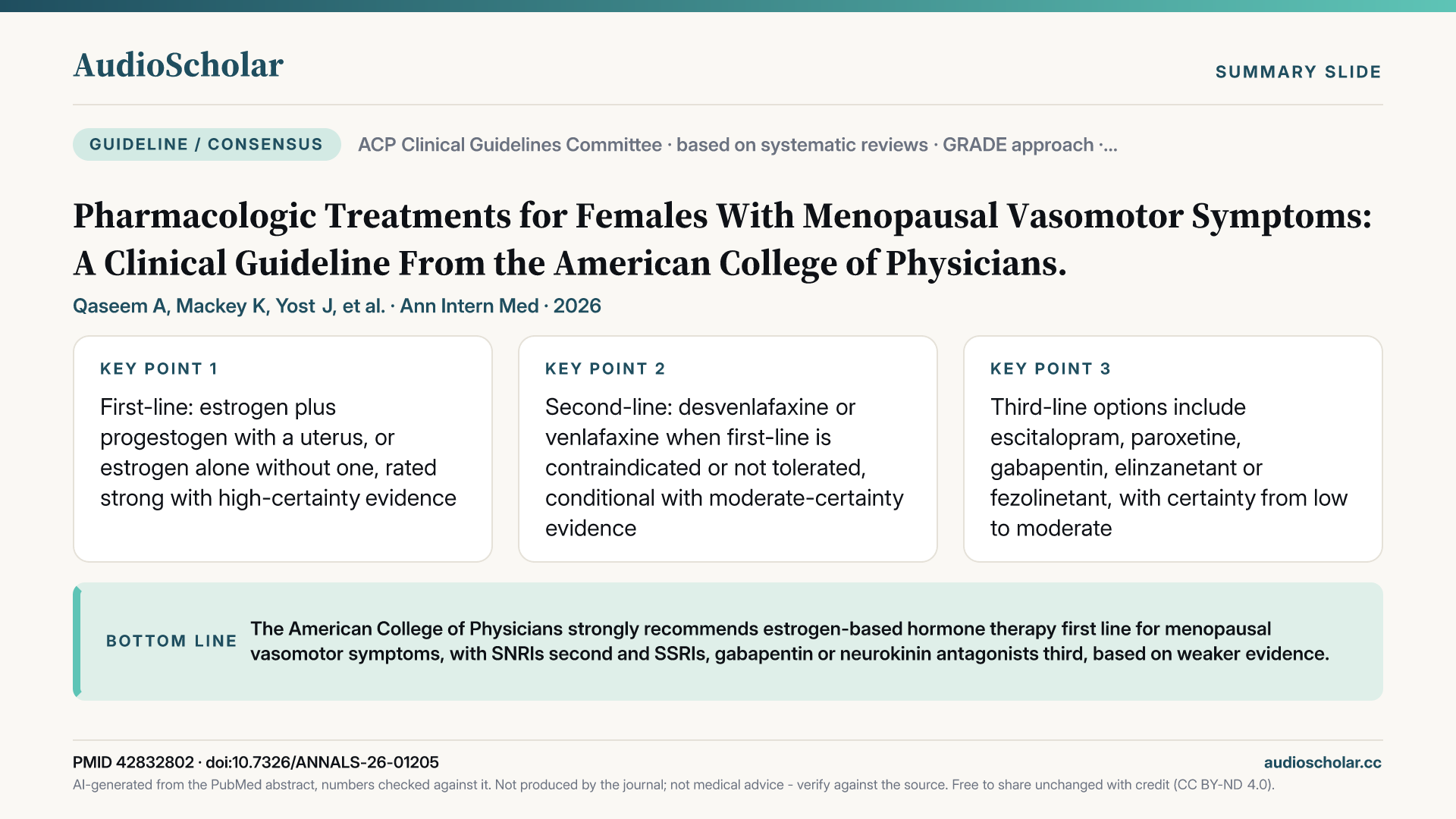
The American College of Physicians strongly recommends hormone therapy as first-line treatment for menopausal hot flashes, with SNRIs second line and SSRIs, gabapentin and neurokinin antagonists third.
Annals of Internal Medicine · 2026 · PubMed

This week’s papers
- 01
Pharmacologic Treatments for Females With Menopausal Vasomotor Symptoms: A Clinical Guideline From the American College of Physicians.
The American College of Physicians strongly recommends hormone therapy as first-line treatment for menopausal hot flashes, with SNRIs second line and SSRIs, gabapentin and neurokinin antagonists third.
Qaseem A et al. · Annals of Internal Medicine · 2026
- 02
Pharmacologic Treatments for Female Menopausal Vasomotor Symptoms: A Systematic Review and Meta-analysis for the American College of Physicians.
Across ninety trials, estrogens reduced both hot flash frequency and severity and offered high economic value, while non-hormonal agents reduced frequency only and long-term harm data remained limited.
Diem S et al. · Annals of Internal Medicine · 2026
- 03
Quadrivalent human papillomavirus vaccination before pregnancy and pregnancy outcomes: nationwide, population based case-control study.
In over 600,000 Swedish first births, prior quadrivalent HPV vaccination was associated with modestly lower odds of preterm birth and other adverse outcomes, especially with vaccination at younger ages.
Zhang Z et al. · BMJ · 2026
- 04
Smoking Cessation Among Underserved Patients Referred for Lung Cancer Screening: A Randomized Clinical Trial.
Among underserved smokers referred for lung cancer screening, financial incentives roughly doubled six-month sustained abstinence versus usual care, whereas adding free pharmacotherapy alone gave no significant improvement.
Hart JL et al. · JAMA · 2026
- 05
Evaluation of Intervention Strategies to Improve Follow-Up Colonoscopy After Abnormal FIT/FOBT Result: A Systematic Review and Meta-Analysis.
Patient navigation, reminders and automated referrals were associated with higher colonoscopy completion after a positive stool test, from about 48 to 69 percent, though study heterogeneity was substantial.
Chua WY et al. · JAMA Internal Medicine · 2026
- 06
Temporary Cessation of DMARD Therapy and COVID-19 Supplemental Dose Vaccine Immunogenicity in Patients With Inflammatory Arthritis: The COVER Randomized Clinical Trial.
Holding biologics or JAK inhibitors for two weeks after a COVID-19 booster did not improve antibody response but more than doubled the odds of transient inflammatory arthritis flares.
Curtis JR et al. · JAMA Internal Medicine · 2026
- 07
Effect of Fluvoxamine and Metformin for Fatigue in Patients With Long COVID : An Adaptive Randomized Trial.
In a Brazilian placebo-controlled trial, fluvoxamine modestly improved long COVID fatigue and quality of life through 90 days with fewer adverse events, while metformin results were inconclusive.
Reis G et al. · Annals of Internal Medicine · 2026
- 08
Nicotinamide Riboside for Patients With Early-Stage Parkinson Disease: The NOPARK Randomized Clinical Trial.
A year of nicotinamide riboside in early Parkinson disease produced slightly worse motor and non-motor scores than placebo, offering no support for it as a disease-modifying therapy.
Brakedal B et al. · JAMA · 2026
- 09
Oral small-molecule GLP-1RA safiglipron versus dapagliflozin in type 2 diabetes: a randomized, double-blind, active-comparator-controlled phase 3 trial.
Oral safiglipron was non-inferior to dapagliflozin for HbA1c lowering in Chinese adults with type 2 diabetes, with the 90 mg dose superior, but caused more gastrointestinal adverse events.
Guo L et al. · Nature Medicine · 2026
- 10
Advances in Systemic Treatment of Breast Cancer.
Breast cancer therapy since 2020 has shifted toward biomarker-guided care using CDK4/6 inhibitors, antibody-drug conjugates and immunotherapy, with growing emphasis on risk-adapted escalation and de-escalation.
Hurvitz SA · New England Journal of Medicine · 2026
The full briefing
This AudioScholar briefing is generated by artificial intelligence for healthcare professionals and trainees. It is not medical advice.
Welcome to This Week in General Medicine. This week we're covering 10 notable papers spanning women's health and menopause care, the gap between screening and follow-through in prevention, and a set of therapeutic trials that range from clearly useful to clearly disappointing. Let's dive in.
We start with menopause, where the American College of Physicians has issued a new guideline on drug treatment for vasomotor symptoms, published in the Annals of Internal Medicine alongside its supporting evidence review. The guideline from Qaseem and colleagues makes a strong recommendation, based on high-certainty evidence, for hormone therapy as first-line treatment in women seeking relief: estrogen combined with a progestogen for women with a uterus, and estrogen alone for women without one [1]. For women who cannot take or do not tolerate hormones, the committee conditionally suggests the serotonin-norepinephrine reuptake inhibitors desvenlafaxine or venlafaxine as second line, and places escitalopram, paroxetine, gabapentin, and the neurokinin receptor antagonists elinzanetant and fezolinetant in the third tier [1]. The reasoning becomes clearer in the companion systematic review by Diem and colleagues, also in the Annals, which pooled ninety randomized trials [2]. Estrogens, with or without a progestogen, reduced both how often hot flashes occurred and how severe they were, and improved menopause-related quality of life; efficacy varied with dose but not with route. The non-hormonal options, including the newer neurokinin agents, reduced hot flash frequency but not severity, though several of them improved sleep. On economics, hormone therapy was judged high value, while fezolinetant was judged low value [2]. The caveats are real: most trials were short, few were designed to capture serious or long-term harms, observational data on long-term risks were excluded, and head-to-head comparisons are scarce. Still, the guideline positions hormone therapy more firmly as the default for symptomatic women than many clinicians have been comfortable with in recent decades, and it places the newer, costly agents behind older, cheaper alternatives.
Staying with women's health, a nationwide Swedish case-control study in the BMJ by Zhang and colleagues looked at more than six hundred thousand first births and asked whether prior quadrivalent human papillomavirus vaccination was linked to pregnancy outcomes [3]. After adjustment, vaccinated women had modestly lower odds of every adverse outcome studied, with statistically significant reductions in preterm birth of about five percent and in very preterm birth of roughly fifteen percent, and the apparent protection was stronger in women vaccinated at younger ages [3]. These are observational associations with small effect sizes, so residual confounding cannot be excluded, but the data are reassuring on safety and hint at a plausible benefit beyond cancer prevention, possibly through fewer cervical procedures.
Our second theme is the gap between ordering a preventive service and actually completing the pathway. In JAMA, Hart and colleagues ran a four-arm randomized trial among more than three thousand people who smoked and were referred for lung cancer screening at health systems in the United States, all of them Black, Hispanic, rural, or of low socioeconomic status [4]. Usual care meant the familiar ask, advise, and refer approach. Adding free nicotine replacement and reimbursed varenicline or bupropion did not improve sustained quit rates over usual care. Adding financial incentives of up to six hundred dollars, paid only for biochemically confirmed abstinence, roughly doubled six-month sustained abstinence compared with usual care, to just under nine percent [4]. A mobile health tool layered on top did not add further benefit. The absolute numbers remain sobering, with fewer than one in ten participants quitting in any arm, but this is a large pragmatic trial in exactly the population that screening programmes struggle to reach, and it strengthens the case for contingent incentives as a cessation tool.
A related problem sits further down the colorectal screening pathway. In JAMA Internal Medicine, Chua and colleagues pooled 21 studies of almost twenty thousand patients to examine strategies for getting people to colonoscopy after a positive stool test [5]. Patient navigation, patient reminders, and clinician reminders each increased completion by roughly a quarter to a third, and automated referral to gastroenterology showed the largest effect, though with substantial inconsistency between studies. Across the pooled data, completion rose from just under half of patients in control groups to about seven in ten with intervention [5]. Heterogeneity was moderate to high and nonrandomized studies were included, so the size of each effect is uncertain, but taken with the smoking trial, the message is that the screening test itself is often not the weak link; follow-through is.
Our third theme is therapeutics, and here the week brings one helpful negative, one modest positive, one clear harm signal, and a new diabetes drug. In JAMA Internal Medicine, the COVER trial by Curtis and colleagues randomized 840 patients with rheumatoid arthritis, psoriatic arthritis, or axial spondyloarthritis to continue or hold their biologic or Janus kinase inhibitor for two weeks after a COVID-19 booster [6]. Holding therapy produced no meaningful improvement in antibody response, and the finding was consistent across drug classes and half-lives. It did, however, more than double the odds of a disease flare, most pronounced with Janus kinase inhibitors; on a validated flare questionnaire, about one in five patients who held therapy worsened meaningfully compared with about one in eleven who continued, although both groups had recovered by six weeks [6]. The authors conclude that routine interruption around COVID-19 boosters is likely not warranted, which directly addresses a common counselling question in rheumatology and primary care.
For long COVID, Reis and colleagues report in the Annals of Internal Medicine an adaptive placebo-controlled trial in Brazil of 399 adults with persistent fatigue [7]. Fluvoxamine at 100 milligrams twice daily for sixty days produced a modest improvement on the Fatigue Severity Scale of roughly half a point by day ninety, with a high Bayesian probability of benefit, along with better quality of life and fewer adverse events than placebo. Metformin results were inconclusive because the dose was cut for tolerability and the arm was stopped for futility [7]. This is a single trial with a short horizon that addressed only fatigue, and whether benefit persists beyond ninety days is unknown, so it is a promising signal rather than an established therapy.
In contrast, the NOPARK trial in JAMA, led by Brakedal, is a clear negative [8]. Among 410 Norwegian patients with early Parkinson disease, a year of nicotinamide riboside at 500 milligrams twice daily led to slightly worse motor and overall scores than placebo, by about three points on the unified rating scale, and non-motor symptom burden also worsened more with the supplement. The difference was below the threshold usually considered clinically important, and serious adverse events were actually less frequent in the treatment group, but the authors state plainly that the findings do not support nicotinamide riboside as a disease-modifying therapy [8]. That matters for primary care, because this supplement is widely sold and marketed for brain health.
In Nature Medicine, Guo and colleagues report OUTSTAND-2, a phase 3 trial in China of safiglipron, an oral small-molecule GLP-1 receptor agonist taken without fasting restrictions, against dapagliflozin in 810 adults with type 2 diabetes on metformin [9]. All three doses were non-inferior on hemoglobin A1C at 32 weeks, and the 90 milligram dose was superior, with a reduction about a quarter to four tenths of a percentage point greater than dapagliflozin. More patients on safiglipron reached an A1C below seven percent, but weight loss was broadly similar to dapagliflozin, and gastrointestinal side effects and discontinuations were more common [9]. The trial has no cardiovascular or kidney outcomes and was conducted in a single country, so its place relative to established agents with outcome data remains to be defined.
Finally, for broader context, Hurvitz reviews advances in systemic breast cancer treatment in the New England Journal of Medicine [10]. The review traces how CDK four and six inhibitors anchor hormone-receptor-positive disease, how antibody-drug conjugates such as trastuzumab deruxtecan are moving into earlier lines for HER2-positive disease, and how immunotherapy has improved outcomes in triple-negative disease, with treatment increasingly escalated or de-escalated by risk and guided by germline and tumour profiling [10]. For generalists, it is a useful map of the therapies their survivorship patients are now receiving.
If you only have time for one paper this week, make it the American College of Physicians guideline on menopausal vasomotor symptoms [1]. It reframes hormone therapy as the evidence-based first choice for a very common outpatient problem and sets the newer, expensive non-hormonal agents in a clearly defined place behind cheaper options.
Here is what this week's evidence adds up to in General Medicine. First, for menopausal hot flashes, high-certainty trial evidence now underpins a strong guideline recommendation for hormone therapy as first line, while long-term harm data in the underlying review remain thin. Second, in screening programmes, the evidence points to process supports rather than free medication as the lever: contingent financial incentives roughly doubled quit rates in a large randomized trial, and navigation and reminders raised colonoscopy completion in pooled, heterogeneous studies. Third, a well-powered randomized trial found that holding biologics or Janus kinase inhibitors around COVID-19 boosters brings no immune benefit and more flares, which largely settles that question for inflammatory arthritis. Fourth, fluvoxamine shows a modest, early signal for long COVID fatigue from a single trial, whereas nicotinamide riboside showed no benefit and slight worsening in early Parkinson disease. And fifth, oral small-molecule GLP-1 agents are arriving with glycaemic data but without outcome trials yet.
That's your roundup for This Week in General Medicine. The full transcript and references are available on the episode page. This is an AI-curated summary — for clinical decisions, always consult primary sources and current guidelines. See you next week.
If this weekly briefing is useful, follow the show in your podcast app so new episodes arrive automatically. And a quick rating on Apple Podcasts or Spotify helps other physicians discover the show.
This is an automated summary generated by artificial intelligence, which can make mistakes. Always review the original source materials.
Spot something worth flagging?
Get this every week in your podcast app — free.
New general_medicine episodes land in your feed automatically — listen on your commute.