This Week in Obstetrics & Gynecology — Oct 8, 2026
Generated Oct 9, 2026 · 10:50
The week's practice-changing Obstetrics & Gynecology research, summarized for clinicians.
If the audio fails to play, refresh the page to renew the link.
Get next week’s Obstetrics & Gynecology briefing — free.
In your podcast app, or readable in your inbox with the audio one tap away.
Pharmacologic Treatments for Female Menopausal Vasomotor Symptoms: A Systematic Review and Meta-analysis for the American College of Physicians.
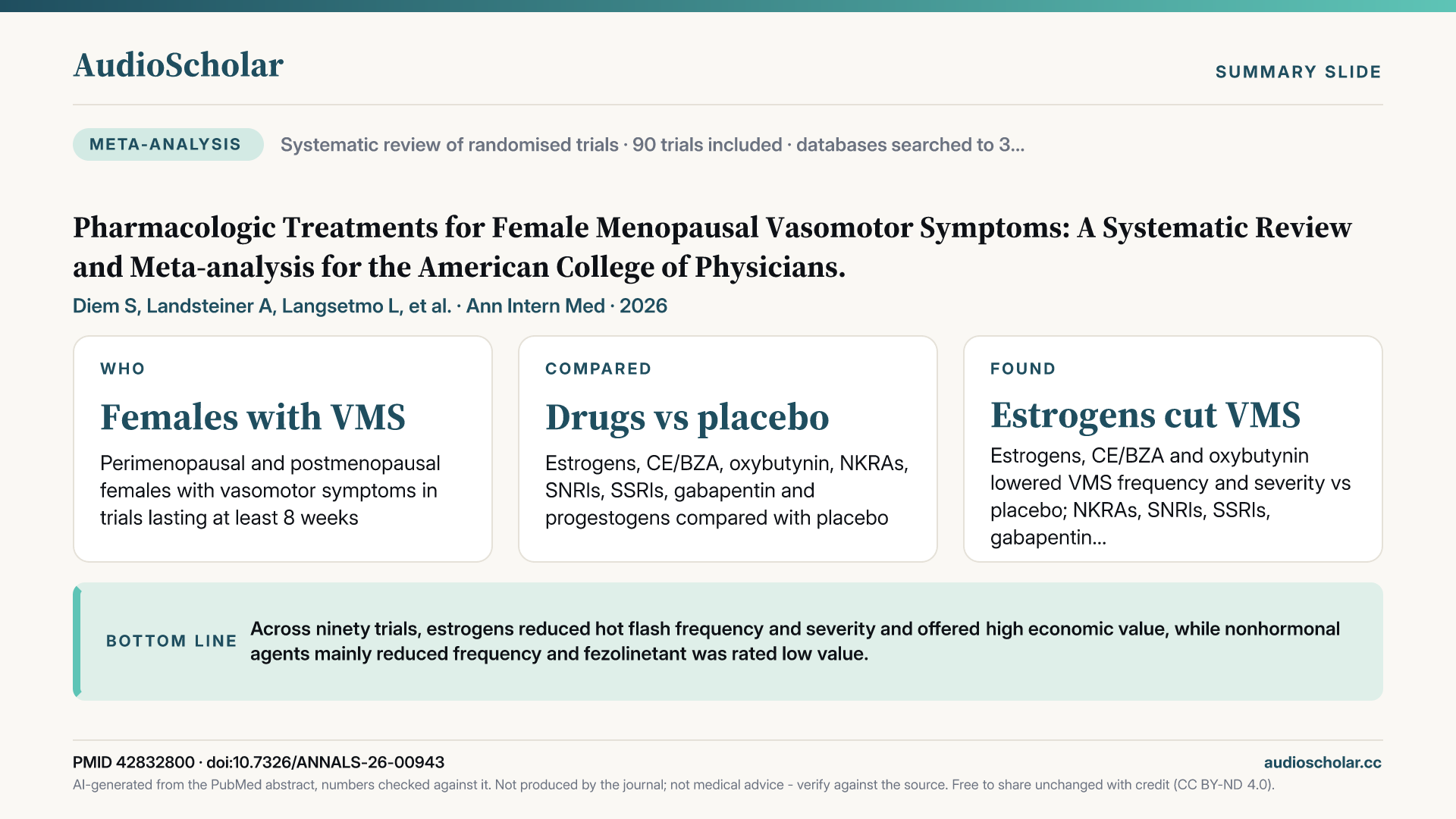
Across ninety trials, estrogens reduced hot flash frequency and severity and offered high economic value, while nonhormonal agents mainly reduced frequency and fezolinetant was rated low value.
Annals of Internal Medicine · 2026 · PubMed

This week’s papers
- 01
Pharmacologic Treatments for Female Menopausal Vasomotor Symptoms: A Systematic Review and Meta-analysis for the American College of Physicians.
Across ninety trials, estrogens reduced hot flash frequency and severity and offered high economic value, while nonhormonal agents mainly reduced frequency and fezolinetant was rated low value.
Diem S, Landsteiner A, Langsetmo L, et al. · Annals of Internal Medicine · 2026
- 02
Effects of neurokinin receptor antagonists on sleep disturbance in menopausal women: a systematic review and meta-analysis of randomized controlled trials.
Pooling seven placebo-controlled trials, neurokinin receptor antagonists improved patient-reported sleep disturbance up to 24 weeks in symptomatic menopausal women, though certainty was low due to heterogeneity.
Lemos MJ, Lopes de Mattos IL, Kaunitz AM · Menopause · 2026
- 03
Quadrivalent human papillomavirus vaccination before pregnancy and pregnancy outcomes: nationwide, population based case-control study.
In Swedish national data, HPV vaccination before pregnancy was associated with modestly lower odds of preterm birth and severe growth restriction, especially when vaccination occurred at younger ages.
Zhang Z, Ploner A, Sengpiel V, et al. · BMJ · 2026
- 04
Genotype-informed docosahexaenoic acid dosing based on the FADS Indel to reduce preterm and prolonged gestation: A secondary analysis of the ADORE randomized trial.
In a post hoc trial analysis, carriers of the FADS insertion allele had fewer early preterm births on 1,000 mg daily DHA, suggesting a genotype-guided dosing hypothesis needing prospective testing.
Li YN, Kothapalli KSD, Carlson SE, et al. · PLOS Medicine · 2026
- 05
Glucagon-Like Peptide-1 Receptor Agonists in Pregnancy: Periconception Exposure and Perinatal Outcomes.
Limited observational data show no clear safety signal after inadvertent periconceptional GLP-1 receptor agonist exposure, but evidence remains too sparse to exclude clinically important pregnancy risks.
Lau KGY, Chopra A, Mullins E, et al. · BJOG · 2026
- 06
Trends in Hypertensive Disorders of Pregnancy Rates by Race and Ethnicity in the United States, 2016-2024.
Hypertensive disorders of pregnancy in the United States rose about 74 percent from 2016 to 2024 across all groups, with highest 2024 rates among American Indian, Alaska Native, and Black individuals.
Anguzu R, Palatnik A · Obstetrics & Gynecology · 2026
- 07
Postpartum Venous Thrombosis in Sweden: A Nationwide Family Study.
Among over 850,000 Swedish first-time mothers, family history of venous thromboembolism raised postpartum thrombosis risk in a dose-graded way according to number and closeness of affected relatives.
Ben Saleh M, Pirouzifard M, Lindqvist PG, et al. · American Journal of Obstetrics & Gynecology · 2026
- 08
Vulvar Lichen Sclerosus as a Risk Factor for Birth-related Perineal Tear.
Women with vulvar lichen sclerosus had more second-degree tears and over triple the risk of obstetric anal sphincter injury, particularly with introital narrowing or symptoms during pregnancy.
Andersen CH, Sloth RB, Schmidt Arenholt LT, et al. · American Journal of Obstetrics & Gynecology · 2026
- 09
Survival Outcomes of Ovarian-Sparing Surgery for Early-Stage Adult Granulosa Cell Tumor.
In 851 women aged 18 to 49 with early-stage adult granulosa cell tumors, ovarian-sparing surgery showed no significant overall survival difference versus bilateral salpingo-oophorectomy; recurrence data are lacking.
Van Biema FL, Huang Y, Ludmir D, et al. · American Journal of Obstetrics & Gynecology · 2026
- 10
Transcutaneous electrical nerve stimulation for pain management during intrauterine device insertion: a randomized controlled trial.
In a double-blind trial of 98 participants, high-frequency TENS did not reduce IUD insertion pain versus sham, and clinicians systematically underestimated patients' maximum pain.
Kus LH, Statis CR, Kudrimoti M, et al. · American Journal of Obstetrics & Gynecology · 2026
The full briefing
This AudioScholar briefing is generated by artificial intelligence for healthcare professionals and trainees. It is not medical advice.
Welcome to This Week in Obstetrics & Gynecology. This week we're covering 10 notable papers spanning nonhormonal and hormonal management of menopausal symptoms, exposures and risk factors that shape pregnancy outcomes, and gynecologic procedures from IUD insertion to fertility-sparing cancer surgery. Let's dive in.
We start with menopause, where two meta-analyses help define what nonhormonal options deliver relative to estrogen. In Annals of Internal Medicine, Diem and colleagues conducted the systematic review that informs the American College of Physicians on pharmacologic treatment of vasomotor symptoms, pooling ninety randomized trials of at least eight weeks [1]. Estrogens, with or without a progestogen, conjugated estrogen with bazedoxifene, and oxybutynin reduced both the frequency and the severity of hot flashes compared with placebo. The neurokinin receptor antagonists, SNRIs, SSRIs, gabapentin, and progestogens reduced frequency but not severity. Estrogen efficacy varied with dose but not with route. Estrogens, the neurokinin antagonists, SNRIs, and SSRIs improved menopause-related quality of life, and several agents, including the neurokinin antagonists, improved sleep. The economic findings stand out: estrogens were rated high economic value with high certainty, while fezolinetant was rated low value with moderate certainty. Certainty was low to moderate for most comparisons, trials were short, long-term harms were largely unaddressed, and head-to-head data were scarce. Complementing this, Lemos, Lopes de Mattos, and Kaunitz in Menopause pooled seven placebo-controlled trials of about 3,200 women and found that neurokinin receptor antagonists improved patient-reported sleep disturbance at four, twelve, and twenty-four weeks, with a larger effect for elinzanetant than fezolinetant [2]. The trials themselves were at low risk of bias, but certainty was rated low because of substantial unexplained heterogeneity, so the size of the sleep benefit remains uncertain even if its direction looks consistent. Taken together, these reviews reinforce estrogen as the most effective and best-value option for those who can use it, and position the neurokinin antagonists as a nonhormonal choice with genuine but more modest and costlier benefits.
Our second theme concerns exposures before and during pregnancy, and what they mean for preterm birth and fetal outcomes. In the BMJ, Zhang and colleagues used Swedish national data on more than 620,000 first births and found that quadrivalent HPV vaccination before pregnancy was associated with modestly lower odds of every adverse outcome studied [3]. The reduction for preterm birth was about five percent, and for very preterm birth about fifteen percent, with lower odds of spontaneous preterm birth and severe growth restriction as well. The association was stronger when vaccination occurred at younger ages. These are small effects from an observational design, where residual confounding by health behaviour is plausible, but they add a reassuring and possibly beneficial obstetric dimension to vaccination. A very different approach to preterm prevention appears in PLOS Medicine, where Li and colleagues reanalysed the ADORE trial of docosahexaenoic acid by a single functional genetic variant, the FADS insertion-deletion polymorphism [4]. Among women carrying at least one insertion allele, early preterm birth before 34 weeks occurred in about four percent on the low 200 milligram dose, compared with under one percent in women without the allele, and the 1,000 milligram dose brought carriers down to about one percent. In women without the allele, high-dose DHA did little for early preterm birth and was linked to more births at 40 weeks or beyond. Black women had higher rates of the insertion allele and benefited most from the higher dose. The authors are clear that this was post hoc, not a prespecified aim, and several subgroups had very few events, so genotype-guided dosing is a hypothesis for prospective testing rather than an established strategy. Rounding out this theme, Lau and colleagues in BJOG offer a narrative review of GLP-1 receptor agonist exposure around conception, an increasingly common clinical scenario [5]. Observational data so far have not shown a clear increase in congenital anomalies or other adverse outcomes after inadvertent periconceptional exposure, but the evidence is thin, confounded, and insufficient to exclude meaningful risk. The authors argue for individualised counselling that treats exposure as neither proven harmful nor proven safe.
The third theme is maternal risk, at the population level and the individual level. In Obstetrics and Gynecology, Anguzu and Palatnik analysed more than 33 million live births in the United States from 2016 through 2024 and found that age-standardized rates of hypertensive disorders of pregnancy rose by roughly three quarters, reaching about 109 per thousand births, with an inflection point in 2021 [6]. The increase occurred across every racial and ethnic group, the steepest relative rises were among Asian and Multiracial individuals, and by 2024 absolute rates were highest among American Indian or Alaska Native individuals, at about 144 per thousand, and Black individuals, at about 133 per thousand. A cross-sectional vital statistics study cannot separate true increases from changes in diagnosis and coding, but the scale of the trend is hard to dismiss. Two papers in the American Journal of Obstetrics and Gynecology refine individual risk assessment. Ben Saleh and colleagues followed more than 850,000 Swedish first-time mothers and found that postpartum venous thromboembolism, which occurred in fewer than one in a thousand women, tracked closely with family history [7]. A parent with thrombosis roughly doubled the risk, an affected full sibling raised it about two and a half times, and a hereditary score weighting relatives by genetic closeness showed a clear dose-response, with the highest category carrying more than three and a half times the risk. This gives a more graded way to think about family history than a simple yes or no, though how it should feed into thromboprophylaxis thresholds is not addressed by the study. Andersen and colleagues, in a Danish regional cohort of 277 births to women with vulvar lichen sclerosus and 533 controls, found that the condition was associated with about a third more second-degree tears and more than triple the risk of obstetric anal sphincter injury after adjustment [8]. Within the lichen sclerosus group, narrowing of the introitus and symptoms during pregnancy were linked to sphincter injury. The sample is small and the estimates imprecise, but the paper flags an under-recognised group for antenatal attention.
Our final theme covers gynecologic procedures, with one reassuring and one negative result. In the American Journal of Obstetrics and Gynecology, Van Biema and colleagues used the National Cancer Database to study 851 women aged 18 to 49 with stage IA or IC adult granulosa cell tumors [9]. After propensity weighting, overall survival did not differ significantly between cystectomy, unilateral salpingo-oophorectomy, and bilateral salpingo-oophorectomy, consistently across age and stage strata. This supports the oncologic acceptability of ovarian-sparing surgery in younger patients, but overall survival is a blunt endpoint for an indolent tumor known for late recurrence, and the database lacks recurrence data, which the authors identify as the critical next step. Also in the American Journal of Obstetrics and Gynecology, Kus and colleagues ran a double-blind trial of 98 participants comparing active high-frequency transcutaneous electrical nerve stimulation with a sham device during IUD insertion [10]. Pain at insertion was essentially identical, around 51 on a 100 millimetre scale in both groups, regardless of parity. A secondary finding deserves attention: clinicians underestimated patients' maximum pain by roughly twelve points on average, and insertions judged difficult were notably more painful. The trial is a clear negative for this device, while underscoring that the pain problem itself remains unsolved.
If you only have time for one paper this week, make it the American College of Physicians review in Annals of Internal Medicine [1]. It lays out, across ninety trials, what each hormonal and nonhormonal option actually achieves for hot flashes, and its value judgments, high for estrogen and low for fezolinetant, are likely to shape guidance and coverage debates.
Here is what this week's evidence adds up to in Obstetrics and Gynecology. First, estrogen remains the most effective and best-value treatment for vasomotor symptoms, while neurokinin antagonists and other nonhormonal agents reduce frequency and appear to help sleep, though with low-certainty and largely short-term data. Second, preconception HPV vaccination is associated with modestly better pregnancy outcomes in observational data, and genotype-guided DHA dosing is an intriguing but post hoc hypothesis that needs prospective confirmation. Third, hypertensive disorders of pregnancy in the United States have risen sharply since 2016, with the highest burden in American Indian, Alaska Native, and Black populations. Fourth, family history of thrombosis carries graded postpartum risk, and vulvar lichen sclerosus appears to raise the risk of sphincter injury, both from observational cohorts. Finally, ovarian-sparing surgery for early granulosa cell tumors shows no survival penalty in registry data, recurrence remains unmeasured, and transcutaneous nerve stimulation offered no benefit for IUD insertion pain.
That's your roundup for This Week in Obstetrics & Gynecology. The full transcript and references are available on the episode page. This is an AI-curated summary — for clinical decisions, always consult primary sources and current guidelines. See you next week.
If this weekly briefing is useful, follow the show in your podcast app so new episodes arrive automatically. And if you have a paper you have been meaning to read, upload the PDF, or paste any link, at audioscholar dot C C. We will turn it into audio like this one, in any of thirty-one languages.
This is an automated summary generated by artificial intelligence, which can make mistakes. Always review the original source materials.
Spot something worth flagging?
Get this every week in your podcast app — free.
New obstetrics_gynecology episodes land in your feed automatically — listen on your commute.