This Week in Neurology — Oct 14, 2026
Generated Oct 15, 2026 · 10:59
The week's practice-changing Neurology research, summarized for clinicians.
If the audio fails to play, refresh the page to renew the link.
Get next week’s Neurology briefing — free.
In your podcast app, or readable in your inbox with the audio one tap away.
Effects of Blood Pressure Lowering by Hematoma Location in Acute Intracerebral Hemorrhage.
In pooled data from over eleven thousand patients across five trials, intensive blood pressure lowering reduced death or disability only in deep intracerebral hemorrhage, not lobar or infratentorial bleeds.
Neurology · 2026 · PubMed

This week’s papers
- 01
Thrombolysis in the Delayed Treatment Window for Acute Ischemic Stroke: Updated Systematic Review and Meta-Analysis.
Across fourteen randomized trials, imaging-selected thrombolysis beyond 4.5 hours improved excellent functional outcomes and independence, raised symptomatic hemorrhage roughly two and a half fold, and did not significantly change mortality.
Pitchan Velammal PNK et al. · Stroke · 2026
From the briefingIn Stroke, Pitchan Velammal and colleagues updated the meta-analysis of randomized trials testing intravenous thrombolysis beyond four and a half hours, or in wake-up and unknown-onset stroke, in patients selected by advanced imaging [1]. Across fourteen trials and roughly 4,200 participants, patients given alteplase or tenecteplase were about a fifth more likely to reach an excellent outcome at ninety days, and functional independence also improved. Both agents contributed to the benefit. The cost was a roughly two and a half fold increase in symptomatic intracranial hemorrhage, but ninety-day mortality did not differ significantly. The authors read this as support for a tissue-based rather than clock-based approach, and it consolidates a direction many centres have already moved toward, though it remains pooled trial-level data rather than a new trial. A related question is what happens when the large vessel opens but outcomes still disappoint.
Written by AI from the published abstract, for healthcare professionals. Not medical advice; check the paper before acting on it.
- 02
Cerebral No-Reflow after Thrombectomy: International Delphi Consensus on Definition and Imaging Assessment.
An international expert Delphi defined post-thrombectomy no-reflow as macrovascular recanalization with impaired microvascular reperfusion, proposing imaging criteria while leaving quantitative thresholds unresolved and requiring validation.
Mujanovic A et al. · Annals of Neurology · 2026
From the briefingIn Annals of Neurology, Mujanovic and colleagues ran a three-round Delphi among 27 international experts to define cerebral no-reflow after thrombectomy [2]. The panel agreed on framing it as macrovascular recanalization with impaired microvascular reperfusion, with recanalization ideally confirmed as an extended TICI grade of 2c without clear distal occlusion or grade 3, plus absence of a wedge-shaped perfusion delay on follow-up CT or MRI. Cerebral blood flow or volume was preferred over time-based perfusion maps, ideally within six hours. This is expert opinion, not validation, and the panel could not agree on quantitative thresholds, but it gives researchers a common vocabulary.
Written by AI from the published abstract, for healthcare professionals. Not medical advice; check the paper before acting on it.
- 03
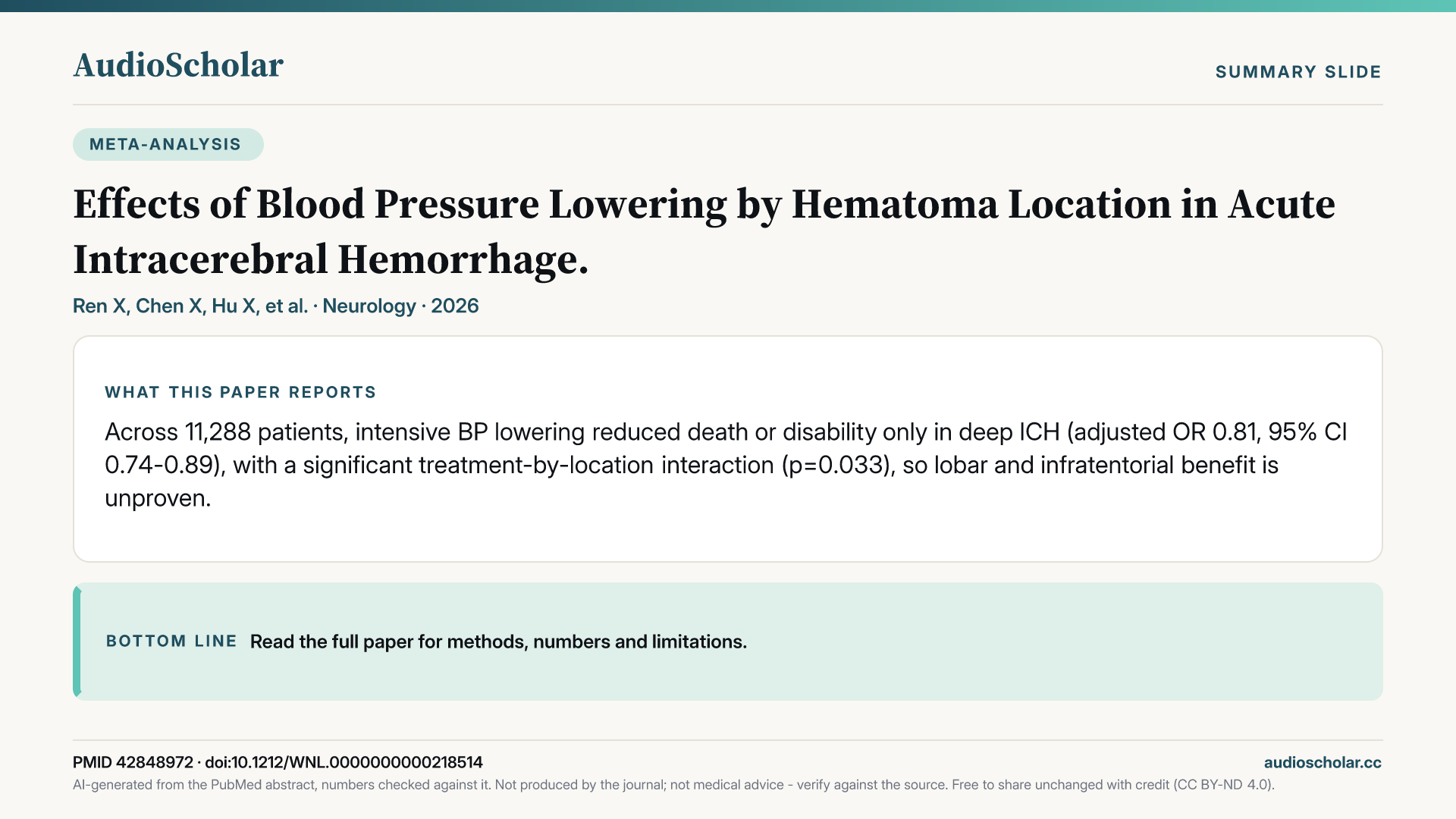
Effects of Blood Pressure Lowering by Hematoma Location in Acute Intracerebral Hemorrhage.
In pooled data from over eleven thousand patients across five trials, intensive blood pressure lowering reduced death or disability only in deep intracerebral hemorrhage, not lobar or infratentorial bleeds.
Ren X et al. · Neurology · 2026
From the briefingIn Neurology, Ren and colleagues pooled individual patient data from all four INTERACT trials and ATACH-II, more than eleven thousand patients, to ask whether intensive blood pressure lowering works equally across hematoma locations [3]. It did not. The treatment effect differed by location, and a clear benefit appeared only in deep hemorrhage, where intensive lowering cut the odds of death or disability by about a fifth. Lobar and infratentorial bleeds showed no clear benefit, although these groups made up only about one in ten patients each, and lobar bleeds were larger and occurred in older patients, so limited power is a real caveat. Still, it raises the possibility that lobar hemorrhage, often driven by amyloid angiopathy, behaves differently.
If you only have time for one paper this week, make it the Neurology pooled analysis of blood pressure lowering by hematoma location [3]. It reopens the assumption that intensive blood pressure control is a uniform benefit in intracerebral hemorrhage and puts lobar hemorrhage squarely back on the research agenda.
Written by AI from the published abstract, for healthcare professionals. Not medical advice; check the paper before acting on it.
- 04
Centrum Semiovale Perivascular Spaces Predict First Hemorrhagic Lesion in Asymptomatic Amyloid-Positive Individuals.
In amyloid-positive, cognitively unimpaired older adults, severe centrum semiovale perivascular spaces nearly tripled the risk of first lobar microbleeds or superficial siderosis, suggesting a marker of prehemorrhagic amyloid angiopathy.
Alten B et al. · Annals of Neurology · 2026
From the briefingThat links neatly to work in Annals of Neurology from Alten and colleagues, a secondary analysis of the A4 trial in cognitively unimpaired, amyloid-positive older adults without baseline hemorrhage [4]. Among 932 participants, those with severe enlarged perivascular spaces in the centrum semiovale had nearly triple the adjusted risk of developing a first lobar microbleed or cortical superficial siderosis over about five years, with roughly a third of these individuals developing such lesions compared with about one in seven of the others. Basal ganglia perivascular spaces, the hypertensive pattern, carried no such risk, which strengthens the topographic argument. Participants who did develop hemorrhagic lesions showed steeper cognitive decline. The authors see this as a marker of a prehemorrhagic stage of amyloid angiopathy, potentially relevant to the Boston criteria and to future prevention trials, and perhaps to risk assessment before anti-amyloid therapy, though that last point is not tested here.
Written by AI from the published abstract, for healthcare professionals. Not medical advice; check the paper before acting on it.
- 05
Nicotinamide Riboside for Patients With Early-Stage Parkinson Disease: The NOPARK Randomized Clinical Trial.
In a phase 3 trial of early Parkinson disease, a year of nicotinamide riboside worsened motor and nonmotor scores versus placebo, offering no support for it as disease-modifying therapy.
Brakedal B et al. · JAMA · 2026
From the briefingIn JAMA, Brakedal and colleagues report NOPARK, a phase 3 trial at eleven Norwegian centres randomizing 410 patients with early, scan-confirmed Parkinson disease to nicotinamide riboside 500 milligrams twice daily or placebo for a year [5]. Nicotinamide riboside did not help. Total MDS-UPDRS scores worsened by about two and a half points more than with placebo, a statistically significant difference favoring placebo, though smaller than the threshold the authors define as clinically important worsening. Nonmotor symptom burden also worsened more on the supplement. Serious adverse events were actually less frequent with nicotinamide riboside. The authors conclude the results do not support it as disease-modifying therapy, which is a firm answer to a question patients frequently raise about over-the-counter NAD precursors.
Written by AI from the published abstract, for healthcare professionals. Not medical advice; check the paper before acting on it.
- 06
Safety and efficacy of delpacibart zotadirsen in Duchenne muscular dystrophy mutations amenable to exon 44 skipping in the USA (EXPLORE44): a randomised, placebo-controlled, double-blind, phase 1/2 trial.
An antibody-oligonucleotide conjugate increased exon 44 skipping and raised dystrophin about 25 percent in Duchenne patients, with acceptable safety overall but two infusion-related discontinuations; functional benefit remains untested.
Veerapandiyan A et al. · The Lancet Neurology · 2026
From the briefingOn the neuromuscular side, The Lancet Neurology published EXPLORE44 from Veerapandiyan and colleagues, a first-in-human phase 1/2 trial in the United States of delpacibart zotadirsen, an antibody-oligonucleotide conjugate delivering an exon 44-skipping oligomer to muscle in Duchenne muscular dystrophy [6]. Among 26 boys and young men, both dose cohorts produced substantial exon skipping and mean dystrophin increases of about 25 percent from baseline, with essentially no change on placebo, alongside falling muscle damage biomarkers. Two participants on the lower dose discontinued after an anaphylactic reaction and an infusion reaction. With small numbers and biomarker endpoints, this is proof of target engagement, not of functional benefit, and phase 3 is the next step.
Written by AI from the published abstract, for healthcare professionals. Not medical advice; check the paper before acting on it.
- 07
Early Pregnancy Use of Anti-CGRP Monoclonal Antibodies and Propranolol and Spontaneous Abortion Risk.
In a large insurance cohort of pregnancies with migraine, early anti-CGRP antibody exposure was associated with about 40 percent higher spontaneous abortion risk, whereas propranolol showed no association.
Flatman LK et al. · JAMA Neurology · 2026
From the briefingIn JAMA Neurology, Flatman and colleagues used a large commercial insurance cohort of about 7,600 pregnancies in people with pregestational migraine to examine early pregnancy exposure to anti-CGRP monoclonal antibodies [7]. Exposure was associated with roughly a 40 percent higher risk of spontaneous abortion than no exposure, and the signal held in bias-adjusted analyses, whereas propranolol showed no association. This is retrospective claims data with the usual limits on confounding by migraine severity and exposure ascertainment, but it is biologically plausible given the role of CGRP in placental development, and the authors frame it as reinforcing preconception counseling and the need for further safety work.
Written by AI from the published abstract, for healthcare professionals. Not medical advice; check the paper before acting on it.
- 08
Prognosis of acute symptomatic seizures and impact of prolonged treatment with anti-seizure medication.
After acute symptomatic seizures with structural causes, three-year risk of unprovoked seizures was about 14 percent, and longer anti-seizure medication treatment showed no apparent protective effect.
Traben H et al. · Epilepsia · 2026
From the briefingRestraint is the message from Epilepsia, where Traben and colleagues followed adults with a first acute symptomatic seizure in the prospective multicentre PROSE register [8]. Among 122 patients with structural causes, the three-year cumulative incidence of unprovoked seizures was about 14 percent. Male sex, early epileptiform EEG activity, and a latency of 48 hours or more after the brain insult predicted recurrence, while anti-seizure medication duration had no apparent effect. The estimated chance of a seizure in the coming year fell below two percent within two years. The sample is modest, but the study adds prospective support to guidelines discouraging prolonged treatment and offers concrete data for driving counseling.
Written by AI from the published abstract, for healthcare professionals. Not medical advice; check the paper before acting on it.
- 09
Antibody-mediated encephalitides: distinct diseases with transdisciplinary implications.
Autoimmune encephalitides such as anti-NMDA receptor, anti-LGI1 and anti-IgLON5 disease differ in triggers, mechanisms, course and treatment, arguing against pooling them and for coordinated multidisciplinary care.
Dalmau J et al. · The Lancet Neurology · 2026
From the briefingDalmau and colleagues contend that autoimmune encephalitides are still too often pooled as a single entity, using anti-NMDA receptor encephalitis, anti-LGI1 encephalitis, and anti-IgLON5 disease to show they differ in demographics, triggers, mechanisms, trajectories, and treatment needs, much as aquaporin-4 and MOG disorders are now treated as distinct diseases [9]. They emphasize multidisciplinary care spanning paediatrics, epilepsy, sleep medicine, intensive care, and rehabilitation.
Written by AI from the published abstract, for healthcare professionals. Not medical advice; check the paper before acting on it.
- 10
Degenerative cervical myelopathy: early detection and the potential for preventing disability.
Advances in quantitative spinal cord MRI, neurophysiology and functional testing now allow earlier detection of degenerative cervical myelopathy, supporting proactive surveillance, though long-term outcome evidence for early surgery is lacking.
Zipser CM et al. · The Lancet Neurology · 2026
From the briefingZipser and colleagues make a parallel case for degenerative cervical myelopathy, the most common non-traumatic spinal cord injury, arguing that quantitative cord MRI, neurophysiology, dynamic biomechanics, and sensitive functional testing now allow detection of injury before overt disability [10]. The evidence supports surgery for moderate to severe disease, while milder disease and asymptomatic stenosis remain an area of active surveillance and selective intervention, with outcome data still lacking.
Written by AI from the published abstract, for healthcare professionals. Not medical advice; check the paper before acting on it.
The full briefing
This AudioScholar briefing is generated by artificial intelligence for healthcare professionals and trainees. It is not medical advice.
Welcome to This Week in Neurology. This week we're covering 10 notable papers spanning acute cerebrovascular care and small vessel disease, therapeutic trials and medication safety across movement, neuromuscular, headache and epilepsy practice, and two major reviews that reframe how we think about autoimmune encephalitis and cervical myelopathy. Let's dive in.
Stroke dominates this week, starting with how far the treatment window can stretch and how we judge whether reperfusion actually worked. In Stroke, Pitchan Velammal and colleagues updated the meta-analysis of randomized trials testing intravenous thrombolysis beyond four and a half hours, or in wake-up and unknown-onset stroke, in patients selected by advanced imaging [1]. Across fourteen trials and roughly 4,200 participants, patients given alteplase or tenecteplase were about a fifth more likely to reach an excellent outcome at ninety days, and functional independence also improved. Both agents contributed to the benefit. The cost was a roughly two and a half fold increase in symptomatic intracranial hemorrhage, but ninety-day mortality did not differ significantly. The authors read this as support for a tissue-based rather than clock-based approach, and it consolidates a direction many centres have already moved toward, though it remains pooled trial-level data rather than a new trial. A related question is what happens when the large vessel opens but outcomes still disappoint. In Annals of Neurology, Mujanovic and colleagues ran a three-round Delphi among 27 international experts to define cerebral no-reflow after thrombectomy [2]. The panel agreed on framing it as macrovascular recanalization with impaired microvascular reperfusion, with recanalization ideally confirmed as an extended TICI grade of 2c without clear distal occlusion or grade 3, plus absence of a wedge-shaped perfusion delay on follow-up CT or MRI. Cerebral blood flow or volume was preferred over time-based perfusion maps, ideally within six hours. This is expert opinion, not validation, and the panel could not agree on quantitative thresholds, but it gives researchers a common vocabulary.
Intracerebral hemorrhage and its vascular substrate are the next thread. In Neurology, Ren and colleagues pooled individual patient data from all four INTERACT trials and ATACH-II, more than eleven thousand patients, to ask whether intensive blood pressure lowering works equally across hematoma locations [3]. It did not. The treatment effect differed by location, and a clear benefit appeared only in deep hemorrhage, where intensive lowering cut the odds of death or disability by about a fifth. Lobar and infratentorial bleeds showed no clear benefit, although these groups made up only about one in ten patients each, and lobar bleeds were larger and occurred in older patients, so limited power is a real caveat. Still, it raises the possibility that lobar hemorrhage, often driven by amyloid angiopathy, behaves differently. That links neatly to work in Annals of Neurology from Alten and colleagues, a secondary analysis of the A4 trial in cognitively unimpaired, amyloid-positive older adults without baseline hemorrhage [4]. Among 932 participants, those with severe enlarged perivascular spaces in the centrum semiovale had nearly triple the adjusted risk of developing a first lobar microbleed or cortical superficial siderosis over about five years, with roughly a third of these individuals developing such lesions compared with about one in seven of the others. Basal ganglia perivascular spaces, the hypertensive pattern, carried no such risk, which strengthens the topographic argument. Participants who did develop hemorrhagic lesions showed steeper cognitive decline. The authors see this as a marker of a prehemorrhagic stage of amyloid angiopathy, potentially relevant to the Boston criteria and to future prevention trials, and perhaps to risk assessment before anti-amyloid therapy, though that last point is not tested here.
Turning to therapeutic trials, this week brings one clear negative and one early positive signal. In JAMA, Brakedal and colleagues report NOPARK, a phase 3 trial at eleven Norwegian centres randomizing 410 patients with early, scan-confirmed Parkinson disease to nicotinamide riboside 500 milligrams twice daily or placebo for a year [5]. Nicotinamide riboside did not help. Total MDS-UPDRS scores worsened by about two and a half points more than with placebo, a statistically significant difference favoring placebo, though smaller than the threshold the authors define as clinically important worsening. Nonmotor symptom burden also worsened more on the supplement. Serious adverse events were actually less frequent with nicotinamide riboside. The authors conclude the results do not support it as disease-modifying therapy, which is a firm answer to a question patients frequently raise about over-the-counter NAD precursors. On the neuromuscular side, The Lancet Neurology published EXPLORE44 from Veerapandiyan and colleagues, a first-in-human phase 1/2 trial in the United States of delpacibart zotadirsen, an antibody-oligonucleotide conjugate delivering an exon 44-skipping oligomer to muscle in Duchenne muscular dystrophy [6]. Among 26 boys and young men, both dose cohorts produced substantial exon skipping and mean dystrophin increases of about 25 percent from baseline, with essentially no change on placebo, alongside falling muscle damage biomarkers. Two participants on the lower dose discontinued after an anaphylactic reaction and an infusion reaction. With small numbers and biomarker endpoints, this is proof of target engagement, not of functional benefit, and phase 3 is the next step.
Two observational studies address medication decisions where the question is risk versus restraint. In JAMA Neurology, Flatman and colleagues used a large commercial insurance cohort of about 7,600 pregnancies in people with pregestational migraine to examine early pregnancy exposure to anti-CGRP monoclonal antibodies [7]. Exposure was associated with roughly a 40 percent higher risk of spontaneous abortion than no exposure, and the signal held in bias-adjusted analyses, whereas propranolol showed no association. This is retrospective claims data with the usual limits on confounding by migraine severity and exposure ascertainment, but it is biologically plausible given the role of CGRP in placental development, and the authors frame it as reinforcing preconception counseling and the need for further safety work. Restraint is the message from Epilepsia, where Traben and colleagues followed adults with a first acute symptomatic seizure in the prospective multicentre PROSE register [8]. Among 122 patients with structural causes, the three-year cumulative incidence of unprovoked seizures was about 14 percent. Male sex, early epileptiform EEG activity, and a latency of 48 hours or more after the brain insult predicted recurrence, while anti-seizure medication duration had no apparent effect. The estimated chance of a seizure in the coming year fell below two percent within two years. The sample is modest, but the study adds prospective support to guidelines discouraging prolonged treatment and offers concrete data for driving counseling.
Finally, two reviews in The Lancet Neurology argue for reframing familiar conditions. Dalmau and colleagues contend that autoimmune encephalitides are still too often pooled as a single entity, using anti-NMDA receptor encephalitis, anti-LGI1 encephalitis, and anti-IgLON5 disease to show they differ in demographics, triggers, mechanisms, trajectories, and treatment needs, much as aquaporin-4 and MOG disorders are now treated as distinct diseases [9]. They emphasize multidisciplinary care spanning paediatrics, epilepsy, sleep medicine, intensive care, and rehabilitation. Zipser and colleagues make a parallel case for degenerative cervical myelopathy, the most common non-traumatic spinal cord injury, arguing that quantitative cord MRI, neurophysiology, dynamic biomechanics, and sensitive functional testing now allow detection of injury before overt disability [10]. The evidence supports surgery for moderate to severe disease, while milder disease and asymptomatic stenosis remain an area of active surveillance and selective intervention, with outcome data still lacking.
If you only have time for one paper this week, make it the Neurology pooled analysis of blood pressure lowering by hematoma location [3]. It reopens the assumption that intensive blood pressure control is a uniform benefit in intracerebral hemorrhage and puts lobar hemorrhage squarely back on the research agenda.
Here is what this week's evidence adds up to in Neurology. First, randomized evidence now consistently supports imaging-selected thrombolysis beyond four and a half hours, with more hemorrhage but no mortality penalty, while the definition of no-reflow after thrombectomy remains a consensus framework awaiting validation. Second, the benefit of intensive blood pressure lowering in hemorrhage appears concentrated in deep bleeds; the lobar data are underpowered rather than definitively negative, and severe centrum semiovale perivascular spaces emerge as an imaging marker of impending amyloid angiopathy bleeding. Third, nicotinamide riboside failed in a well-powered phase 3 Parkinson trial and trended toward harm, while exon 44 skipping in Duchenne shows target engagement but no functional data yet. Fourth, observational data raise a credible miscarriage signal for anti-CGRP antibodies in early pregnancy, not seen with propranolol, and prospective data find no benefit from prolonged anti-seizure medication after acute symptomatic seizures; both findings need confirmation but align with current caution in each direction.
That's your roundup for This Week in Neurology. The full transcript and references are available on the episode page. This is an AI-curated summary — for clinical decisions, always consult primary sources and current guidelines. See you next week.
If this weekly briefing is useful, follow the show in your podcast app so new episodes arrive automatically. And a quick rating on Apple Podcasts or Spotify helps other physicians discover the show.
This is an automated summary generated by artificial intelligence, which can make mistakes. Always review the original source materials.
Spot something worth flagging?
Get this every week in your podcast app — free.
New neurology episodes land in your feed automatically — listen on your commute.